
Horizon’s $27 Million Quantum Deal Has a Number Shareholders Still Need
The proposed Entropica acquisition would connect two parts of the quantum software stack. Its shareholder arithmetic remains unfinished.
Reading tools for text size, copying, printing and your reading list


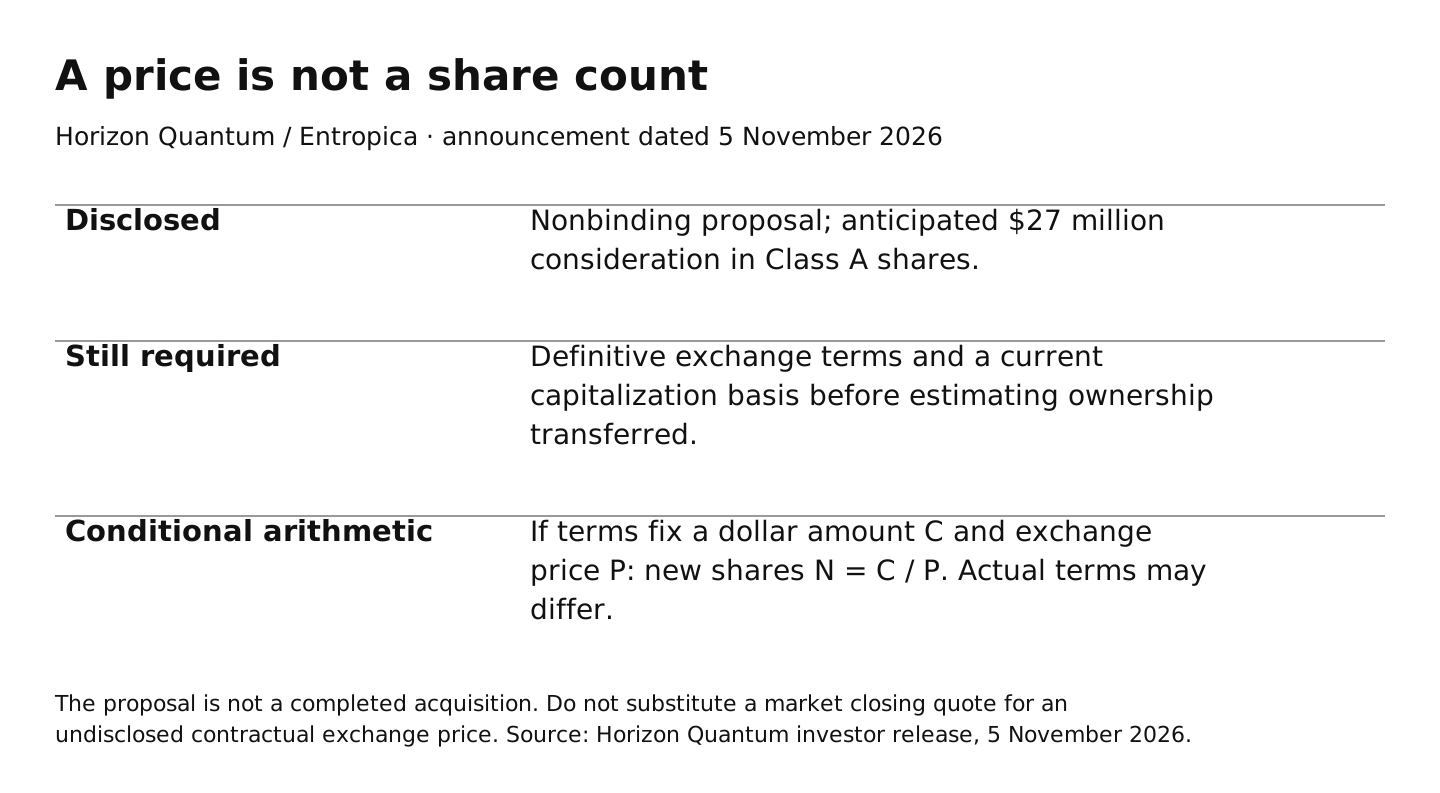
Horizon Quantum announced a nonbinding proposal on November 5 to acquire Entropica Labs for anticipated consideration of $27 million in Class A ordinary shares. For investors following Nasdaq-listed HQ, the crucial next number is how many shares would actually change hands.[1][2]
The reviewed announcement gives a dollar value, but no exchange price, exchange ratio or final issuance count. That leaves an important distinction: a proposed purchase price is a headline; the ownership transferred to pay it is a separate calculation. The missing terms prevent a reliable dilution estimate from this announcement alone.[2]
Completion depends on diligence, audits, definitive agreements and customary conditions. The reviewed release does not establish a closing date. Signing and closing would be separate milestones. A definitive agreement could establish the exchange mechanics and obligations, while completion would mark the actual transfer on the terms ultimately agreed. Readers should check which milestone a future announcement describes before treating a proposal as an acquired business. The next headline should identify any changed terms and the stage reached, rather than carrying the original dollar figure forward as though the transaction were already settled.[1][2]
Why this software combination matters
Horizon describes Triple Alpha as a development environment spanning multiple levels of quantum programming. Entropica is developing Loom, a compiler for fault-tolerant quantum computing. Those descriptions point to a potentially useful connection between writing a program and preparing it for protected execution. They do not, by themselves, establish a working integrated product.[2]
addresses the errors that accumulate while a machine stores and processes information. At the software level, that creates a translation problem: an algorithm written in terms of logical operations must eventually become instructions compatible with the chosen error-correction scheme and hardware. A compiler helps organize that translation; the existence of one does not establish that the underlying machine can run a commercially valuable workload.
Entropica’s September 29 update described work on a surface-code compiler. Its documentation also presents tools for designing and testing error-correction codes and compiling operations. These are company descriptions of development work, useful for understanding the intended product direction. They are not independent measurements of commercial quantum advantage.[6][7]
The strategic possibility is straightforward. A more connected software workflow could spare customers some of the work of combining separate tools. That possibility becomes financially meaningful only if customers adopt it, pay for it and keep using it. Acquisition announcements cannot supply those outcomes in advance.
The share count is the investment question
An all-share transaction can conserve acquisition cash while changing the ownership of the combined business. Both effects matter. Calling such a transaction inexpensive because it uses shares overlooks the economic interest being transferred to the seller. If a definitive agreement fixed a dollar consideration and used an agreed price per newly issued share, the simplified calculation would be: New shares issued = fixed equity consideration ÷ agreed price per share.
Actual terms could use a different mechanism, including a fixed share count, a reference-period price, a collar or adjustments. The announced value alone does not identify which mechanism will apply. Those are possibilities to check in a future agreement, not reported features of this proposal.
The second calculation is the ownership represented by the newly issued shares: new shares divided by the total shares after issuance. A useful estimate therefore requires both final issuance terms and a reliable count of the relevant existing shares and securities. That fraction equals a new recipient’s total stake only if it had no previous holding. Using an old denominator can make a precise-looking percentage misleading.
Horizon’s September 15 clarification reported 34,811,740 Class A shares and 19,744,585 Class B shares outstanding as of September 14. Together that is 54,556,325 shares, but it is a dated snapshot, not a verified November 6 capitalization table. It is also not a measure of freely tradable shares. The ownership calculation needs another qualification: economic ownership and voting control may differ where share classes have different rights. A final analysis should use the applicable rights and transaction documents, not simply add share classes and assume every percentage answers the same question.[4]
Why a stock quote cannot finish the calculation
A stock quote shows the price of a market trade. It does not establish the price or mechanism used in this proposed acquisition. Until definitive terms disclose the exchange mechanics, using a quote to estimate the number of new shares would turn an unknown contractual term into an assumption.
The next evidence investors need
Horizon previously reported $113.3 million of cash at June 30. That provides historical balance-sheet context, not a current cash estimate or an acquisition budget. Even a transaction settled in shares can bring legal, integration, staffing and development costs. Investors need updated cash and operating-expense information to evaluate the combined plan.[5]
The commercial questions deserve equal weight. How much product integration is required? What will customers buy? Which revenue comes from repeatable licenses or subscriptions, and which depends on bespoke work? What independently reproducible evidence shows that the combined tools improve cost, reliability or execution time for a defined workload? Those questions set an evidence standard; the reviewed announcement does not answer them. A useful future disclosure would connect the product roadmap to measurable customer adoption, while distinguishing technical demonstrations from paid deployment.
A deal update would be more useful if it separated the target’s stand-alone business from the expected combined business. Relevant inputs include the revenue period being reported, whether sales are recurring, customer concentration and the costs needed to deliver the integration. Any forecast should identify its assumptions. A later revenue increase could come from adding a business to the accounts, even if demand for the original products had not grown. Those are disclosure questions raised by the proposal, not financial characteristics established for Entropica.
There is a scheduled opportunity for an update. Horizon has announced third-quarter results for November 10 before the U.S. market opens, with a call at 8 a.m. Eastern Standard Time, or 5 a.m. Pacific. That event may provide more current financial context; the notice does not promise definitive acquisition terms.[3]
For now, the most consequential development is a proposed connection between quantum programming and error-correction software. The next investment-grade milestone is more concrete: a definitive agreement explaining the ownership exchange, followed by evidence that the combined product earns its place in customers’ workflows.