
Hot rubidium gas gave away a hidden interaction between atoms
A small shift in the color of light passing through a glass cell helped researchers distinguish atoms interacting in pairs from the effects of stray electrical charges.
Reading tools for text size, copying, printing and your reading list
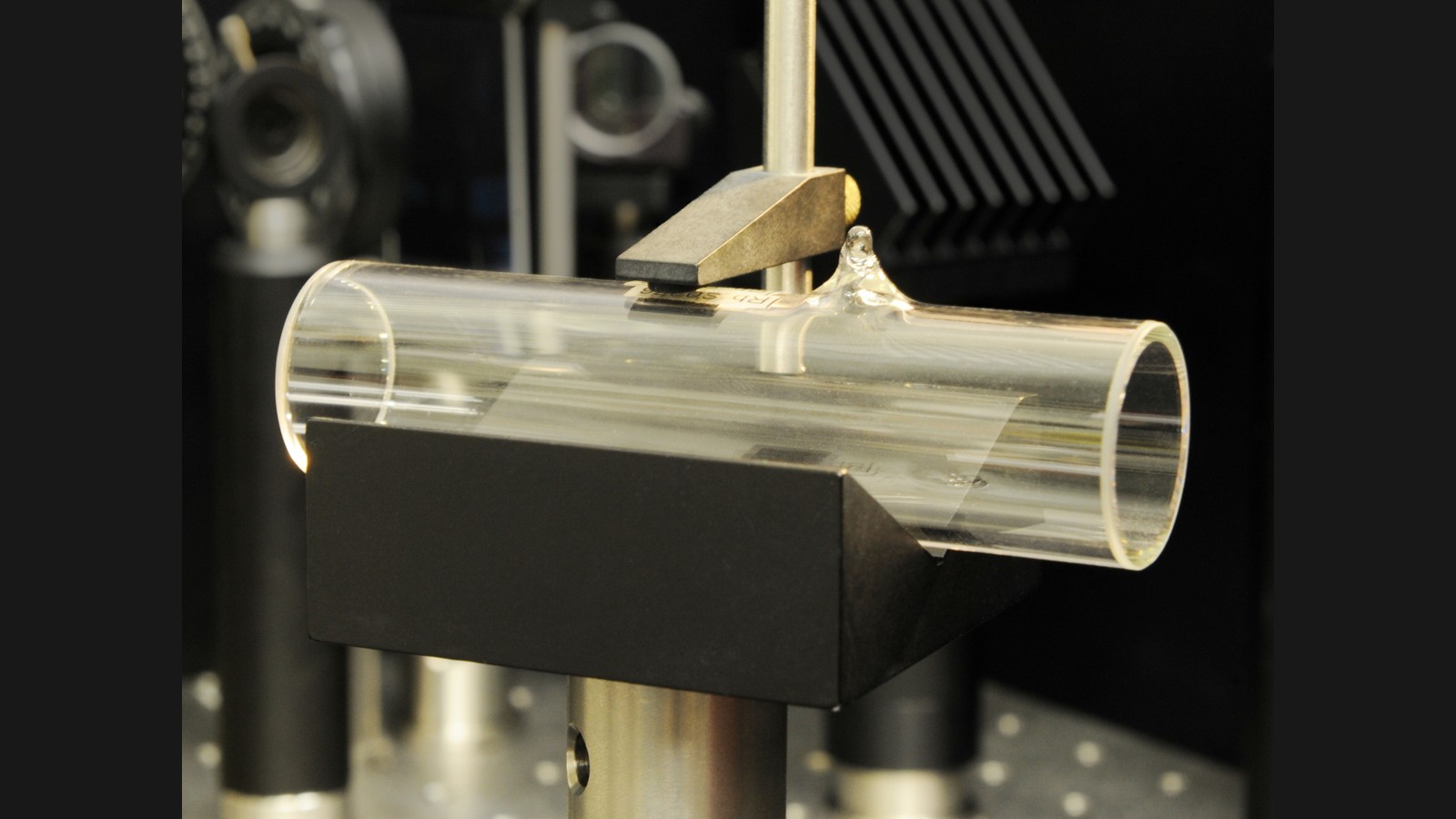
Heat a glass cell of rubidium and shine lasers through it, and you can watch for one color at which the vapor becomes more transparent. That color was different in a hotter, denser sample than in a room-temperature reference cell. But for one particular way of exciting the atoms, it moved farther than the pattern for nearby states would predict. The team reports in a new preprint that the extra shift is evidence of a resonance between pairs of atoms.[1]
It’s an unusually hard distinction to make. An excited atom can lose an electron and become an ion. The ion’s electric field changes the energies of neighboring atoms, which can move the transparency peak even if the excited atoms aren’t strongly interacting in pairs. In this experiment, that charge effect explained much of what the team saw. The telltale result was the exception, not the overall shift.[1]
Two causes can move the same peak
Richard Wolfendale and colleagues probed rubidium atoms in high-energy states known as Rydberg states. The outer electron in these states is unusually far from the nucleus, making the atom sensitive to electric fields. By tuning two lasers, the researchers made the vapor more transparent over a narrow range of frequencies. Watching where that window opens lets them read changes in the atoms’ energies without watching individual atoms.[1]
The team used a short, heated cell with about 29 times the estimated atom density of a longer room-temperature reference cell. It compared the peak positions across several excited states and modeled the effect of ionization. The two cells also differed in length and were probed at different strengths, so this was not a test in which only the temperature changed. The researchers used the reference to anchor the frequency comparison and the modeled spectra to help identify shifts.[1]
For one state, labeled 43D, the peak was shifted to a frequency 1.1 ± 0.2 megahertz lower than the fitted pattern for its neighbors predicted. That figure is the extra shift, not the entire difference between the two cells. The ionization model could still approximate the shape of that spectrum. The evidence for a second effect came from comparing the positions of the peaks across states rather than from a feature that was obvious in a single scan.[1]
Why that state stood out
Imagine two arrangements of the same pair of atoms. If their total energies almost match, an interaction can mix the two arrangements particularly strongly. That near-match is called a Förster resonance. Calculations identified such a match for a pair of rubidium atoms in the 43D state, which is why the researchers attribute the extra shift to pairs in the gas. They measured the response of the vapor as a whole, not the behavior of a single pair in isolation.[1]
Researchers use similar vapor-cell techniques to study electric fields. For those measurements, a shifted peak is useful only if you know what moved it. The new experiment didn’t build a better sensor or show that the atoms were . It did show why a reading in dense vapor can reflect more than one process: stray charges can explain the broad pattern while a near-match in the energies of two atoms can still leave a measurable mark.[1]