
Could a laser cool a bead of glass? Watch the light it gives back
A glass sphere about a tenth of a millimeter wide gave off infrared photons with more energy on average than the laser photons driving it. The missing measurement is whether the glass actually cooled.
Reading tools for text size, copying, printing and your reading list
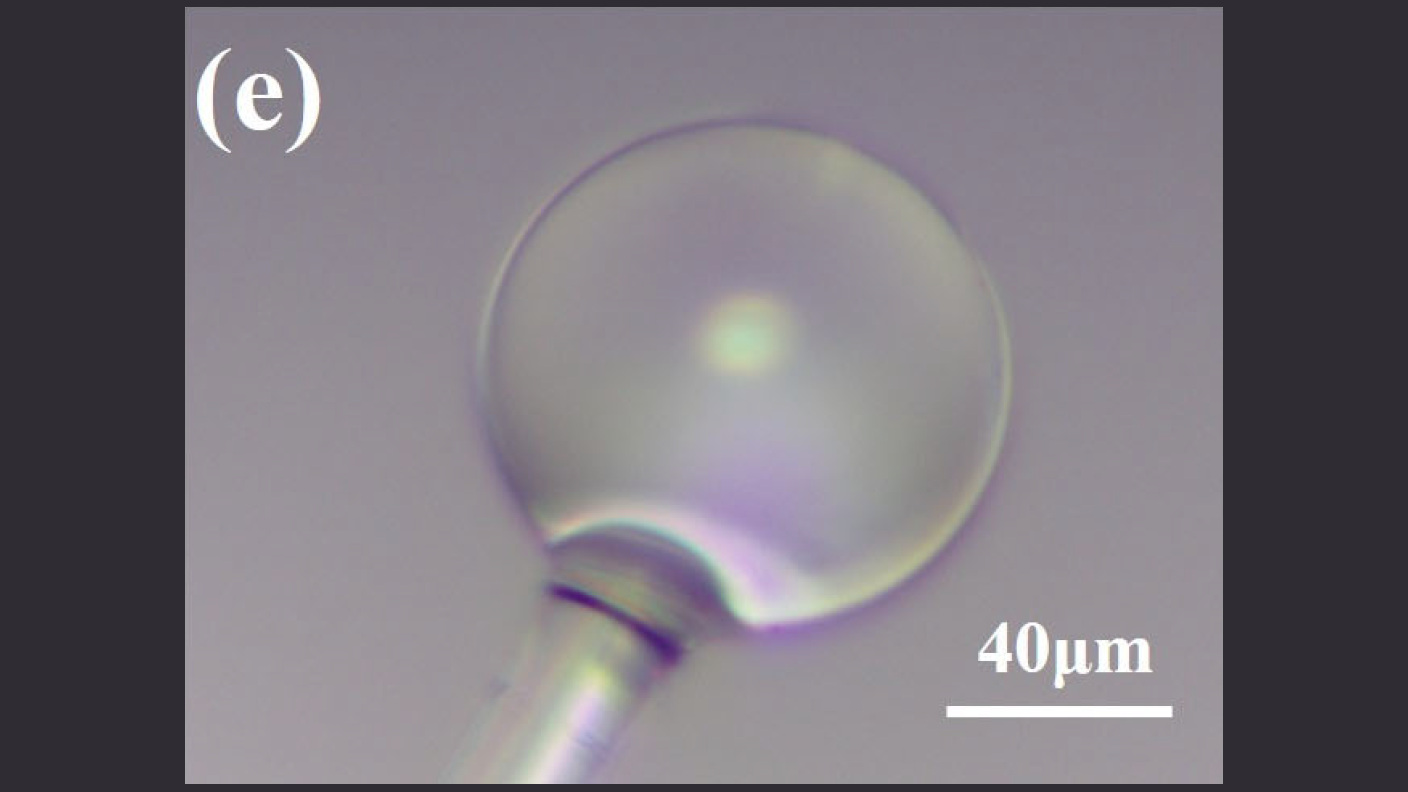
Lasers usually heat what they shine on. A team at Tel Aviv University and Technion is testing how to get a tiny piece of glass to do the opposite. In a preprint made public November 25, the researchers describe a silica sphere with an erbium coating. When they shone infrared light into the sphere, the fluorescence they collected had a higher average photon energy than the incoming light. That is a necessary ingredient for laser cooling, not a temperature measurement.[1]
Where the extra energy can come from
An erbium ion can absorb an infrared photon while drawing a little extra energy from thermal vibrations in the surrounding material. Later it can give off a new photon that carries away both contributions. This is called anti-Stokes fluorescence. Think of the laser as paying most of the fare and the glass paying the rest. If enough photons escape, and other processes do not put more heat back, the material loses thermal energy. No energy is created in the exchange.[1][2]
Researchers proved that light could cool a solid in 1995 using a different glass doped with ytterbium. Here the question is whether the balance can be tipped in a much smaller device designed to hold light. In the new test a thin optical fiber fed light sideways into the 106-micrometer sphere. Some of the light traveled repeatedly around the inside surface. Physicists call that a whispering-gallery mode, after the way sound can carry around the curved wall of a dome. The repeated passes give the light more chances to interact with the erbium.[1][2]
They waited for the laser to go dark
The team pulsed the laser and collected the remaining infrared glow after the pump light had time to die away. At a pump wavelength of about 1,568 nanometers, the spectrum was weighted toward photons with more energy than the pump photons. In another test, the researchers heated the platform holding the sphere themselves. The average energy of the glow rose as the platform went from 25 to 62 °C. That tells them how the emission responded to outside heating, not how much the laser changed the sphere's temperature.[1]
The microscope also caught different patterns of visible green glow depending on which resonance the researchers excited. Those pictures show where the erbium lit up through a separate process involving multiple photons. They are not thermal images, and the green light is not what the team used to calculate the infrared energy difference.[1]
What would count as a tiny refrigerator?
The decisive test is an independent thermometer, paired with a measurement of how much laser power the device absorbed. Not every photon absorbed by the sphere returns as light. Some of that energy can turn straight into heat. The team also estimated total fluorescence from the fraction it collected. Neither that estimate nor the extra energy per emitted photon settles the overall heat balance.[1]
A measured temperature drop would make this more than a promising spectrum. It would give researchers a way to test whether light can help manage the heat in optical devices that already guide and store it. Until then, the finding is that a tiny glass sphere can send back higher-energy infrared photons, not that it has become a refrigerator.[1][3]