
A cat qubit uses its own readout circuit to fight bit flips for minutes
A Weizmann preprint reports a 448-second timescale for bit flips. The circuit drains unwanted energy through the same hardware used to read it.
Reading tools for text size, copying, printing and your reading list
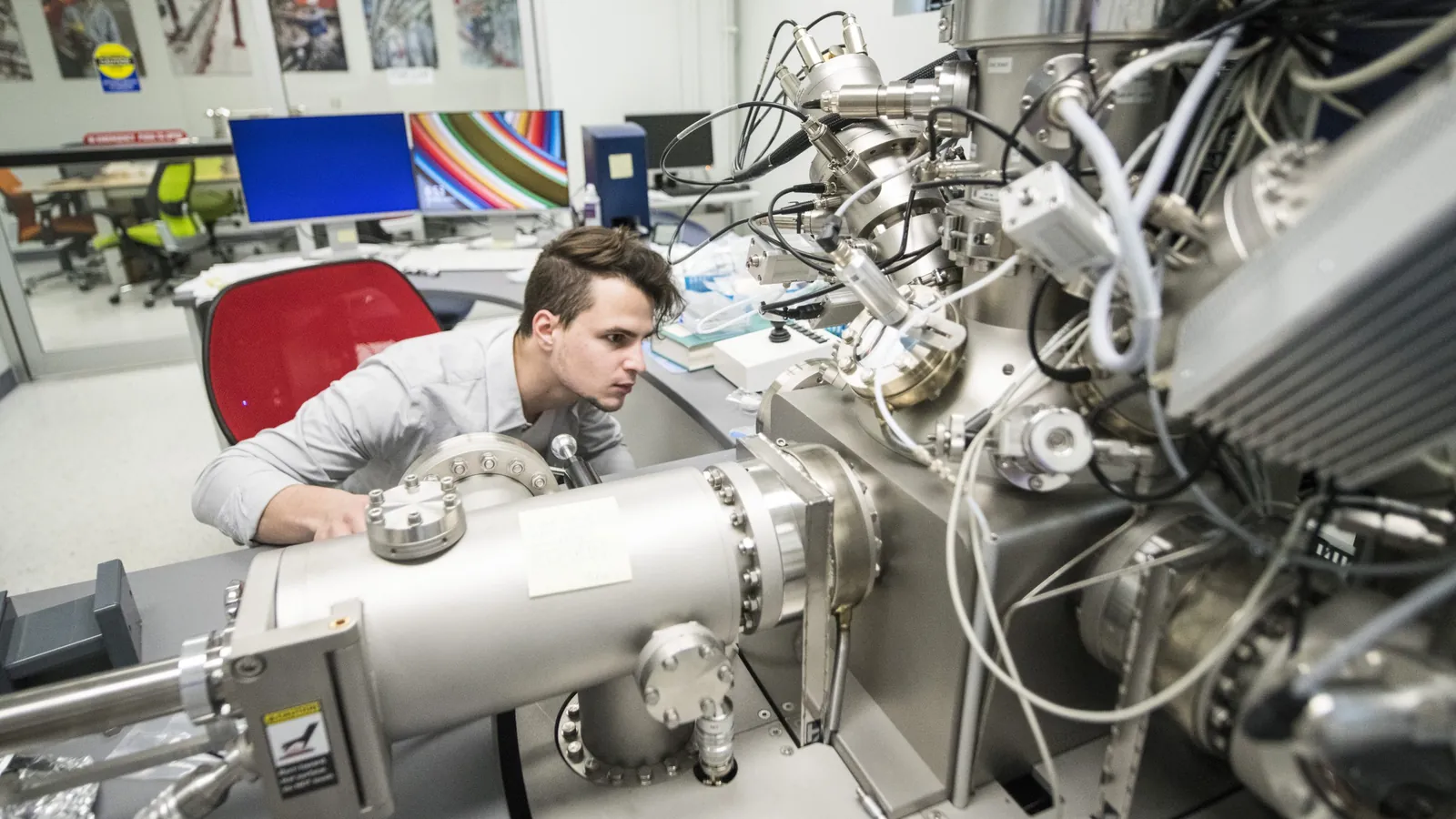
One way to protect a quantum bit is to give stray energy somewhere to go. Researchers at the Weizmann Institute of Science found that a part of their circuit already had just the right escape route. When they tuned it carefully, one kind of error became so rare that their usual 100-second test could no longer put a number on it.[1][2]
Writing in a November 3 preprint, Sergey Hazanov, Mikhail Svintsov and colleagues report an idle bit-flip time of 448 ± 57 seconds, about seven and a half minutes. That measures how long the device retains information about which of two states it started in. Keeping the full quantum information intact requires a second kind of protection.[1][2]
What exactly can flip?
The device is a superconducting circuit in which a microwave field can oscillate in either of two opposite patterns. Picture two pendulums swinging at the same rate: at the instant one reaches the left end, the other reaches the right. The two patterns play the roles of zero and one. A switch between them is a bit flip. The pendulums are a way to picture the timing; what oscillates in the circuit is an electromagnetic field.[1][2]
Experimental preprint
Two settings for the same qubit
A bit flip swaps the two encoded states. A phase flip changes their relative phase. Researchers adjusted the average number of photons in the oscillator and tracked how quickly each kind of information decayed.
| Average photons | Bit-flip time | Phase-flip time |
|---|---|---|
| 24.2 | 3.55 ± 0.23 seconds | 113 ± 24 nanoseconds |
| 33.8 | 448 ± 57 seconds, inferred at idle | Too little signal contrast for a reliable value |
Only the first row gives both error times under the same conditions. Read Figure 4 and the measurement methods in the preprint.
A can also carry a combination of the two patterns, with a relative phase that determines how their contributions add or cancel during a later operation. An error can reverse that relationship while leaving the chances of reading zero or one unchanged. This is a phase flip. Checking only which pattern the circuit occupies can miss that error entirely.[1][2]
How the circuit sheds energy
This design, called a Kerr-cat qubit, uses a microwave drive to hold the two patterns apart. The researchers describe them as two valleys in an energy landscape. Near the bottom of either valley, switching sides is difficult. Noise can lift the oscillator into an excited state from which it crosses more readily. Making the valleys deeper helps, but energy that has already entered still needs a way out.[2]
The team adjusted the drive until an energy change inside one valley matched an exchange the readout circuit could accept. An unwanted excitation could then become a microwave photon in that circuit and dissipate. The same interaction that helps create the valleys powers this exchange. In measurements of the circuit’s frequencies and how quickly excitations died away, the authors found evidence for that route. No separate cooling drive was needed.[1][2]
How thirteen switches become a timescale
At the strongest setting, two readings separated by up to 100 seconds showed no detectable decay in the aggregate signal. So the researchers asked a different question: over many much longer records, how often did the device actually change sides? In one series they checked every ten milliseconds. Across eleven 1,000-second records, they counted thirteen switches.[2]
Dividing 11,000 seconds by thirteen gives about 846 seconds per observed switch. The paper’s bit-flip time measures how quickly a later reading loses its correlation with an earlier one. In the researchers’ model either side can flip at the same rate, so the correlation decays twice as fast. The same records give about 423 seconds. By varying the time between readings, the authors could separate measurement-induced flips from idle flips. The fitted idle value across runs was 448 seconds.[2]
The other clock
At the strongest setting, the team could not prepare a combination of the two patterns clearly enough to measure its phase lifetime reliably. At a lower setting where both measurements worked, they found a bit-flip time of 3.55 ± 0.23 seconds and a phase-flip time of 113 ± 24 nanoseconds. A nanosecond is a billionth of a second. The phase behavior there was consistent with the oscillator losing individual photons.[2]
Such unequal vulnerabilities can be useful. In an earlier experiment with a different cat-qubit design, another group connected several qubits so that a repetition code could identify and correct phase flips. The Weizmann result gives researchers a reason to try that division of labor with a Kerr-cat design. Its contribution is the way an existing readout circuit can remove excitations. Earlier Kerr-cat work using controlled dissipation had reported bit-flip times up to 3.6 milliseconds.[2][3][4]
A telling next experiment would be to connect this cooled qubit to another circuit, repeatedly check for phase errors and measure both kinds of error under those same conditions. That would show how much of the idle protection survives the work required to use it.[2][4]
About the evidence
This account follows version 1 of the authors’ preprint. The paper says its underlying data and code are available from the authors on request. QuamCore funded part of the research, and co-author Serge Rosenblum discloses a shareholding in the company.[1][2]
Keep your reading trail
Keep up with these topics
Choose the subjects you want to find again in Your Updates.