
A shaped beam of light sent tiny plastic beads into orbit
Researchers used a laser to hold one-micrometer beads in water and steer them around rings. Changing the mix of light in the beam changed the size of the orbit.
Reading tools for text size, copying, printing and your reading list
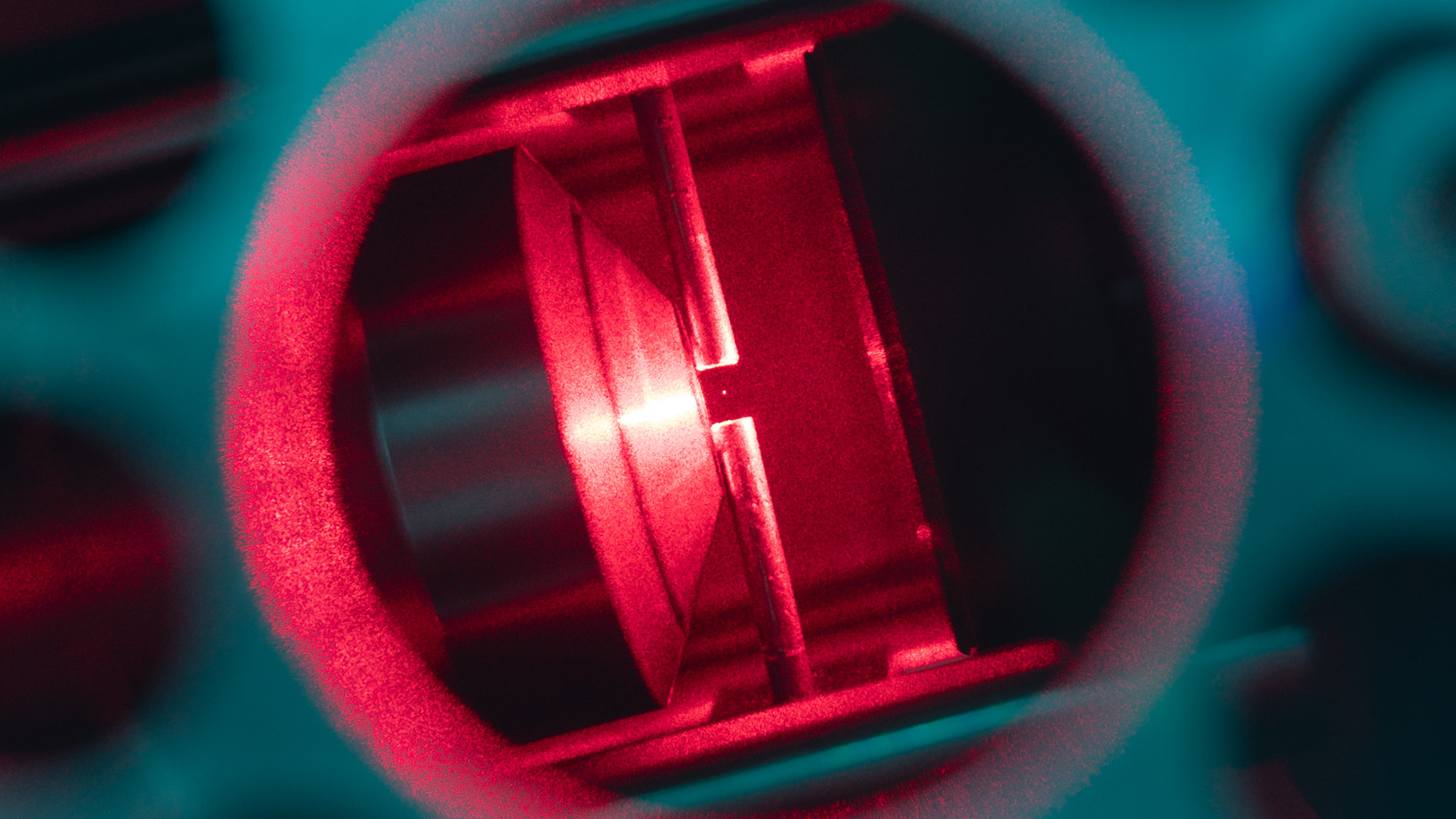
A focused laser can hold a particle still. This one sent tiny plastic beads around a ring. In a new preprint, Liuhao Zhu and colleagues describe how they trapped roughly one-micrometer polystyrene beads in a thin layer of water and changed the size of their orbits by changing the mix of light in the beam. The beads went around the center of the trap, like runners changing lanes on a tiny circular track.[1]
Optical tweezers work because light carries momentum. When a particle bends or scatters a beam, the exchange of momentum can exert a small force on it. Focus a beam tightly enough and the force can keep a particle from drifting away. The researchers wanted to see what happened when that beam was not just focused but also deliberately patterned, with its polarization changing from point to point across its face.[1][2]
Two ways to shape the light
Polarization describes how the electric field of a light wave oscillates. In many simple beams it has the same character across the whole beam. Here an optical plate produced a beam with contrasting polarizations across its cross-section. Some patterns had a winding structure called a skyrmion. Another part of the experiment varied how much of the beam was in a vortex mode, in which the phase winds around the center. Polarization winding and phase winding are related parts of the experiment, but they are not the same thing.[1]
In three representative settings, the group went from roughly equal vortex and non-vortex contributions to a vortex-dominated mix and finally a pure vortex. The beads orbited in all three, and their paths grew wider as the vortex contribution increased. The beam power measured before the microscope objective actually fell from about 46 to 27 milliwatts across those settings. That points to the structure of the beam as a factor, though the experiment did not vary that structure at constant power.[1]
A wider orbit is not a universal rule
In a separate trial, two patterns with the same overall winding number but different polarization layouts produced qualitatively similar motion. That distinction matters: changing one feature of a beam can alter its mechanical effects, but a shared winding number does not prove two beams must move particles the same way. The authors found a similar response under their particular conditions, not a rule that holds for every particle or setup.[1]
The computer model captured the general move toward wider rings but missed the orbit in the equal-weight setting. It modeled a single particle at one fixed height. The physical experiment had multiple trapped particles that could sit slightly away from the nominal focus. The comparison is useful because it shows where the model helps and where a better test is still needed.[1]
For now, the result is a laboratory demonstration with plastic beads. One next question is whether the same approach can reliably move particles that respond differently to light depending on how they are oriented, without losing the trap. No such sorting or biological application was demonstrated in this study.[1]