
On Quantinuum Hardware, the Less Precise Circuit Won
A 48-qubit experiment found that a local adiabatic circuit could beat an exact fermionic Fourier transform once noise entered the picture, exposing a blind spot in gate-count optimization.
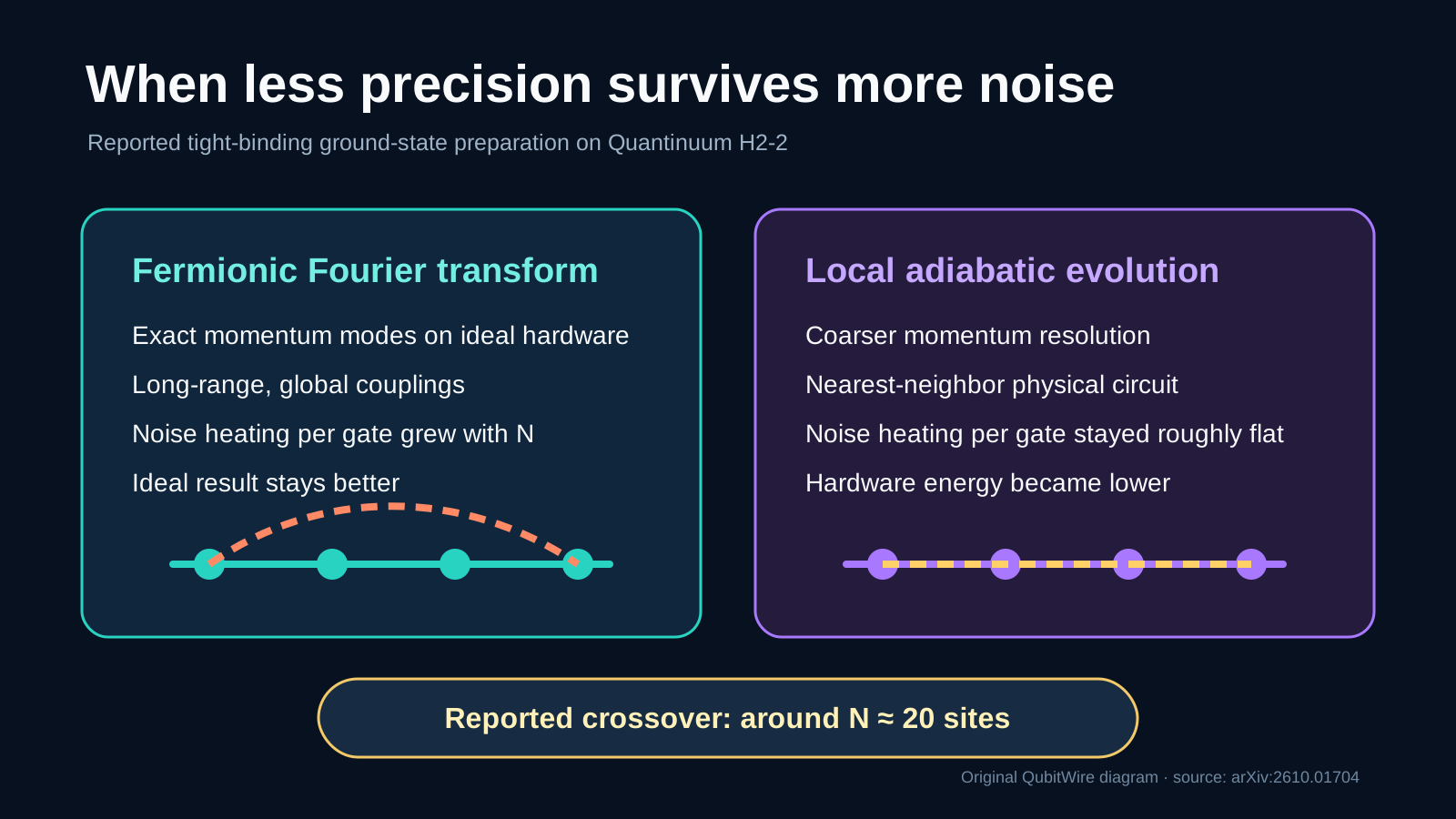
The circuit that is mathematically exact was not the circuit that worked best on the quantum computer. In experiments on Quantinuum's H2-2 machine, researchers preparing a tight-binding-chain ground state found that a local adiabatic routine reached lower measured energy than a fermionic Fourier transform once the chain grew beyond roughly 20 sites.[1][2]
That reversal matters because the comparison was designed to remove the usual explanation. At each tested size, the two approaches used approximately the same number of two- gates. At 48 sites the adiabatic circuit also won when matched against the Fourier circuit's depth, even though the ideal, noiseless Fourier transform prepares the exact target more efficiently.[1][2]
The authors trace the gap to where errors travel. A Fourier transform resolves momentum differences as fine as 2π divided by N, but that precision corresponds to long-range couplings in real space. On the hardware data, noise-induced energy heating per two-qubit gate grew with system size for the Fourier circuit, while it stayed roughly constant for the local adiabatic evolution.[2]
Locality changes the damage radius. The paper argues that a single error in the global Fourier circuit can affect the energy density by order one, whereas an error in the adiabatic routine affects it by order one divided by N. The trade is deliberate: give up exact momentum resolution so hardware noise does not spread as aggressively.[1][2]
The team tested the same idea at measurement time. Its Momentum Distribution from Local Measurements protocol measures short-range observables with local fermionic-swap circuits, then reconstructs a smooth momentum profile by maximum entropy. The method cannot reproduce arbitrarily sharp features unless longer-range observables are added, so lower noise is purchased with explicitly limited resolution.[2]
For a spectral-function experiment on H2-2, the local protocol used observables out to separation three. The reconstructed distribution put the peaks in the correct locations and avoided the noise floor seen in the earlier Fourier-based hardware result, although peak amplitudes did not perfectly match the noiseless reference.[2]
This is not a universal verdict against quantum Fourier transforms. The experiment covers one free-fermion model, one trapped-ion platform and particular state-preparation and measurement tasks. The Fourier transform can prepare arbitrary excited states and retains the ideal-hardware advantage; the paper leaves open whether similarly robust local protocols exist for those broader uses.[1][2]
The practical lesson is sharper than 'use fewer gates.' Circuit compilers may need a noise-sensitivity objective that accounts for connectivity, interaction range and how faults propagate through the observable being estimated. The next test is whether that objective predicts better choices across other Hamiltonians, hardware architectures and eventually error-corrected machines operating near their logical-error limits.[1][2]