
A chip that guides light can remember which way the laser was tuned
In a lithium niobate experiment, the same device responded at different wavelengths depending on whether the researchers tuned the laser up or down.
Reading tools for text size, copying, printing and your reading list
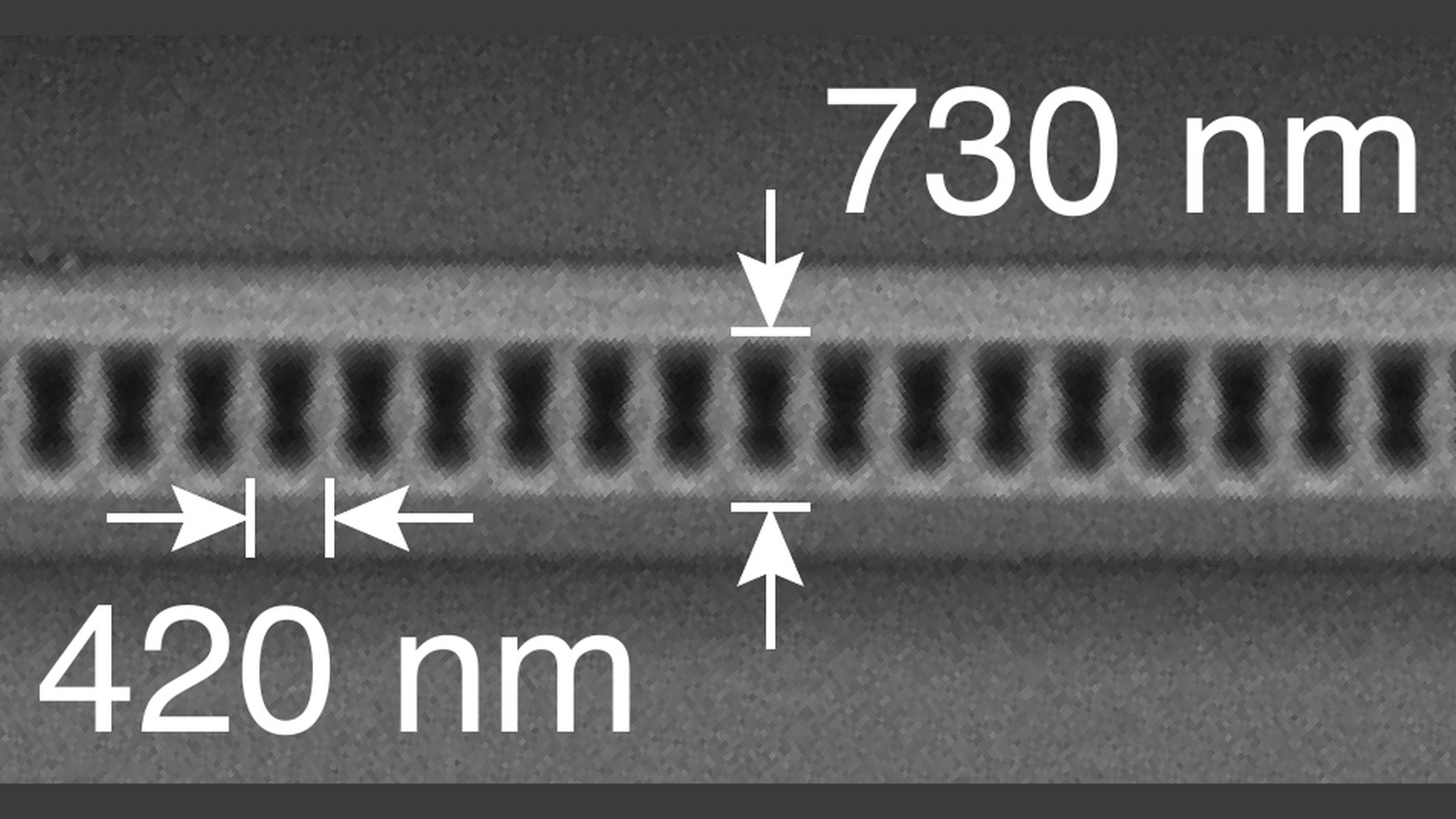
Sweep a laser across the colors a tiny optical cavity responds to, then run the sweep backward. You might expect the same optical feature at the same color. In a newly reported experiment, researchers found that the feature appeared at one wavelength on the way up and another on the way down. They saw this in three cavities on the same lithium niobate chip, and the gap increased as they sent in more light or applied a stronger voltage.[1]
A cavity is a small structure that holds light particularly well at certain wavelengths. Think of a guitar string that rings most strongly at a particular note. The chip version is useful because researchers can tune which wavelengths the cavity responds to, helping a circuit direct or modulate light. The catch is that voltage and laser settings may not tell the whole story. What happened to the cavity just before you measured it can also matter.[1]
Turning the dial faster didn’t erase the gap
Alessandro Buzzi and colleagues had already reported how the chip could route light between ports. The new preprint asks a different question about that hardware: what happens to the cavity itself when the wavelength changes? The team measured the two directions of the sweep under several combinations of voltage and light power. Then it tested one cavity across a 200-fold range of sweep speeds. At one fixed voltage and light setting, the two directions were separated by 81 picometers at the slowest speed and 88 at the fastest. A picometer is a trillionth of a meter. The effect survived a large change in how fast the laser was tuned rather than disappearing at the fastest speed they tested.[1][2]
Engineers call this dependence on the path taken hysteresis. A common example is a thermostat that turns the heat on at one temperature and off at another. At a temperature in between, whether the heat is on depends on where the temperature came from. The thermostat is designed that way; the optical cavity isn’t. But it offers the same lesson: the direction of the change can matter even when a dial comes back to the same setting.[1]
What could give a cavity that kind of history?
The researchers’ model points to electrical charges. Light can free some charges inside the material. An applied voltage can help push them toward sites where they get trapped. Once those charges build up, their own electric field changes the optical properties of the cavity. In the model, sweeping in opposite directions lets the system follow different stable patterns of trapped charge, which shifts where the optical feature appears. The researchers measured the light coming out, not the trapped charges themselves.[1]
The model reproduced the broad trends across the three cavities, but it fell short where the gap kept growing at higher voltages, particularly with stronger light. The experiments also didn’t establish how long the effect would last with the laser held at a fixed setting. This is not a demonstration of a memory chip or a quantum operation. It is a reason to calibrate an optical circuit in both directions: a setting that sends light where you want it on the way up may not do the same on the way back down.[1]