
A Quantum Link Can Tolerate 50% Interface Erasure—Until Local Noise Arrives
A distributed lattice-surgery design reaches a 50% interface-erasure threshold only when local noise is absent. At one error in a thousand, the advantage largely disappears.
A modular quantum computer has an awkward seam. can be protected inside separate processors, yet an operation that crosses the photonic link between them must survive losses that are much harsher than the errors inside either machine. A new preprint asks whether the interface can borrow the loss tolerance of fusion-based quantum computing without replacing the local processors.[1][2]
The researchers use ZX-calculus transformations to design hybrid syndrome-extraction protocols for rotated surface-code lattice surgery. Lattice surgery is the established method of joining and splitting encoded surface-code patches so they can perform a logical operation while retaining local interactions. The new work changes the seam: Bell pairs or short photonic cluster states are fused into the checks that connect two matter-based quantum processing units.[1][2]
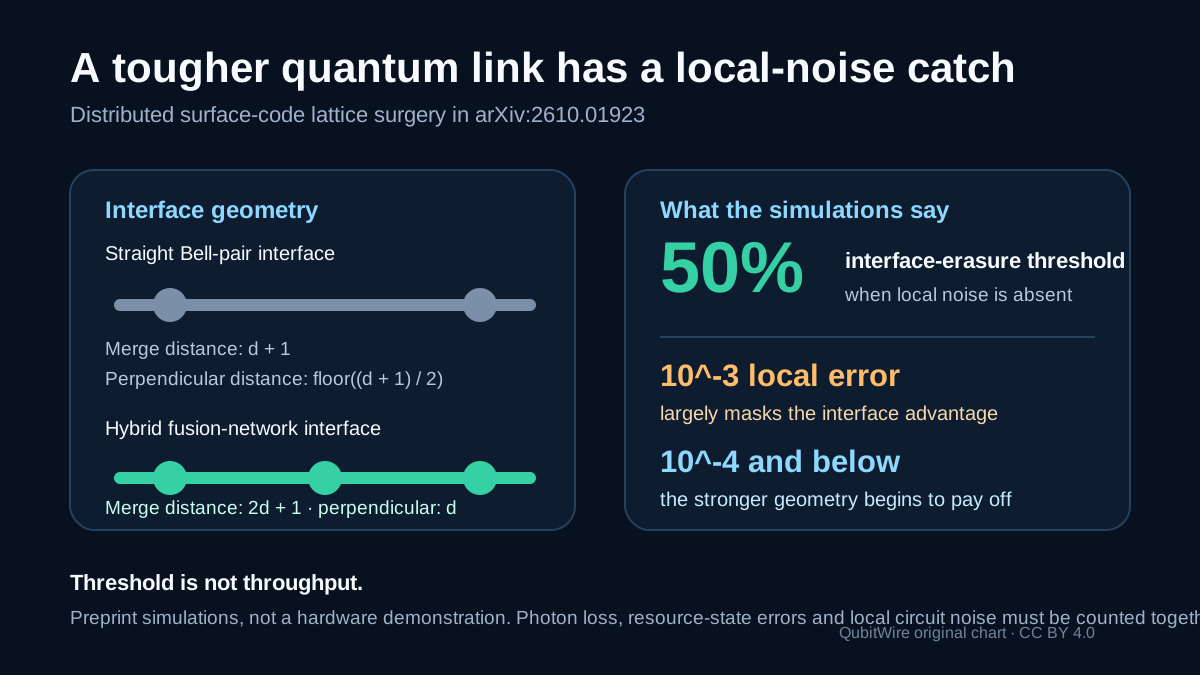
The headline number is striking but conditional. Several modeled protocols reach a 50% interface-erasure threshold when local noise is absent. That means the code can remain below threshold even if as many as half of the relevant interface outcomes are erased in the idealized model. It does not mean a working network can discard half its photons without cost.[1]
The proposed geometry strengthens the logical seam. Compared with a straight Bell-pair interface, the hybrid protocols increase the merge-observable interface distance from d plus 1 to 2d plus 1, while restoring the perpendicular-observable interface distance from floor((d plus 1) divided by 2) to d. In plain language, more independent interface failures are required before some logical errors can cross undetected.[1]
The authors also translate erasure thresholds into photon-loss thresholds and test fusion boosting, which spends extra photonic resources to make a fusion attempt more likely to succeed. Truncated resource states, resource-state errors and local circuit noise are all included in the correctable-region maps. That accounting matters because a better interface distance cannot erase faults created everywhere else.[1]
The reality check is the most useful result. At local circuit and resource-state error rates of 10^-3, those local faults largely mask the interface-distance advantage. When local errors fall to 10^-4 and below, the linear-chain protocols improve more rapidly as erasure decreases. The stronger seam pays off only after the processors on both sides become quiet enough.[1]
This is a 31-page preprint with simulations and analytical constructions, not a hardware demonstration. The 50% figure belongs to the zero-local-noise boundary, and practical photon loss depends on the fusion scheme and resource state. The study does not establish an end-to-end rate, latency or hardware overhead for a deployed modular quantum computer.[1]
The next decisive test is an experiment that combines measured photon loss with measured local gate, preparation and readout errors at the same time. If the local error budget approaches 10^-4, fusion-network interfaces may turn loss from a fatal defect into a design parameter. Until then, the result is a map of where the trick could work, not proof that it already does.[1]
Keep your reading trail
Keep up with these topics
Choose the subjects you want to find again in Your Updates.