
A superconducting chip let one patch of molecular spins sense another
Two groups of molecules sat less than a millimeter apart. Researchers used a microwave circuit to make their collective excitations interact, but did not demonstrate a quantum gate.
Reading tools for text size, copying, printing and your reading list
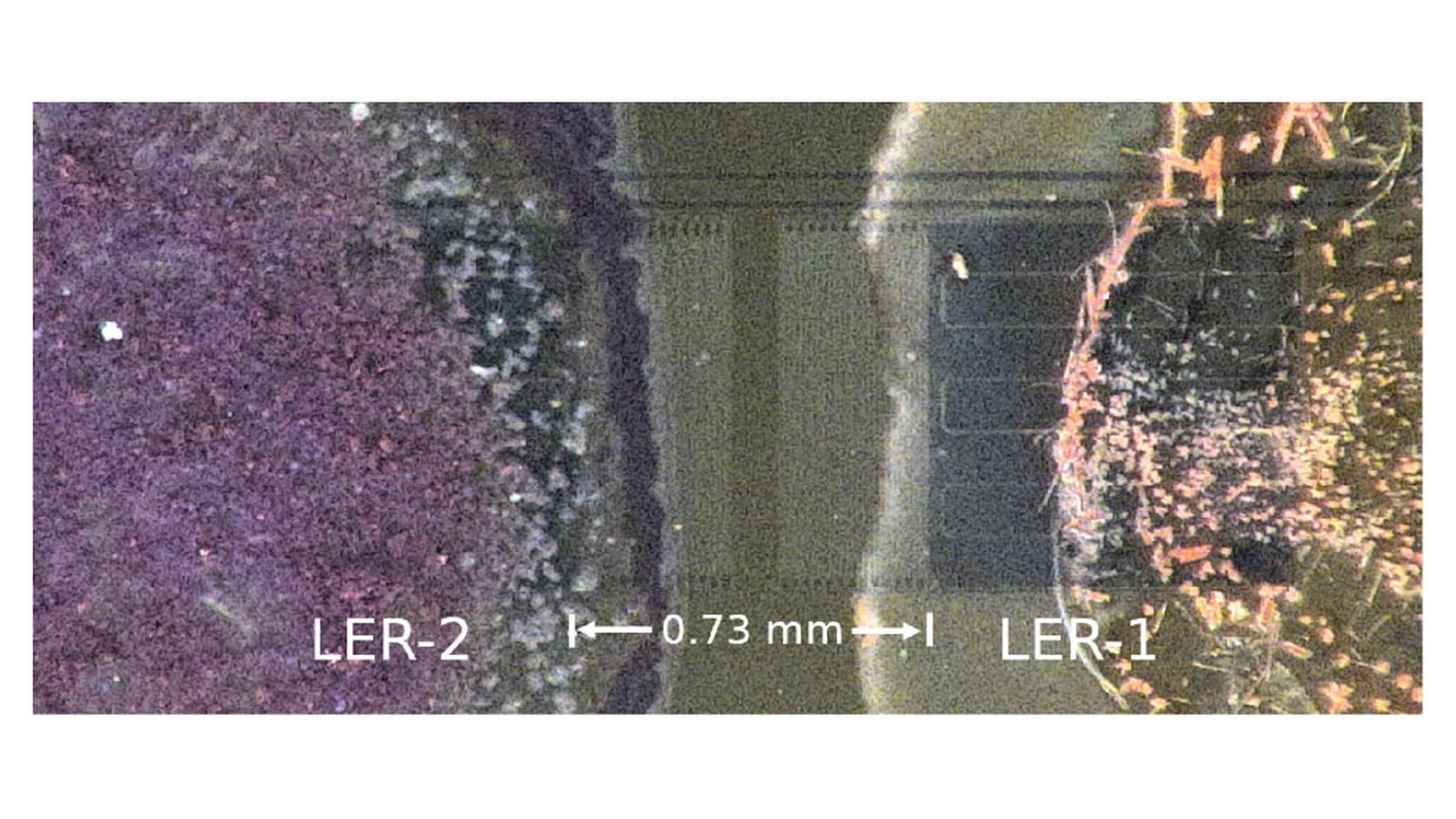
Researchers put two patches of magnetic molecules on a superconducting chip and made an excitation on one side influence what they could measure on the other. The study, published November 25 in PRX Quantum, shows a way to connect groups of molecular spins without having to put both groups in the same microwave resonator. The device is a laboratory test of that connection, not a processor running a calculation.[1][2]
How the chip links the two patches
Each patch contains many molecules with an electron spin. The patch sits beside its own resonator, a tiny circuit designed to respond to microwaves at particular frequencies. When the molecules and the local microwave field interact, an excitation can take on properties of both. Physicists call that hybrid excitation a polariton. The experiment was about these collective excitations, not about reading out or controlling individual molecules.[1]
The chip had seven pairs of resonators. The team designed the two resonators in each pair with slightly different frequencies so they could be addressed separately, and connected them through their capacitors. An external magnetic field changed the spin frequencies and let the team bring the hybrid excitations closer to the same frequency. In the pair shown in the microscope photo, the marked separation between the two sites is 0.73 millimeters.[1]
What changed when the two sides were tuned together
The researchers compared a connected pair with resonators that were not connected. In the connected pair, two frequency traces approached but did not cross. The closest separation in the measured upper branches was about 1.9 megahertz. Here, that number measures a gap between two resonances, not the speed of a logic operation. That gap is a sign the two excitations are interacting: without the connection, the traces can pass through one another. The team then drove one excitation with a microwave signal and measured a shift in the response of the other.[1][2]
That second test matters because it shows more than two peaks on a graph. The shift lets the researchers infer that one side was excited by looking at the other. It does not show that the chip faithfully transferred an arbitrary quantum state. The researchers' model predicts that the linked modes can share quantum correlations, including , but the measurements did not independently verify an entangled state or demonstrate a two- operation.[1][2]
Why build the link this way?
A shared resonator can connect multiple groups of spins, but it constrains where they sit and how they couple to the field. Giving each group a local resonator and connecting the resonators gives designers more freedom to choose which sites interact and how to address them. INMA described the work earlier this month; the full journal paper now lays out the measurements and the model. A next test would be to show what quantum information the connection can carry and how well it survives the trip.[1][2][3]