
A molecule becomes a light-linked qubit. Its chip test comes next.
A molecule-to-light result reaches Nature as NVision outlines a chip integration plan. The measured component and roadmap are distinct.
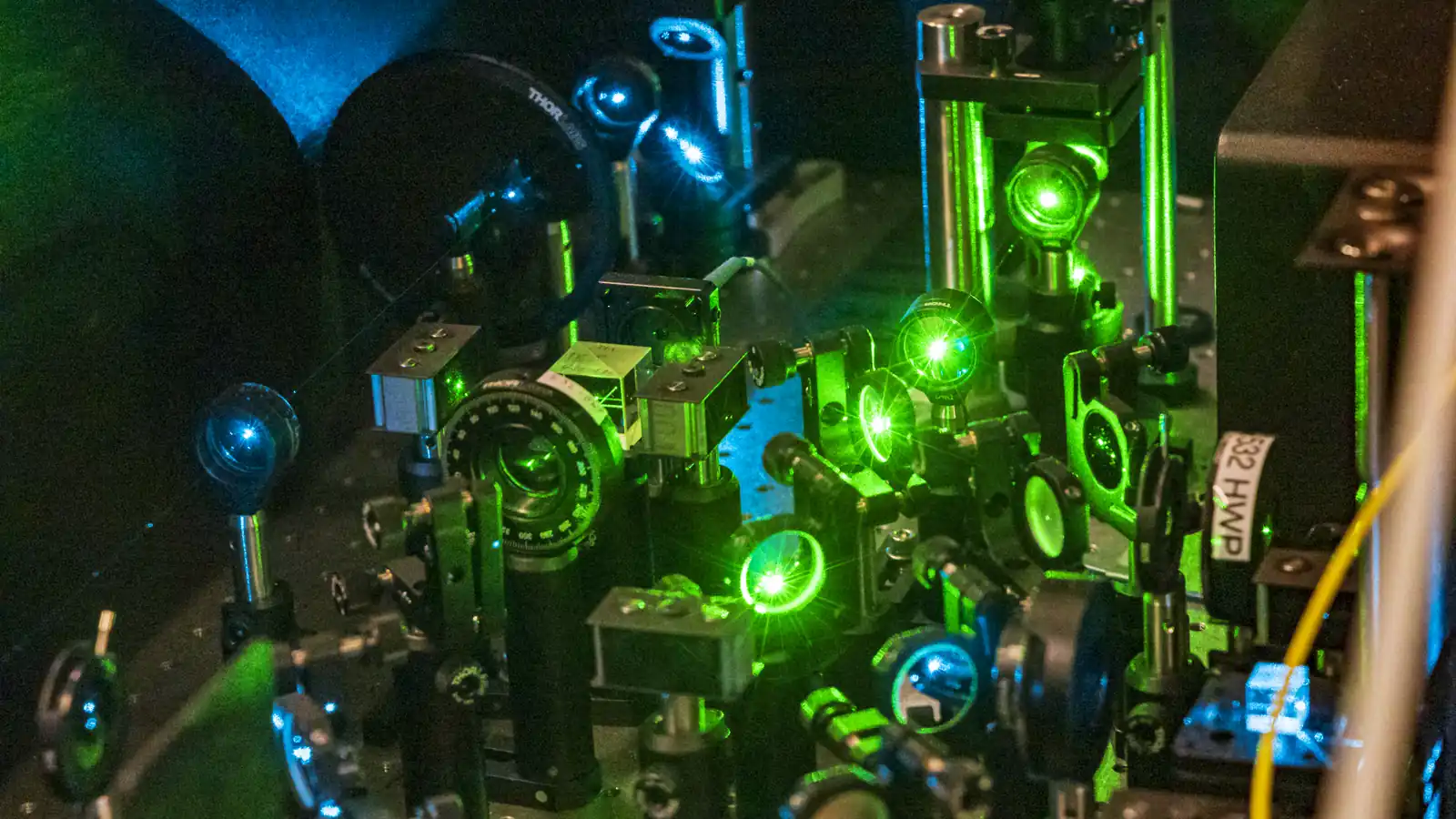

A single molecule can be addressed through a spin–photon interface in a host crystal. The Nature paper, published October 28, reports millisecond spin coherence with dynamical decoupling at 4.5 kelvin. NVision separately announced work with photonics company HyperLight toward an on-chip demonstration by the end of 2026.[1][2]
The molecule is a carbene engineered into a structurally matched crystal. Optical transitions provide access to its spin, while the experiment measures the coherence needed to retain quantum information. The paper had first appeared as a preprint in May; the October 28 publication and commercial integration announcement are the current news.[1][3]
The useful idea is chemical control. If a quantum component can be specified by a molecular design, researchers can ask which changes improve the properties needed by a larger machine. That turns the question from finding one promising specimen toward identifying a reproducible recipe. It does not, by itself, answer how well that recipe survives fabrication and packaging.
A spin–photon interface connects two jobs: retaining a quantum state locally and interacting with light that can carry information elsewhere. Both matter. A memory with no effective optical connection is difficult to network; an optical connection that destroys the stored state does not solve the memory problem.
The industrial claim therefore deserves a separate test. NVision’s roadmap is a company target, not a result already established by the Nature experiment. The announced HyperLight work concerns integration with thin-film lithium-niobate photonics; the source does not report a completed processor built from these molecules.[2]
For a chip experiment, three measurements would make the story substantially stronger: how many usable sites survive fabrication, how much light reaches the intended channel, and whether coherence remains adequate after integration. Those are proposed reporting questions, not results or thresholds supplied by this paper.
Readers should also keep the temperature beside the coherence number. Removing that condition would turn a specific laboratory result into an implied operating specification. The same applies to : a promising physical component should not be described as an already demonstrated .
The reason to follow this result is the opportunity to compare chemistry and chip engineering against the same device. A subsequent integrated demonstration could reveal which advantages carry over and which new bottlenecks appear. Until then, the strongest account is a measured interface result with a dated, separately attributed integration plan. Success at that next stage would give researchers a common platform on which to test the trade-offs together.