
A thin crystal emits single photons, but matching them is harder
A study newly published by Nature Communications shows why a good single-photon source is not automatically a good source of matching quantum light.
Reading tools for text size, copying, printing and your reading list
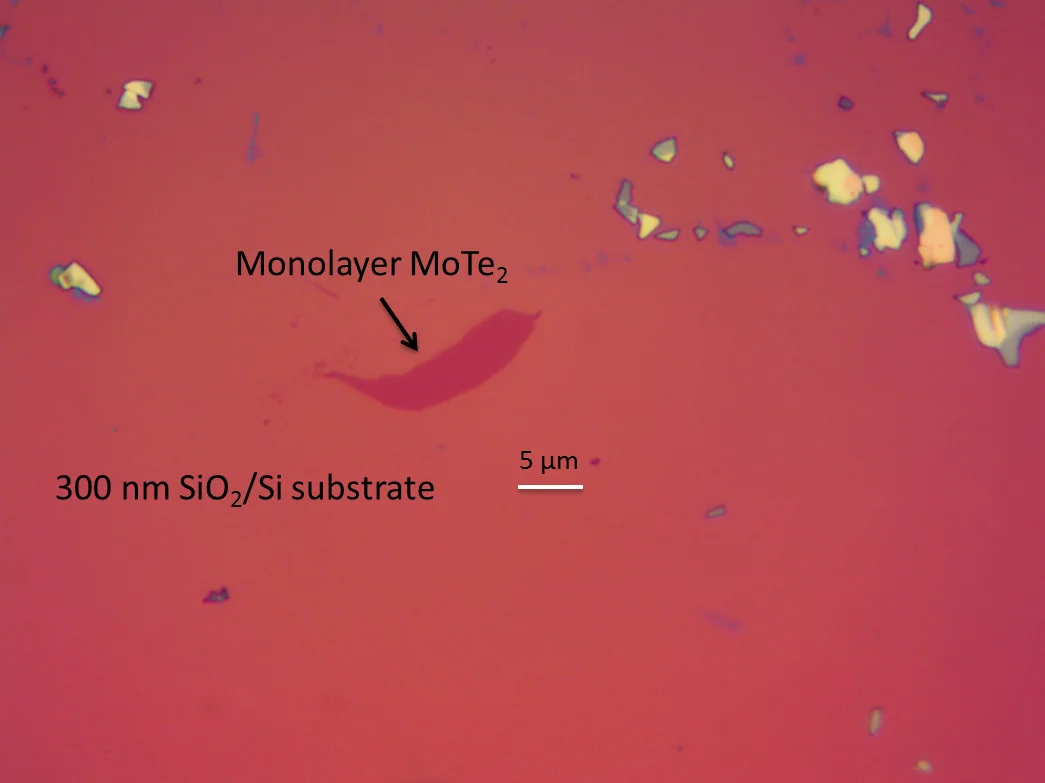
Researchers at the Technical University of Denmark used a two-layer crystal of molybdenum ditelluride, or MoTe2, to produce near-infrared photons with very little unwanted multiphoton emission. But a separate interference test exposed a tougher challenge: getting successive photons to behave alike. The work appeared as an accepted journal article on November 11; its principal results were already public in an October 6 preprint revision.[1][2]
The distinction matters because quantum-photonic devices need more than isolated flashes. In an interference experiment, sufficiently similar photons arriving at a beamsplitter are more likely to leave through the same output than distinguishable photons. That behavior is a resource for quantum information processing.[2]
The team shaped the crystal over tiny pillars and introduced defects with an electron beam. At about four degrees above absolute zero, selected sites emitted individual photons. A carefully chosen laser excitation reduced background light, yielding a fitted multiphoton-correlation measure, g²(0), of 0.010±0.004 for the best-result emitter, which was encapsulated in hexagonal boron nitride. Lower values on this measure indicate stronger suppression of simultaneous multiple photons. It does not mean 99% of excitation attempts produced a useful photon.[2]
For the matching test, the researchers delayed one photon to meet a later photon from the same emitter. Across the full 12.5-nanosecond integration window, their interference visibility was 7.1%, with an uncertainty of 0.9 percentage points, after correcting for photon bunching. Visibility measures the contrast between interfering and noninterfering cases, not source efficiency.[2]
Selecting only detections in much narrower time windows increased that contrast, reaching about 60% with the tightest filtering. That timing selection discards detection events. This is the useful comparison: the higher number describes a selected part of the record, not a source that makes every photon match that well. The paper identifies rapid loss of coherence as the main limitation.[2]
The photons span roughly 1090–1200 nanometers, short of the telecom bands targeted for low-loss fiber networks. Better optical cavities and excitation methods are proposed next steps. The concrete test is whether a future device can deliver strong interference without relying on such restrictive event selection.[2]