
Researchers isolate a tiny quantum mirror’s reflected light
A semiconductor dot inside a tapered nanowire reflects light one photon at a time. The experiment solves a collection problem, while fluctuations still weaken its average reflection.
Reading tools for text size, copying, printing and your reading list
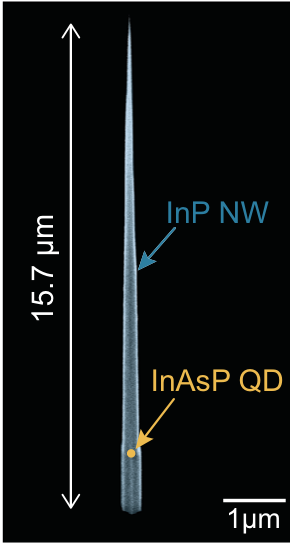
A microscopic semiconductor dot can behave unlike an ordinary mirror: when it is occupied interacting with one photon, its response to the next changes. Researchers in Canada have found a way to collect this quantum reflection while filtering out laser light that missed the dot.[1]
The experiment, published as a peer-reviewed accepted article in Nature Communications on November 11, offers a cleaner way to study interactions involving very small amounts of light. It does not demonstrate a quantum computing gate. An earlier version was available as an April preprint.[1][2]
The team included joint first authors Tarun Patel and Matteo Pennacchietti at the University of Waterloo. The team embedded an indium arsenide phosphide quantum dot in an indium phosphide nanowire. The wire guides light toward the dot. Its tapered tip helps match the shape of the incoming laser beam to the light pattern the wire can carry.[1]
Getting light in is only half the problem. The same optical arrangement must collect the returning signal without drowning it in unwanted reflections. The researchers used spatial filtering: the collection fiber accepts the desired beam shape while rejecting much of the stray light. That avoids relying on crossed polarization filters to separate excitation light from the dot’s response.[1]
At low input power, the reflected signal showed strongly suppressed simultaneous photon detections. The measured correlation, called g²(0), was 0.02 ± 0.01; a value near zero means pairs are strongly suppressed. This is a test of the photons’ arrival statistics, not a claim that 98% of the incoming light was successfully reflected. The input itself was a continuous laser beam, not a stream of perfectly prepared individual photons.[1]
The experiment also shows why different efficiency figures cannot be swapped. The authors estimate that about 95% of the incoming beam coupled into the desired waveguide mode. But fluctuations in the dot’s resonance, the frequency it responds to most strongly, spread the response over a much wider range. The time-averaged reflection peak reached only about 3% of the ideal two-level emitter’s peak. Efficiently guiding light toward an emitter therefore did not guarantee a strong, stable reflected signal.[1]
Measurements were made at about 4.5 kelvin, close to absolute zero. Reducing those resonance fluctuations remains important, and the authors say pulsed excitation is needed to resolve the reflection and transmission dynamics in time. For photon-based quantum technology, the useful advance is access to a cleaner signal that researchers can test and improve, not a finished optical processor.[1]