
PsiQuantum and AMD reshape an AI decoder for photonic quantum hardware
PRISM targets the classical processing behind quantum error correction. Its fastest published timing still needs a complete hardware mapping.
Reading tools for text size, copying, printing and your reading list
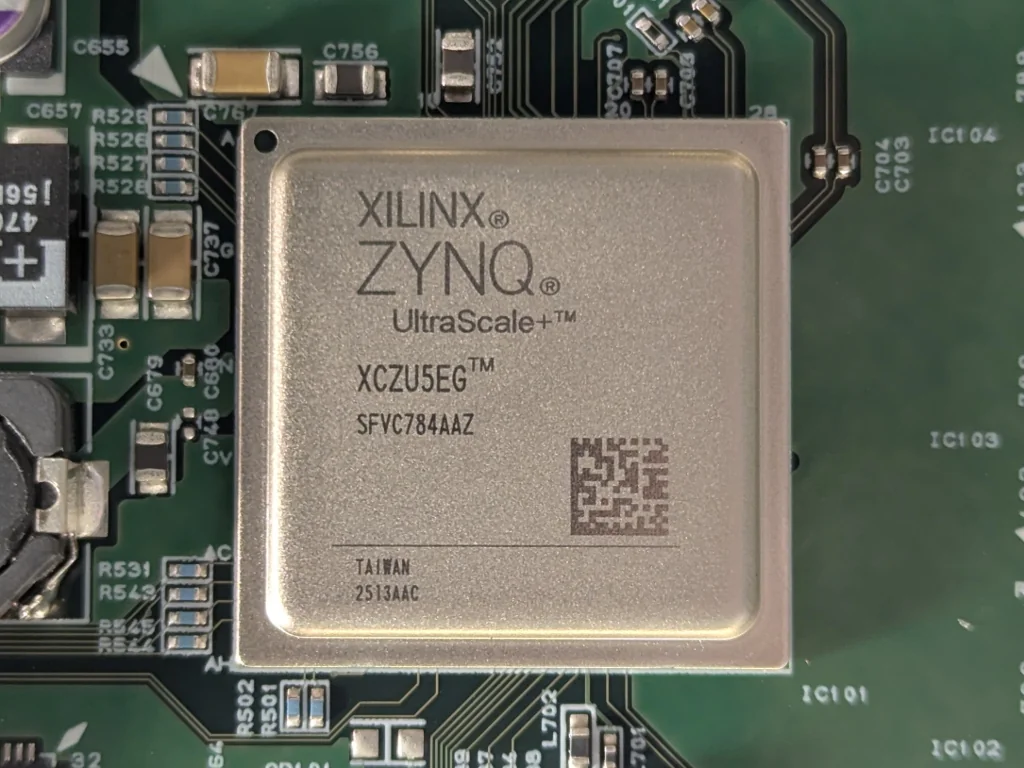
PsiQuantum and AMD researchers have designed PRISM, a machine-learning system that interprets error signals for photonic quantum computing, and adapted a version for a programmable chip. Their November 10 preprint addresses a practical bottleneck: needs ordinary computers to keep up with quantum hardware.[1]
This is decoder engineering, not a demonstration of a working fault-tolerant quantum computer. The complete design maps to an AMD VP1902 FPGA, a reconfigurable processing chip, at 250 MHz. The faster 400 MHz estimate comes from individual layers, with full integration left for future work.[1]
A decoder is the interpreter between warning lights and a response. Quantum error checks provide clues about what went wrong without simply reading out the protected information. The classical system must turn those clues into useful decisions before a backlog builds or a later operation has to wait.[1]
PRISM also uses the known locations of missing or unreliable outcomes, called erasures. Knowing where information disappeared is different from discovering that an unknown value was wrong: a marked blank narrows the search.[1]
The team's hardware results separate two clocks. At 250 MHz, the design has a reported 10.11-microsecond processing latency and a 2.39-microsecond interval between successive blocks. The reported 6.59-microsecond estimate is based on individually implemented layers at 400 MHz.[1]
The mapped design uses a distance-eight test configuration, a measure of its error-protection scale, not an entire quantum computation. The timings describe the decoder design, not a measured roundtrip from quantum hardware to correction.[1]
Latency is how long one item takes to finish. Throughput is how often completed items can emerge once work overlaps, like different orders moving through a kitchen. Neither number alone describes the whole service.[1]
The takeaway: useful quantum error correction also depends on carefully engineered classical hardware. Completing the faster mapping is a concrete next test; connecting such decoding to a larger computation also requires handling communication and buffering between blocks.[1]
Keep your reading trail
Keep up with these topics
Explore the subjects covered in this story.