
NEC and IBM Japan combine quantum keys with post-quantum cryptography
The companies tested two ways of establishing encryption secrets together, without changing existing applications.
Reading tools for text size, copying, printing and your reading list
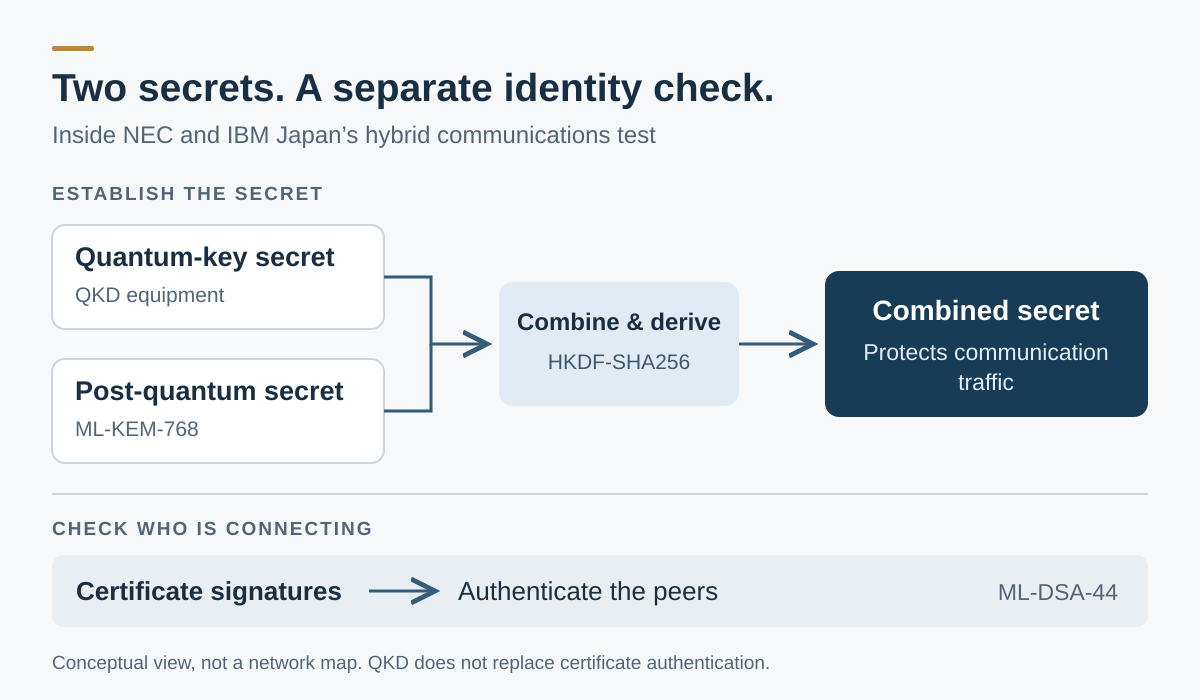
NEC and IBM Japan have tested a way to add quantum-distributed keys to post-quantum protection for network connections without rewriting existing applications. Announced on November 17, the July–September demonstration connected NEC equipment to a custom version of IBM Quantum Safe Proxy, an intermediary handling secure connections.[1]
The system combined two ingredients: secret material delivered by NEC’s quantum key distribution equipment and a shared secret established by post-quantum software. It used the combination to derive the secret protecting network traffic. Digital certificates still checked who was communicating.[1]
That distinction matters. Establishing a shared secret and checking identity are different jobs. The software used ML-KEM, a NIST-standardized way to establish a secret over a public channel, and ML-DSA digital signatures for authentication. Both are designed to resist attacks by future quantum computers; neither requires a quantum computer to run.[2][3]
The companies demonstrated that their equipment and software could work together. They did not test quantum keys as a replacement for certificate authentication or as an independent backup channel. Financial-sector applications are a proposed next step, not an announced banking deployment.[1]
For prospective users, the useful result is compatibility with existing applications. The next questions are practical: how the combined system performs, what it costs to operate and how it handles failures.