
Why two photon detectors need their clocks to agree
The UK’s National Physical Laboratory reports picosecond-level synchronization and entanglement distribution on its three-user quantum network.
Reading tools for text size, copying, printing and your reading list
One detector clicks in one laboratory. A second detector clicks in another. Each records a time, but the two lists come without labels saying which photons were born together. On November 3, the UK’s National Physical Laboratory reported two results on a three-user network connected by installed optical fiber. It distributed energy-time between remote users and synchronized the network at the scale of picoseconds. A picosecond is a trillionth of a second.[1][2]
Why the timestamps can disagree
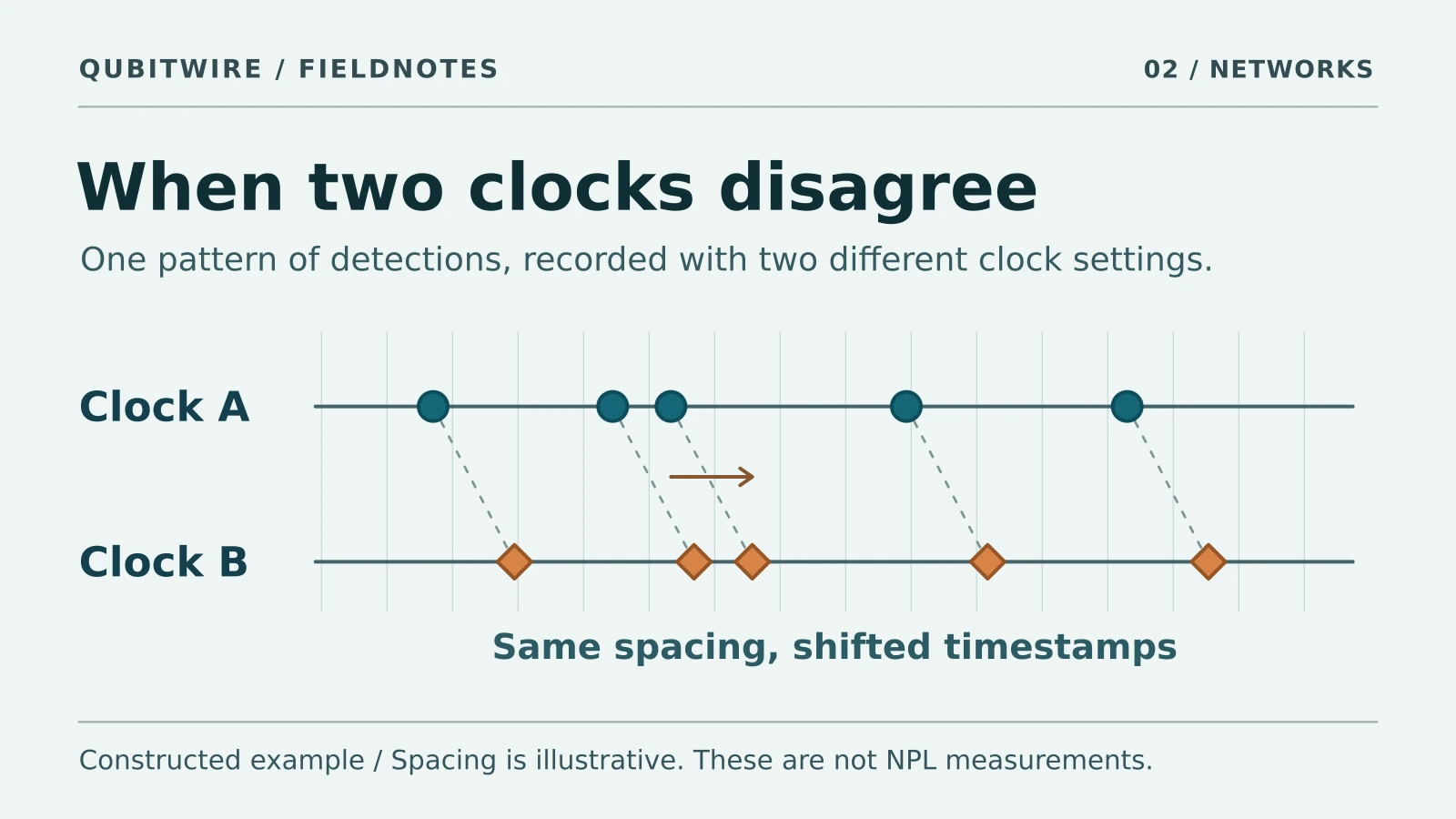
Imagine one clock is three ticks ahead. A short series of arrivals logged at ticks 2, 7 and 11 on one clock could appear at 5, 10 and 14 on the other. Subtracting three lines up all three timestamps. Those are invented numbers, with travel time held equal.[2][3]
In a real link, light can take longer along one route. A change in the fiber’s temperature can also change its travel time. Either effect can shift the recorded arrivals even when the clocks keep perfect time.[2][3]
Match the detector clicks
In this example, three known pairs each produce one click at detector A and one at detector B. Clock B starts three ticks ahead. Change its timestamps to make each diamond sit directly below its matching circle.
0 of 3 events line up. The spacing already agrees. Slide B’s series to the left to remove its three-tick lead.
Read the timestamps as numbers
| Detector record | Click 1 | Click 2 | Click 3 |
|---|---|---|---|
| A | 2 | 7 | 11 |
| B as logged | 5 | 10 | 14 |
| B after your shift | 5 | 10 | 14 |
Without drift, subtracting three turns B’s 5, 10 and 14 into A’s 2, 7 and 11. This example holds light-travel times equal. On real fiber, unequal paths can shift arrival times even when clocks agree. These constructed ticks are independent of the NPL measurements. Matching timestamps alone cannot establish entanglement.
A timing correction lets researchers look for detections that could belong together. Establishing entanglement takes a different measurement. In one published energy-time experiment, researchers changed the settings of optical instruments and measured how the number of paired detections rose and fell. That pattern carried information that a list of matching timestamps alone could never supply. NPL’s announcement does not identify the test its own researchers used.[1][4]
What the UK result tells us
The British team ran its network between instruments in separate laboratories. Its announcement gives the scale of the synchronization but leaves out the fiber lengths, the observation time and a numerical uncertainty. Those details would make it possible to ask a more demanding question. Once the clocks line up, how long can the network keep finding the right detections as the fiber changes?[1][2][3]