
Oak Ridge’s quantum compiler keeps error-correction costs in view
A new preprint connects program translation to hardware estimates. In one small example, supporting hardware accounts for five-sixths of the modeled qubit footprint.
Reading tools for text size, copying, printing and your reading list
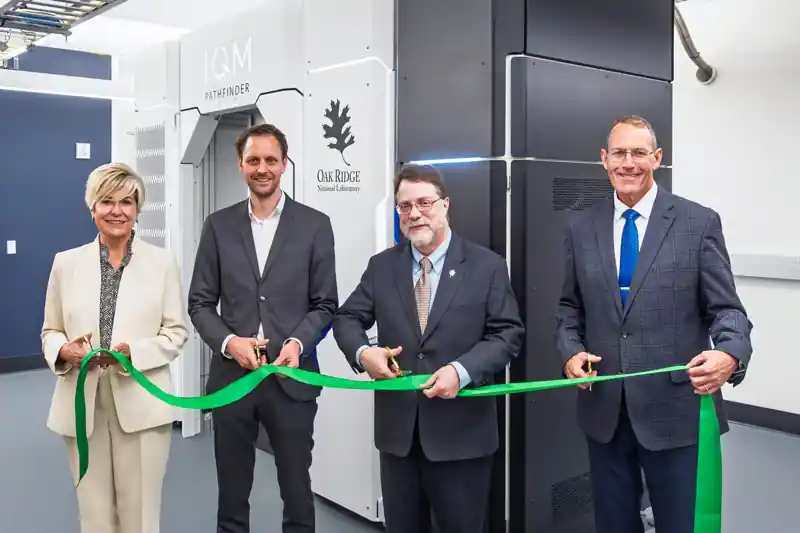
Oak Ridge National Laboratory researchers have described a quantum compiler that keeps track of choices as it translates a program toward machine instructions. The aim is practical: make it harder for software to lose sight of the supporting hardware a protected quantum calculation needs.[1]
Their November 9 preprint illustrates the problem with a three-qubit quantum Fourier transform, a building block used in quantum algorithms. Under the paper’s chosen resource model, the encoded calculation needs 39 , while a supporting “magic-state factory” needs another 195. That is an estimate, not a 234-qubit computation performed on a machine.[1]
A is information protected by spreading it across physical qubits. The compiler’s example uses the Steane error-correcting code, budgeting seven data qubits and six helpers for each logical qubit. Three such blocks therefore require 3 × 13 = 39 physical qubits.[1]
Some quantum operations also need specially prepared states. A magic-state factory is the supporting circuit that produces those states. In this model, one factory uses 15 encoded blocks: 15 × 13 = 195 physical qubits. It is reused to supply the program’s six required states, rather than counting six separate factories.[1]
QubitWire’s calculation from those inputs puts the factory at 195 ÷ 234, or about 83% of the combined peak footprint. The important lesson is not that every three-qubit program needs this hardware. It is that counting the protected algorithm alone can miss most of the modeled machinery around it.
The compiler carries information about the chosen code through successive translations, checks for incompatible operations and supports multiple output formats. That lets resource accounting stay connected to the program being transformed. It does not introduce a new error-correcting code.[1]
The team also tested small encoded circuits on Oak Ridge’s 20-qubit IQM Pathfinder. In one 512-shot identity experiment, classical decoding reduced logical readout error from 20.7% to 6.2%. This was a small hardware test of the pipeline, not a full fault-tolerant algorithm or a comparison against an unencoded baseline.[1]
For planners, the next question is how space trades against time. The factory estimate counts peak qubits but does not include a complete accounting of preparation, failed attempts or operating time. Adding that scheduling detail, and testing larger programs, would make the compiler more useful for deciding what a future machine must actually provide.[1]
Keep your reading trail
Keep up with these topics
Explore the subjects covered in this story.