
A quantum shortcut saved in one place—and cost more overall
A new IonQ–Classiq analysis shows why optimizing one part of a proposed quantum computation can make its total hardware demand worse.
Reading tools for text size, copying, printing and your reading list
A quantum calculation can improve on one scorecard while becoming more demanding overall. In a November 4 technical analysis, IonQ and Classiq researchers describe a modeled example that used 3% fewer T states—resources for a particular quantum operation—yet needed 41% more physical hardware-time (called physical spacetime volume in the source) than a different compilation of the same program. These are estimates for a proposed fault-tolerant computation: a saving in one operation can create a larger demand elsewhere.[1]
The machine stays occupied between operations
To understand the issue, imagine reserving workshop benches. Ten benches for two hours and five benches for four hours both use twenty bench-hours. Neither arrangement is automatically better: one needs more space, the other more time. This is an invented everyday example, not a model of the reported resource comparison. Its purpose is to show why a resource total needs both dimensions.
A quantum resource estimate can likewise count how much physical hardware remains occupied as the calculation proceeds. Protected information needs , and that information may have to wait while another operation finishes. Researchers also have to arrange where operations happen and how the necessary interactions are carried out. Changing the sequence can change the wider demand. The TACO research on compiler and architecture design examines this scheduling and routing problem explicitly.[2]
One program, different priorities
The company example starts from one Grover-style program and produces alternative circuits. Its comparison is between a circuit optimized for T/Rz cost and one optimized for depth, under a transversal fault-tolerance model. It is not a comparison of machines from different manufacturers.[1]
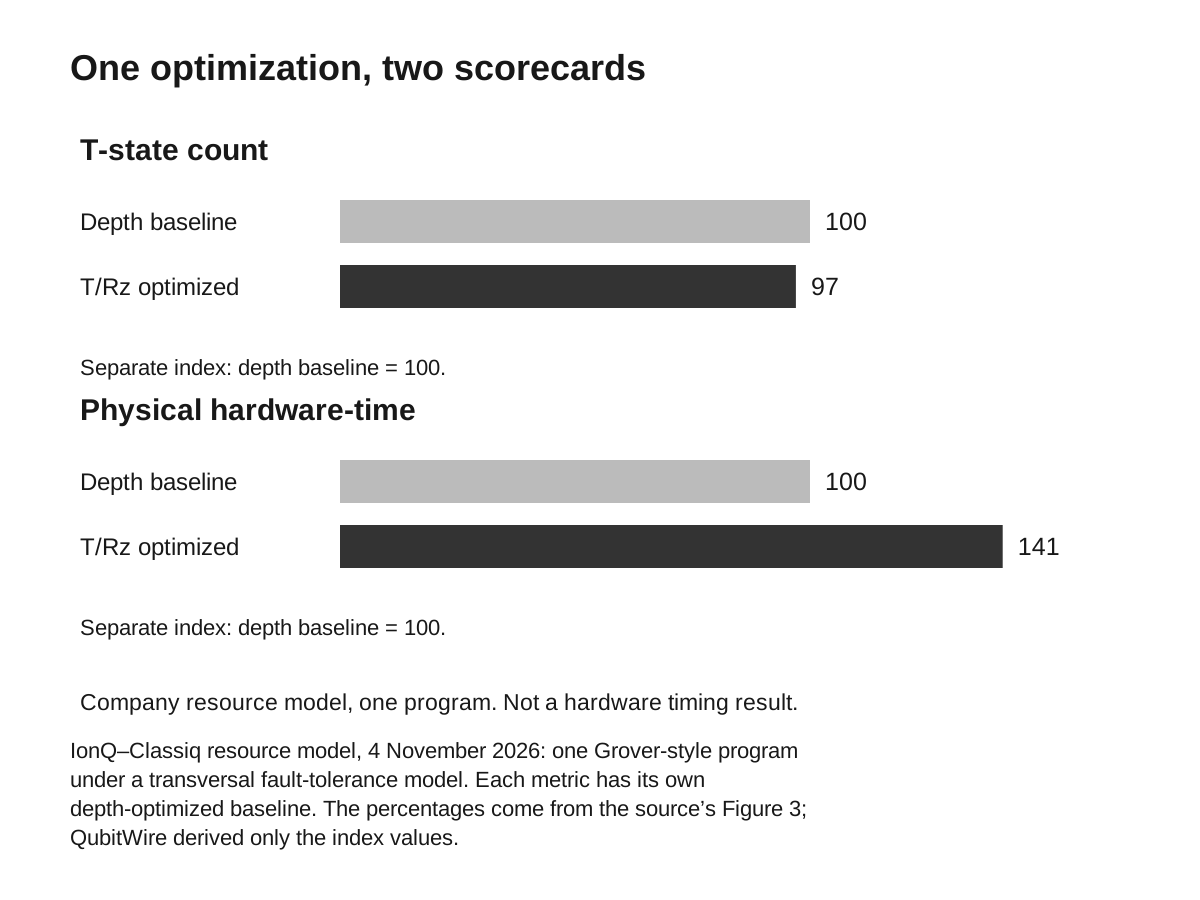
The chart below sets each baseline to 100 separately. The T/Rz-optimized circuit has a T-state index of 97 and a physical hardware-time index of 141, compared with 100 for each metric in the depth-optimized circuit. The two metrics have different units; their bars cannot be added together. Neither is a price in dollars, an electricity bill, or an absolute qubit count.[1]
The chart as a table
Two measures, two separate baselines
Each row sets the depth-optimized circuit to 100. The T/Rz-optimized circuit uses fewer T states but more physical hardware-time, called physical spacetime volume in the source.
| Resource measure | Depth baseline | T/Rz optimized |
|---|---|---|
| T-state count | 100 | 97 (3% fewer) |
| Physical hardware-time | 100 | 141 (41% more) |
These are two independently normalized indices, so they cannot be added together. The comparison models one Grover-style program under a transversal fault-tolerance model. It is a company resource estimate, not measured hardware performance, a dollar cost or an absolute qubit count. QubitWire calculated the indices from the reported percentage changes.
Read IonQ and Classiq’s analysis and Figure 3 · November 4, 2026
Why researchers count these operations
Fault-tolerant computing aims to keep useful quantum information protected while a calculation runs. Some operations need additional specially prepared quantum states. Work on magic-state cultivation explores ways to prepare those states with lower overhead under specified noise assumptions. When one part becomes less demanding, the parts that were previously less prominent deserve another look.[3]
That observation does not identify a universal best architecture. A factory that excels at producing one resource might still be the right choice for a workload that needs a great deal of it. Another workload might spend more of its time moving or preserving information. The useful question is which arrangement serves the same task at the same required accuracy.
A result readers can ask someone to reproduce
QubitWire has not independently rerun the company comparison. We did not find a complete reproduction package for this example in the material reviewed. That limits the claim to an attributed illustration. The broader research agenda is well established: the Grand Challenge of Quantum Applications framework asks researchers to connect concrete problems, algorithms and resource requirements.[1][4]
A useful comparison would publish the program, accuracy target, hardware assumptions, compiler settings and schedule, then allow another team to repeat the calculation. It should also show which choice wins when an important assumption changes. That would reveal whether the result is robust or depends on a narrow operating point.
For the next claim about a cheaper quantum computation, ask one extra question: cheaper after counting what? The answer should connect the appealing headline number to the work the complete machine would need to do.