
A quantum vision experiment changes what happens before the camera
Oxford researchers trained an optical measurement to recognize known patterns. Its striking error reduction comes with a major optical-loss caveat.
Reading tools for text size, copying, printing and your reading list

A camera normally records a picture before software decides what it shows. Oxford physicists have tested a different approach: train the optical measurement itself to make a particular recognition task easier, before the light reaches the detector.[1]
Their November 6 preprint reports an optical experiment that distinguishes known patterns using limited photon information. It is a quantum-measurement study, not a quantum computer, and not yet a demonstration that an everyday camera can recognize unfamiliar objects better in the dark.[1][2]
The distinction matters because a recognition system does not always need a beautiful picture. If its job is to choose between known possibilities, an optical transformation can emphasize the features that help make that decision rather than preserve the original image.[1]
Train the measurement, not just the software
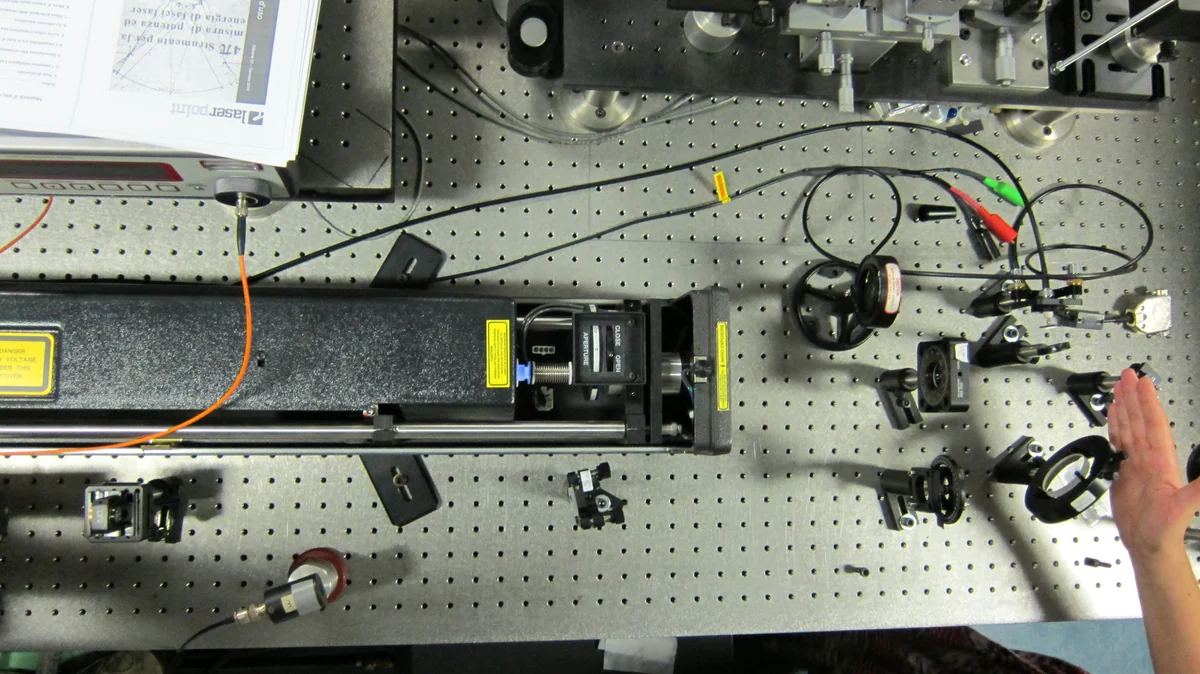
The team encoded pictures onto coherent laser light, then sent it through four trained layers implemented with a programmable spatial light modulator and a mirror. These layers change the optical field before a camera measures it. A computer-based digital twin was used to train the settings offline. The apparatus was not photographing real clothes or animals.[1]
The researchers compared two training goals. One asks for the best decision from a single photon. The other asks how rapidly mistakes should fall as evidence accumulates from more photons. The best measurement for the first goal was not generally the best for the second.[1]
On ten known Fashion-MNIST clothing categories, the second approach produced a reported tenfold lower error at 500 sampled photons than direct imaging. That result used photon samples drawn from camera distributions measured with bright light, under a noiseless-detection model. It was not a direct 500-photon low-light camera measurement, and tenfold lower error does not mean tenfold higher accuracy.[1]
The light the comparison leaves out
A crucial engineering cost sits alongside that result. The prototype’s four modulator bounces lost roughly 20 decibels of light, and the authors excluded that implementation-specific loss from their reported photon budget. They argue manufactured fixed phase plates could avoid it; that replacement is not demonstrated in this experiment.[1]
Twenty decibels of attenuation means only 1% of the optical power survives that loss: a hundredfold reduction. This is QubitWire’s conversion of the reported decibel value, before other losses. The classification result therefore cannot be read as a demonstrated end-to-end photon or energy saving in the present prototype.
Not all losses were ignored. The analysis accounts for other scattering introduced by the trained optical transformation. In one binary test, the better-performing measurement scattered more light, yet still distinguished the classes more effectively. Light that carries the same information for both choices may be less useful than a smaller amount that separates them.[1]
A second test confronts detector noise
A separate experiment did use genuine photon-counting detection. The researchers tested deliberately difficult cat-versus-dog patterns with an electron-multiplying camera, accumulating many low-light frames. The pattern sets were chosen so direct intensity imaging would have difficulty telling the two classes apart.[1]
The detector generated about 10,000 false clicks per detected signal photon, largely because reading the sensor creates unwanted charge. These are spurious detector counts, not 10,000 incoming background photons. Training that included this noise concentrated the useful light into a smaller region. Under those test conditions, direct imaging did not perform significantly better than guessing.[1]
The broader lesson is that a measurement can be optimized for the question being asked. It need not first create a conventional image and leave every decision to software. That is a concrete connection between quantum measurement theory and visual inference, rather than a claim that this apparatus accelerates general-purpose computing.
The experiment concerns known sets of patterns encoded in coherent laser light. Recognizing unseen objects, handling ordinary partially coherent or incoherent scenes, and replacing the lossy prototype optics remain separate challenges. Microscopy and astronomy motivate the research; neither is a demonstrated deployment here.[1]
The most useful next result would combine a lower-loss physical implementation with a complete input-photon budget and tests on unfamiliar examples. Until then, the achievement is a trained measurement that extracts task-relevant evidence in a controlled experiment, with an explicit boundary between that result and a practical low-light camera.[1]