
A quantum chip helped forecast fluid flow. The comparison still matters.
A new hardware experiment improves a specific prediction pipeline. Its strongest lesson is how to separate a useful quantum feature from a proven practical advantage.
Reading tools for text size, copying, printing and your reading list
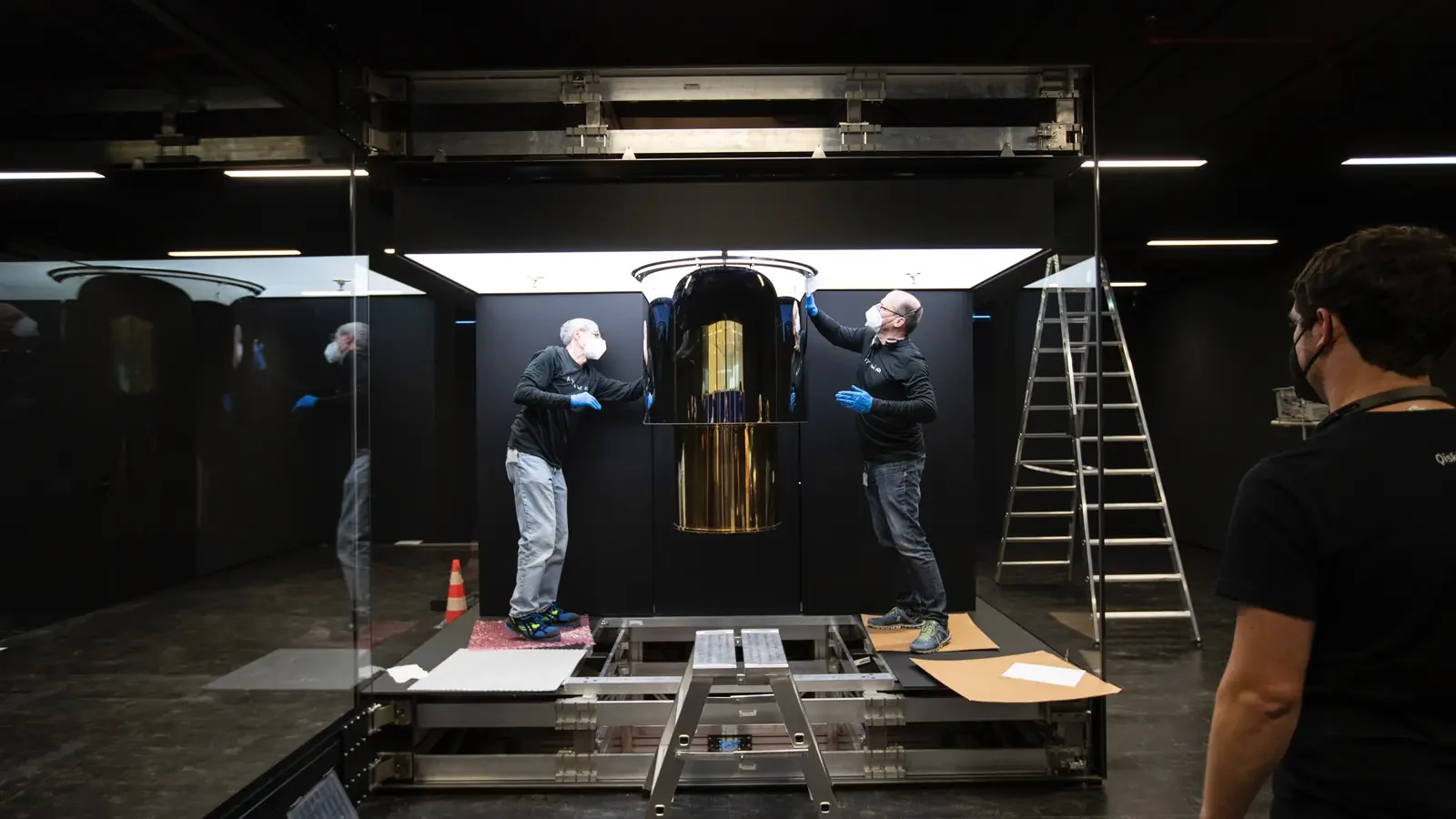

A quantum processor has helped predict the changing flow around a cylinder in a new research demonstration. The result is a useful step toward testing quantum tools on engineering data, but it does not show that quantum computers can solve fluid problems faster than ordinary computers.[1]
The November 7 preprint reports experiments using 26 and 52 on IBM hardware. Instead of replacing a conventional simulation, the quantum circuit supplies extra patterns to a prediction system that also relies heavily on classical machine learning. The work has not been peer reviewed.[1][2]
For the cylinder experiment, adding those quantum-derived features reduced the reported prediction error from 0.121 to 0.081 on the authors’ normalized error scale, about one-third. The comparison is with the same compressed-data linear predictor without those features, not with the best available classical forecasting system.[1]
There is another important qualification: the supplementary methods select several prediction settings using test-set error. That means the reported scores are not a clean final test on data untouched by model selection. They are evidence about this experimental pipeline, not a settled estimate of how well it will generalize.[3]
What the quantum chip actually does
The cylinder dataset begins with a conventional OpenFOAM simulation on 33,824 cells. Those cells form an irregular mesh that follows the shape of the problem. A classical neural network compresses each snapshot into a much smaller set of numbers before it reaches the quantum circuit.[1][3]
The circuit acts as a reservoir: it transforms a sequence of inputs into additional measurable features. Its operations are fixed rather than trained through repeated quantum optimization. A classical readout learns how to combine the features and reconstruct a prediction. This is a hybrid forecasting method, not a quantum solution of the governing equations from scratch.[1]
The researchers also tested a reaction–diffusion model, in which two interacting chemical concentrations form changing patterns. Its reported error fell from 0.225 to 0.133, about 41%, against the same kind of linear baseline. Both 26- and 52-qubit hardware runs returned that rounded score, so the table does not establish an accuracy gain from doubling the qubit count.[1]
A useful way to read these results is to separate three questions: can the circuit run on real hardware, do its features help this particular predictor, and does the complete method beat the strongest practical alternative? The experiment addresses the first two. The third requires a different comparison.
Why the large speedup number is not the headline
The paper reports that executing some 26-qubit circuits on the quantum processor was roughly 1,800 to 3,300 times faster than exactly simulating those same circuits on one NVIDIA H100 GPU. That is not a speedup over a classical fluid solver. The authors explicitly say classical PDE solvers would likely be faster and more accurate on these problems.[1]
The timing table also excludes quantum-machine queueing. It compares circuit execution, not the complete job of creating training data, compressing it, choosing model settings and producing a useful engineering answer. Simulating a quantum circuit is a different task from finding the best non-quantum way to forecast a flow.[1]
The hardware uses repeated measurement and reset of part of the circuit to maintain a fading memory of recent inputs. That lets the overall computation continue beyond individual qubits’ coherence times. It is not a demonstration of fault-tolerant memory or an unknown quantum state preserved indefinitely.[1]
The test that would make the result stronger
The supplement describes randomly partitioned snapshots for training and evaluating the classical compression models, as well as test-error selection for readout settings. An independent assessment should use a separate validation stage for those choices and reserve genuinely untouched sequences for the final comparison.[3]
That comparison should include strong nonlinear classical predictors on the same compressed data, with matched tuning effort and complete time and resource costs. The authors identify broader classical comparisons as future work. Their source code is available, but QubitWire has not independently reproduced the experiments.[1][4]
For engineers, the promising development is specific: a noisy quantum processor can contribute useful features inside a fluid-forecasting experiment. Whether those features earn their cost in a real workflow remains the next question, rather than an achievement this paper already establishes.[1]