
Skip to content
HARDWARE · QUANTUM HARDWARE · PROTECTED QUBITS

A qubit redesign targets the noise left behind by built-in protection

New simulations extend a March experiment, outlining a possible redesign rather than demonstrating longer-lived hardware.

Published Updated Source report Sources checked
Reading tools for text size, copying, printing and your reading list
My reading list
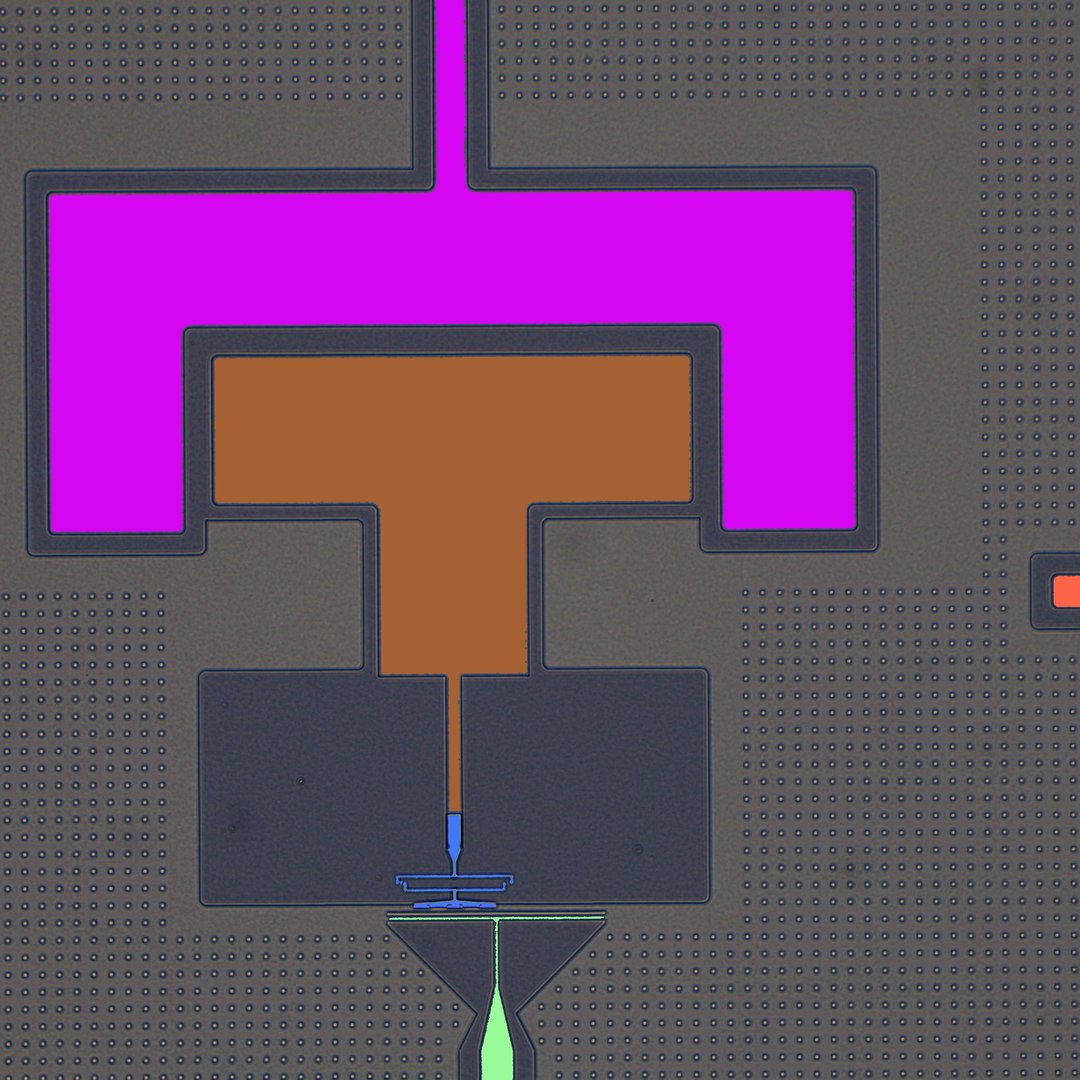
False-color optical micrograph of the fabricated transmon, with its central island colored brown.
The fabricated transmon in the team’s study. The proposed changes to reduce flux-noise sensitivity were evaluated in simulations.Erwan Roverc’h et al.

A Paris-led team simulated a redesign of a that is already built to limit dielectric loss, the leakage of energy into insulating materials. The proposed design would also make the qubit less sensitive to changes in the magnetic field threading its circuit. The study tested the redesign in simulations.[1][2]

The November 12 preprint revision builds on an experiment first posted in March. That earlier version already reported control and single-shot readout of a qubit whose circuit symmetry suppresses coupling to one loss channel. Its energy-relaxation time, measuring how long its excitation energy survives, was about 70 microseconds. Its echo coherence time, measuring phase-information survival after a refocusing sequence, was about 2.5 microseconds. Magnetic-flux noise remained a bottleneck.[1][2]

What is new is a simulated route beyond that bottleneck, not a new experimental lifetime. The researchers use an existing circuit model to explore larger inductances, adjusting other circuit parameters to preserve important transition frequencies and protection against dielectric loss. Their calculations identify a regime in which a trade-off suggested by a simpler model need not apply.[1][2]

Using the present device’s noise level, the proposed redesign has a predicted flux-noise-limited relaxation time of 2.7 milliseconds and an echo time of 99 microseconds. Those are modeled limits associated with flux noise, not measured total performance. A separate, more optimistic scenario assumes lower noise as well as the redesign.[1]

Other effects could intervene first. Readout interactions and other circuit losses are not fully accounted for; controlling and reading a protected qubit also remain challenges. Suppressing one failure channel does not establish protection against every error or a working error-corrected processor.[1]

The next useful hardware test would check whether the redesigned circuit retains its charge protection, then compare measured relaxation and coherence with predictions based on its actual noise. That would reveal whether the proposed improvement survives in a real device, or simply uncovers another limiting mechanism.[1]

Keep your reading trail

Evidence & context

3 linked sources

Revised preprint: new redesign simulations extend earlier measurements, not a demonstrated hardware improvement.

How to read the evidence and dates

An announcement records what an organization stated. An experiment reports an observation. A simulation or resource estimate depends on its assumptions. QubitWire’s analysis connects these sources; the labels are not quality scores.

Published is the article’s first QubitWire publication. Updated marks a substantive content change. Sources checked records a review of the underlying evidence. An older paper can support a new explanation, and another press release about the same work is not independent replication.

For material corrections, check the article’s context note and source trail. A routine formatting or link change does not create a new scientific result.

QubitWire take

Protection against one loss mechanism must be tested against the remaining noise and readout limitations.

Sources

  1. November revision: Experimental realization of a cos(2φ) transmon qubit

    November 12, 2026 preprint revision, section VIII and Figure 6. The redesign and flux-noise limits are simulations; no redesigned-device measurement or associated journal publication is established.

  2. March original version

    March 13 original experiment. Its measured relaxation and echo values predate the new revision; the existing circuit model is not itself the new result.

  3. Canonical submission and revision history

    Version history: March 13 v1 and November 12, 2026 at 13:35:48 UTC v2; no later revision identified.

READ NEXT

Continue exploring

All Hardware stories
  1. Quantum hardware / Superconducting circuits

    A removable neon coating could help clean superconducting-chip surfaces

    A November preprint provides fuller evidence for a previously reported resonator effect, including second-chip results and surface microscopy.

    Published · Source report · Sources checked · About 2 min read
  2. Quantum manufacturing

    Why Matching Quantum Chips Can Still Behave Differently

    A blinded study points to nanoscale oxide and etching differences as clues to uneven qubit lifetimes.

    Published · Source report · Sources checked · About 3 min read