
China’s Qianzhen quantum prototype aims to link machines
A new neutral-atom prototype puts interconnection at the center of its design. The next test is what linked machines can actually do together.
Reading tools for text size, copying, printing and your reading list
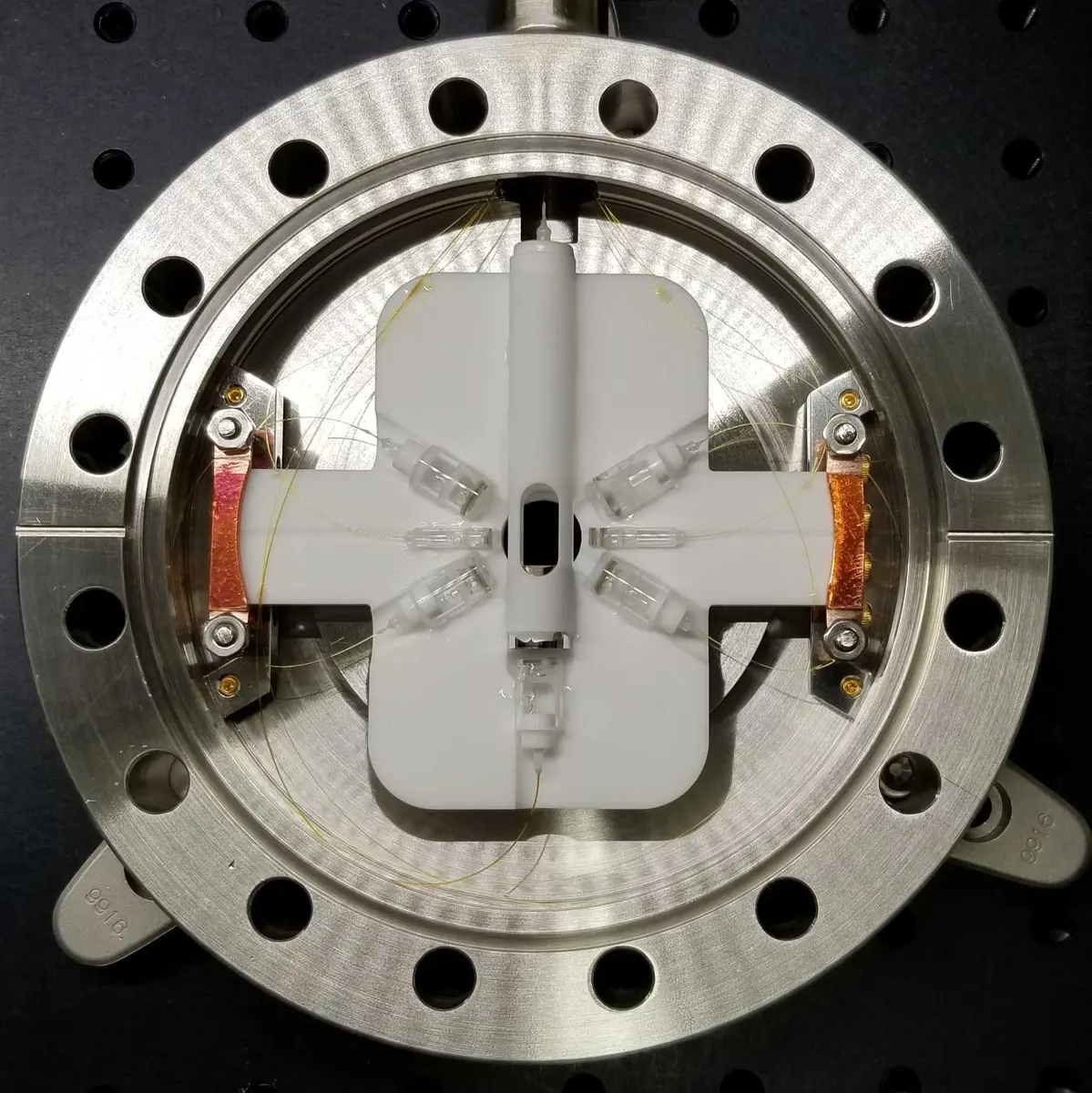
Hefei Qianyuan Quantum Technology unveiled a neutral-atom quantum-computer prototype called Qianzhen in Hefei on November 8. Its ambition extends beyond making one machine larger: the company wants multiple machines to work together.[1]
According to China News Service’s launch report, chairman Li Gang said interconnection was incorporated into the prototype’s architecture from the outset. He described future validation and demonstrations for research and industry users. A joint laboratory with Shanxi University was also inaugurated, with work planned on atom arrays, interconnection interfaces and optical components.[1]
This is a prototype announcement. The launch account does not supply measured inter-machine operation accuracy or a demonstrated application advantage. It should not be read as public evidence that a useful computation has already run across a network of Qianzhen machines.[1]
Why the connection matters
Neutral-atom processors use electrically neutral atoms as carriers of quantum information. Arrays of tightly focused light can hold the atoms in place. The attraction of linking processors is that growth need not depend only on fitting more of these carriers into a single machine.[1]
Ordinary data centers expand by connecting computers. Quantum processors face a more demanding version of that task: a link intended to support operations across processors must preserve the quantum resources those operations require. Simply sending ordinary instructions to two separate machines does not turn them into one larger quantum processor.[2]
A useful comparison comes from Oxford’s February 2025 research using a different technology, trapped ions. There, researchers used optical links to establish between modules and perform quantum operations across them. Entanglement is a shared quantum relationship between systems; in this experiment it enabled operations involving separate modules.[2]
That experiment illustrates the kind of demonstrated behavior that separates distributed quantum computation from an architectural intention. It does not validate Qianzhen’s implementation, and results from trapped ions cannot simply be assigned to a neutral-atom machine.
Imagine two processors that each complete a separate job and return their answers to an ordinary computer. Coordinating those jobs can be useful. It is a different capability from carrying out a quantum operation that involves information held in both processors. A credible demonstration needs to make clear which of those tasks occurred.
For readers following the race to scale quantum computing, the interesting question is therefore not only how many atoms a machine contains. It is what two machines can reliably accomplish together.
The roadmap predates the unveiling
Qianyuan’s investor Zhongying described the company’s modular ambitions in an October 28 announcement. It identified separate product lines for components, individual processors and multi-machine systems, and said funding would support engineering and development. The November launch should not be mistaken for the first disclosure of that entire strategy.[3]
Nor should a prototype be confused with a fault-tolerant computer, a system able to keep useful calculations running despite its components making errors. Building a link, making it accurate and using it in a reliable computation are related engineering problems, but they are not the same milestone.
The next evidence worth watching is specific: a documented experiment linking processors, the accuracy and rate of their shared operations, and a computation that actually uses the connection. These are editorial criteria for evaluating progress, not results reported at this launch.
Accuracy matters because a connection that introduces too many errors can undermine the work it enables. Rate matters because processors may need to wait for a shared operation. The relevant account includes those costs rather than treating a physical connection as free additional computing power.
Qianzhen adds another entrant to the effort to scale quantum machines through interconnection. Its significance will become clearer when the engineering promise is accompanied by measurements outsiders can examine.
Keep your reading trail
Keep up with these topics
Explore the subjects covered in this story.