
Quantinuum Finalizes a $100 Million CHIPS Research Award
The federal agreement targets ion-trap manufacturing and optical components, not a finished fault-tolerant computer.
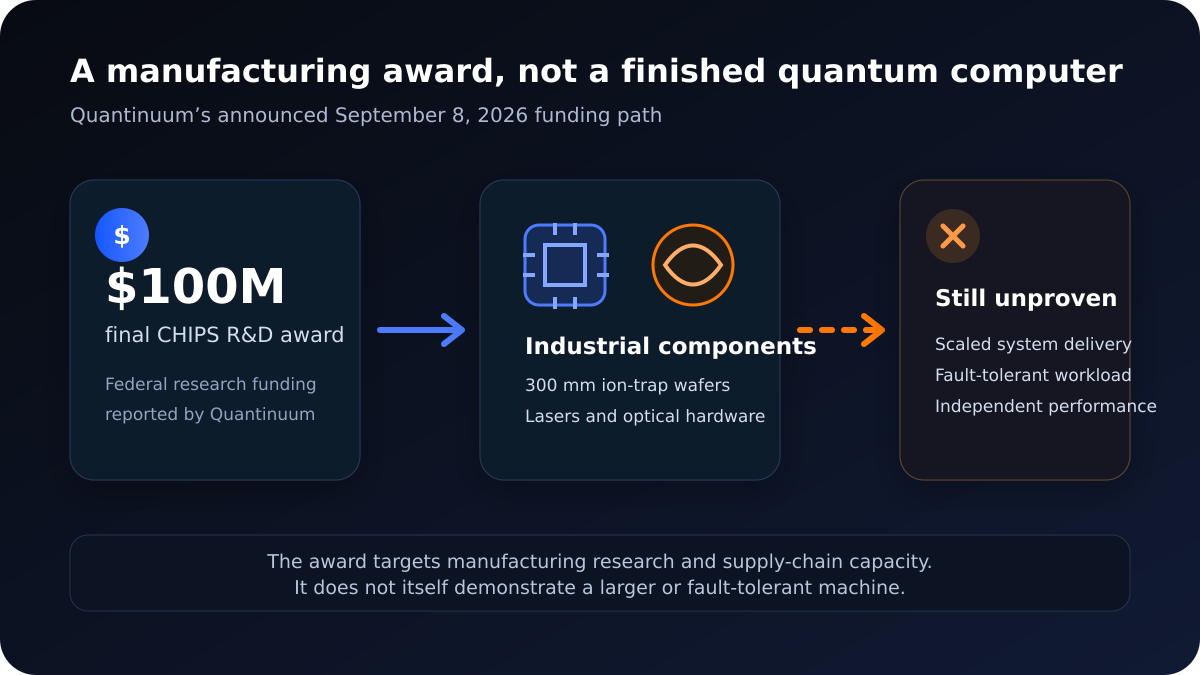
Quantinuum says it finalized a $100 million agreement with the U.S. Department of Commerce's CHIPS Research and Development Office. The September 8 announcement turns a May letter of intent into a final award aimed at manufacturing research for trapped-ion quantum computers. Trapped-ion machines hold charged atoms in carefully controlled electromagnetic traps. Scaling them also requires repeatable trap fabrication, control electronics, lasers and optical components. Funding those less-visible parts could make future systems easier to build consistently rather than as collections of specialized laboratory equipment.
The company says GlobalFoundries will fabricate next-generation ion traps and electronics with a focus on 300 mm wafers, a standard semiconductor-manufacturing format. Monarch Quantum is expected to develop lasers and optical components. NIST says the broader CHIPS research office supports the domestic semiconductor research ecosystem.
The award is a funding and supply-chain milestone, not a hardware benchmark. Quantinuum's release provides no new count, error rate, delivered machine or demonstrated fault-tolerant workload. The specific agreement is described by the company; the reviewed NIST overview confirms the program's role but does not independently list Quantinuum's award.
Useful follow-through will be manufactured components, integration results and measured system performance. Until those appear, the clearest claim is narrower: federal money is backing a U.S. production path for critical trapped-ion hardware, while the larger fault-tolerant computer remains to be demonstrated.