
When quantum observers can disagree
A recent study maps the limits of agreement.
Reading tools for text size, copying, printing and your reading list
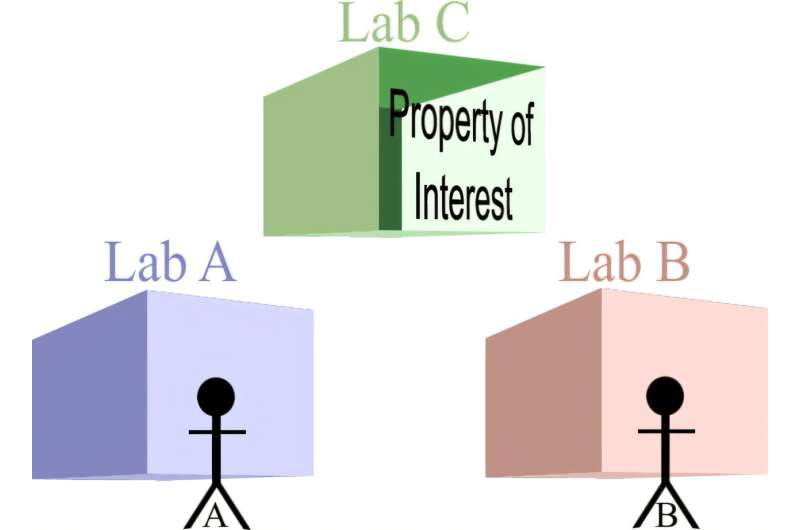
Two quantum observers can assign different probabilities without either making a calculation error. A theoretical study published online in PNAS on November 12 maps when that disagreement is possible. The work first appeared as a 2025 preprint.[1][2]
The model uses three finite-dimensional systems and local projective measurements. Both observers start from the same quantum state. Their mutual awareness is formalized as common certainty: certainty about each other’s assessments, repeated through every level.[1]
Under common certainty, when the measurements and the property being assessed commute, meaning their mathematical order can be swapped, agreement follows. A constructed example allows disagreement when one measurement does not commute with that property. The observers’ measurements still commute with each other; quantum coherence makes their conditional assessments differ.[1]
Recording outcomes in a classical register removes the relevant coherence in that example and restores agreement. The disagreement model omits observers’ beliefs about measurement order. These are mathematical results under specified information assumptions, not experimental findings.[1]