
Skip to content
RESEARCH · QUANTUM RESEARCH

Two quantum dots steer light left or right on a chip

A newly published experiment shows a way to control where a quantum light source sends its photons.

Published Source report Sources checked
Reading tools for text size, copying, printing and your reading list
My reading list
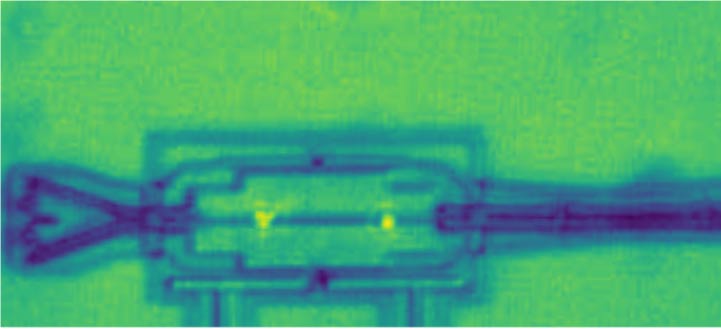
Optical microscope image of the patterned device, with two bright excitation beam spots.
Optical device image; excitation spots mark quantum-dot positions, not resolved dots. Figure 5(b), extracted without labels or scale bar.Clara Henke et al.

Two semiconductor quantum dots, 13 micrometers apart, can steer their light predominantly left or right along a microscopic channel. Researchers switch the preferred direction by changing the relative phase of the lasers exciting them.[1][2]

Local electric fields align the dots’ emission frequencies; the shared waveguide lets them interact. The experiment ran in a 4-kelvin cryostat and also observed correlated photon pairs.[1][2]

The PRX Quantum paper was published November 16 after an April preprint. Directional sources could help route light between quantum devices, but this was a two-emitter laboratory test, not a network router.[1][2]

Emission was imperfect. Stronger excitation and fluctuating emission frequencies limited directionality; proposals for larger arrays remain scaling analysis.[1][2]

Keep your reading trail

Evidence & context

2 linked sources

Peer-reviewed two-emitter laboratory experiment; network use prospective.

How to read the evidence and dates

An announcement records what an organization stated. An experiment reports an observation. A simulation or resource estimate depends on its assumptions. QubitWire’s analysis connects these sources; the labels are not quality scores.

Published is the article’s first QubitWire publication. Updated marks a substantive content change. Sources checked records a review of the underlying evidence. An older paper can support a new explanation, and another press release about the same work is not independent replication.

Sources

  1. Henke et al., PRX Quantum: directional and correlated optical emission

    Peer-reviewed publication November 16, 2026; two-emitter optical experiment.

  2. Full research manuscript and methods

    April 7 preprint; full device, measurement and scaling methods.

READ NEXT

Continue exploring

All Research stories
  1. Explore chip components

    For Quantum Light, Matching Matters as Much as Making Photons

    A cavity changes how a quantum dot releases light, improving photon interference while separating the useful signal from the excitation laser.

    Published · Source report · Sources checked · About 3 min read
  2. Explore chip components

    HRL Demonstrates Digital Cryogenic Control of a Silicon Quantum Chip

    A Nature study combines a 4-kelvin controller, ribbon-cable interconnect and millikelvin silicon quantum-dot processor.

    Published · Source report · About 1 min read