
A Majorana qubit responds to control, but protection is still unproven
QuTech researchers made a qubit encoded in four Majorana modes oscillate on command. The peer-reviewed result is a test of control, not proof of a fault-tolerant qubit.
Reading tools for text size, copying, printing and your reading list
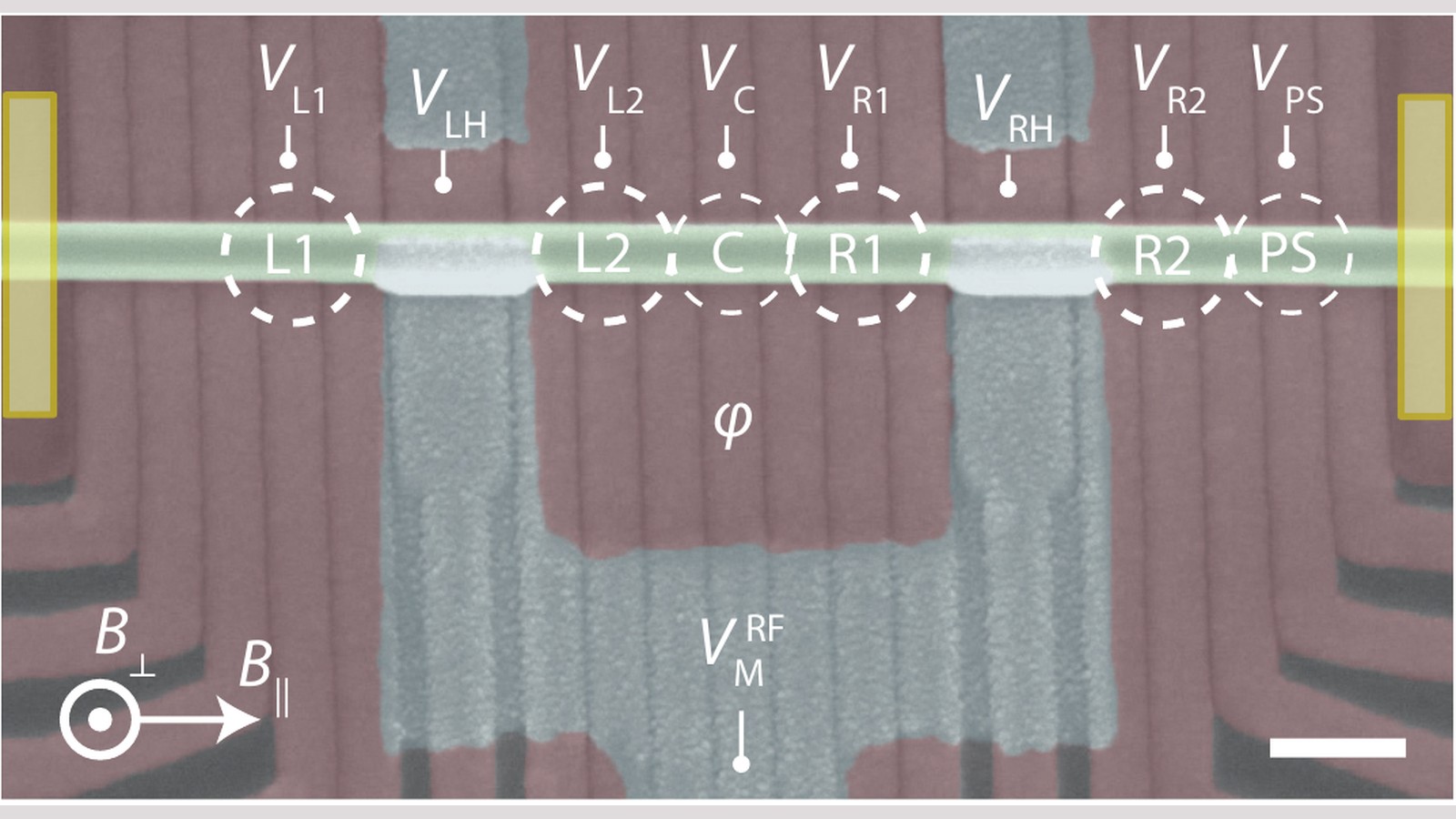
Researchers at QuTech in Delft have taken a device that showed signs of Majorana modes and used those modes to control a . They applied electrical pulses and watched the device move back and forth between two states in a predictable rhythm. The group first reported the experiment in a July preprint; Nature published the peer-reviewed paper on November 25. It answers whether the team can manipulate this encoding in time, not whether it can keep errors away.[1][2][3]
The bit is stored in a relationship
Here a Majorana is not a particle discovered flying through a detector. It is a pattern of quantum behavior that can form inside a device that combines a semiconductor with a superconductor. The Delft experiment used two short chains, each with two quantum dots, tiny regions where the motion of electrons is confined. Four Majorana modes, two in each chain, give the researchers a way to store one qubit across the device.[1][2]
One way to understand the encoding is to distinguish an even count from an odd count, a property physicists call parity. If the total parity is even, the two chains can be even–even or odd–odd. Those are two different configurations with the same total parity. The researchers could pulse a connection between the chains to make the qubit evolve between those configurations while staying mostly inside that pair of states. A related test used configurations with odd total parity.[1][2]
What the rhythm shows
Reading the states and steering them are separate jobs. The group used an electrical circuit to tell which parity it measured before and after a control pulse. Varying the pulse duration then revealed a repeating change rather than just a one-time switch.[1][2]
At an operating point chosen to separate the Majorana modes, the two kinds of oscillation ran at about 113 and 118 million cycles per second. The point is not that the qubit runs at a particular clock speed. It is that these rates came within 5% of each other, consistent with the modes being largely isolated in the authors’ model. At a different setting, one fit found that the oscillation contrast decayed on a timescale of about 26 nanoseconds. That was a specific measurement under drive, not a universal lifetime for the device.[1][2]
The long-term appeal of this approach is that storing information across separated modes could make it harder for a local disturbance to corrupt it. The two-dot chains here are too short to demonstrate that kind of topological protection. The observation does not show reliable universal operations, braiding or an improving error rate as the chains grow. The next test is not simply whether a longer device also oscillates. It is whether it can hold and manipulate the same information with measurably less sensitivity to local noise.[1][2][3]