
Reshaping a trap made of light could keep an atom’s motion precise longer
A simulation found that adding a second pattern of light slowed the early loss of precision. The effect didn’t last indefinitely.
Reading tools for text size, copying, printing and your reading list
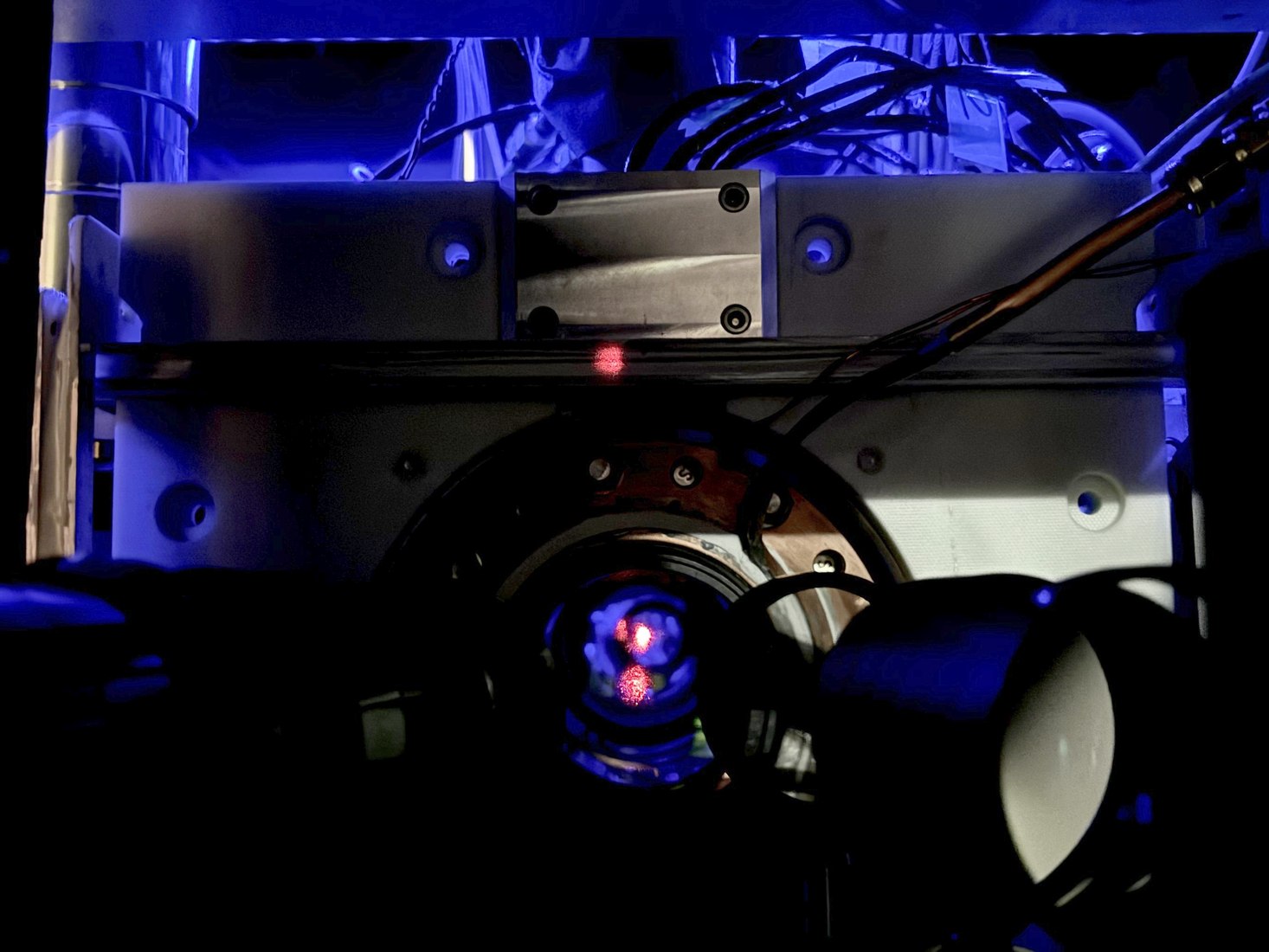
A lattice made of laser light can hold atoms in a row of tiny wells. A new study from researchers at National Taiwan University and Academia Sinica asks whether changing the shape of those wells can keep an atom’s motion more precisely defined for longer. In a one-dimensional model, adding a weaker pattern of light made the precision fade more slowly at first. That’s a prediction for a lab to test, not a performance gain measured on real atoms.[1]
The trick depends on what physicists call squeezing. Even if an atom is cold enough to sit in its lowest energy state, its position and momentum aren’t both perfectly sharp. Squeezing redistributes that uncertainty: for example, the spread in position can get smaller while the spread in momentum grows. As the atom moves, the direction in which the uncertainty is smallest changes. What the researchers wanted to preserve was the size of that advantage at its best moments, not to keep the atom perfectly still.[1]
Why the shape of the well matters
In an ideal spring-like trap, neighboring steps on the atom’s energy ladder are equally spaced. In a simple sinusoidal light trap they aren’t, so the motions associated with those steps drift out of rhythm. A weaker pattern with two or three times the spatial frequency brings two of the most important energy gaps closer together. It doesn’t need to be adjusted at each moment to chase the atom’s motion.[1]
In one comparison, the team started the shaped and ordinary traps with the same amount of squeezing and the same trap frequency. About 17 microseconds after the trap returned to its final setting in the two-change sequence, two versions of the shaped trap reached early peaks of about 4.3 and 4.1 decibels of squeezing, against about 2.4 for the ordinary trap. Higher means a greater reduction in the uncertainty being tracked. The comparison didn’t match laser power, and at later times the ordinary trap sometimes came out ahead.[1]
The experiment still has to happen
The model tracks one atom moving in one dimension. It leaves out effects that a lab would have to contend with, including the time it takes to switch the light, motion in other directions and the presence of other atoms. The team’s next proposed test would measure how position and momentum uncertainty evolve in a physical trap. That could show whether the extra early precision survives outside the simulation and lasts long enough to be useful.[1]