
A quantum experiment finds a molecular state protected by interference
RPTU researchers identify an unusual state in ultracold lithium. The same isolation that protects it also makes it harder to access.
Reading tools for text size, copying, printing and your reading list
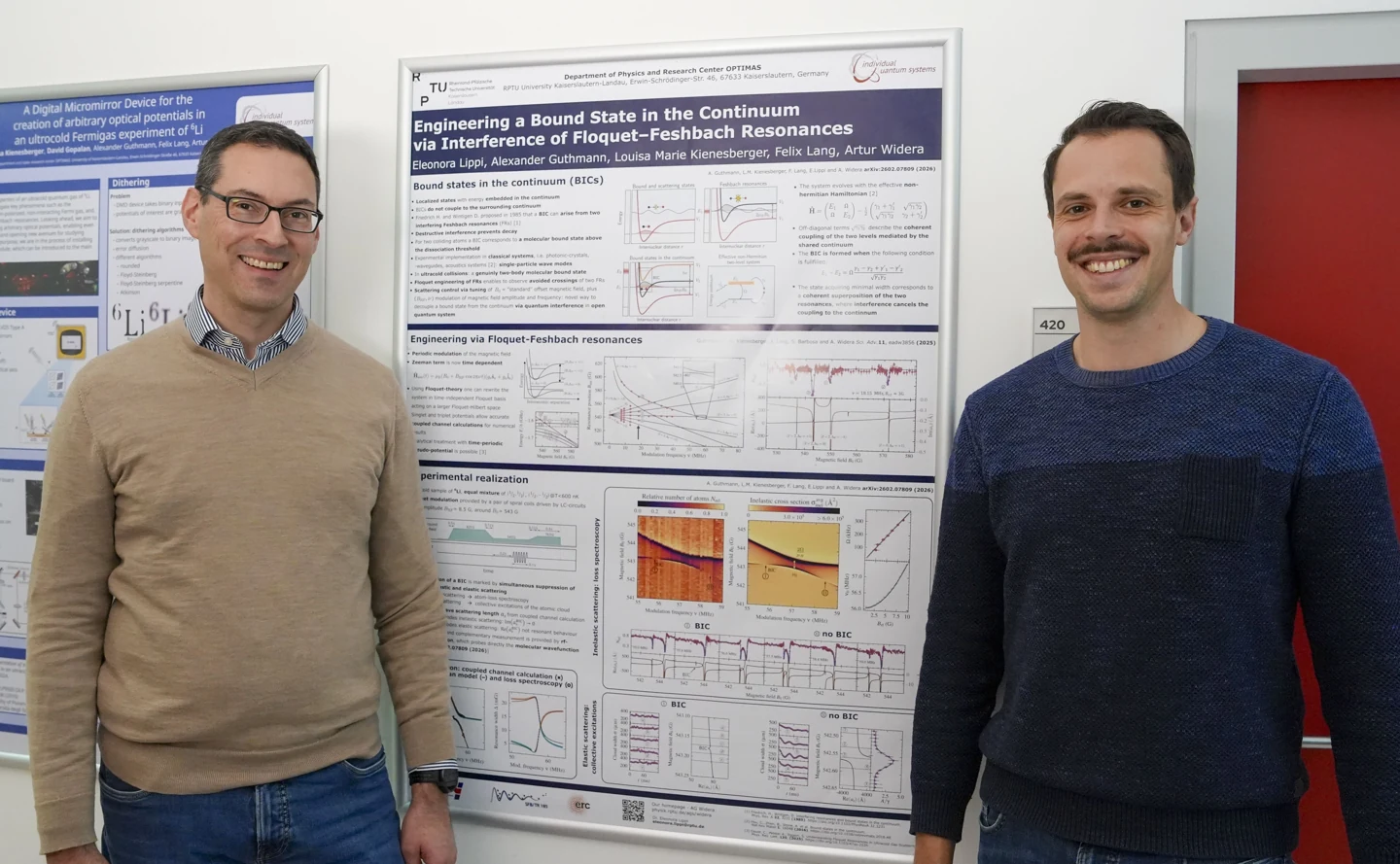
Researchers at RPTU University Kaiserslautern-Landau have reported evidence of a molecular state that remains bound even though its energy would normally allow the atoms to separate. Their study, published in Nature Physics on November 9, uses quantum interference to suppress the state’s connection to the surrounding scattering states.[1]
The evidence comes from how ultracold lithium atoms scatter, rather than a camera recording a molecule that refuses to break apart. Under carefully tuned conditions, resonant scattering features disappeared. That disappearance is the signature of a bound state becoming isolated from states in which the atoms can move apart.[1]
How interference supplies protection
A bound state ordinarily sits below the energy needed to separate its constituents. Above that threshold lies a range of possible states in which the atoms can move apart. Physicists call that range a continuum. A bound state in the continuum is an exception: it remains confined even though escape is energetically possible.[1]
In this experiment, contributions from two molecular resonances cancel through destructive interference. A resonance is a condition in which the atoms interact particularly strongly. Tuning the relationship between the two resonances suppresses the connection that would otherwise permit decay.[1]
The team used lithium atoms cooled to less than one millionth of a degree above absolute zero. Carefully controlled magnetic fields brought the resonances into the required relationship. Measurements of atom loss, the cloud’s response to a change in its trap, and radio-frequency spectroscopy supplied complementary evidence.[1][2]
A disappearing signal can be evidence
Why use several tests? The paper identifies two regions where atom losses are suppressed. In one, the cloud still responds with collective oscillations, showing that strong elastic interactions remain. In the other, that response disappears too. Reduced loss alone would therefore have been insufficient to identify the protected state. The combination of measurements distinguishes two situations that could look similar in a single test.[1]
The mechanism is called a Friedrich–Wintgen bound state in the continuum, following a 1985 theoretical proposal. The broader idea is older, and related effects have already been studied in optical and acoustic systems. This experiment concerns interacting atoms, rather than a wave confined by an optical structure.[1]
Protection also changes access
For quantum research, the significance is a controllable way to investigate how a system connects to its environment. Unwanted interactions can destroy quantum information, but this experiment does not establish a better processor. It reports no -memory benchmark, improved or result.[1]
At exact decoupling, the protected state cannot be populated directly from the surrounding scattering states. The protection therefore changes how researchers can reach it. Disappearing scattering features are evidence for the state, not a demonstration of a ready-to-use quantum memory. Preparing, controlling and reading such states would require further work.[1]
The November publication is a peer-review milestone rather than the first public account of the experiment. The team posted a preprint on February 8. QubitWire’s earlier coverage of electron waves confined inside a metal describes a different material and experiment; the shared idea of a bound state in the continuum does not make the two results interchangeable.[1][3]
The next useful evidence would show how these protected states can be prepared and used while preserving the interference that isolates them. The authors also propose investigating whether more complex driving fields can reduce the remaining resonance width. Those are research directions, not capabilities demonstrated by this report.[1]