
Skip to content
SECURITY · POST-QUANTUM CRYPTOGRAPHY

Saltgrain plans quantum-resistant rules that travel with encrypted files

NTT’s approach controls access by credentials rather than named recipients. Integration testing has begun, with no release date yet.

Published Source report Sources checked
Reading tools for text size, copying, printing and your reading list

My reading list
Open silver MacBook Pro displaying a desktop and product information on a wooden table.
A MacBook Pro with an M4 Pro chip, the laptop model used in the encryption benchmark. This photograph shows a separate unit.Illustrative photoAzureSaturn

A copied company file can travel far beyond the system that originally controlled access to it. NTT Research and Saltgrain announced on November 16 that they are testing a way to attach quantum-resistant access rules to the encrypted data itself. Integration has begun, but no availability date has been announced.[1]

The idea is attribute-based encryption: a key works because its holder meets a rule, rather than because someone named that individual as a recipient. A hypothetical payroll file could require both a finance role and a manager credential. The new schemes let organizations introduce new attribute labels without enumerating every possible label at setup. These rules control decryption, not what an authorized reader does with the plaintext.[2]
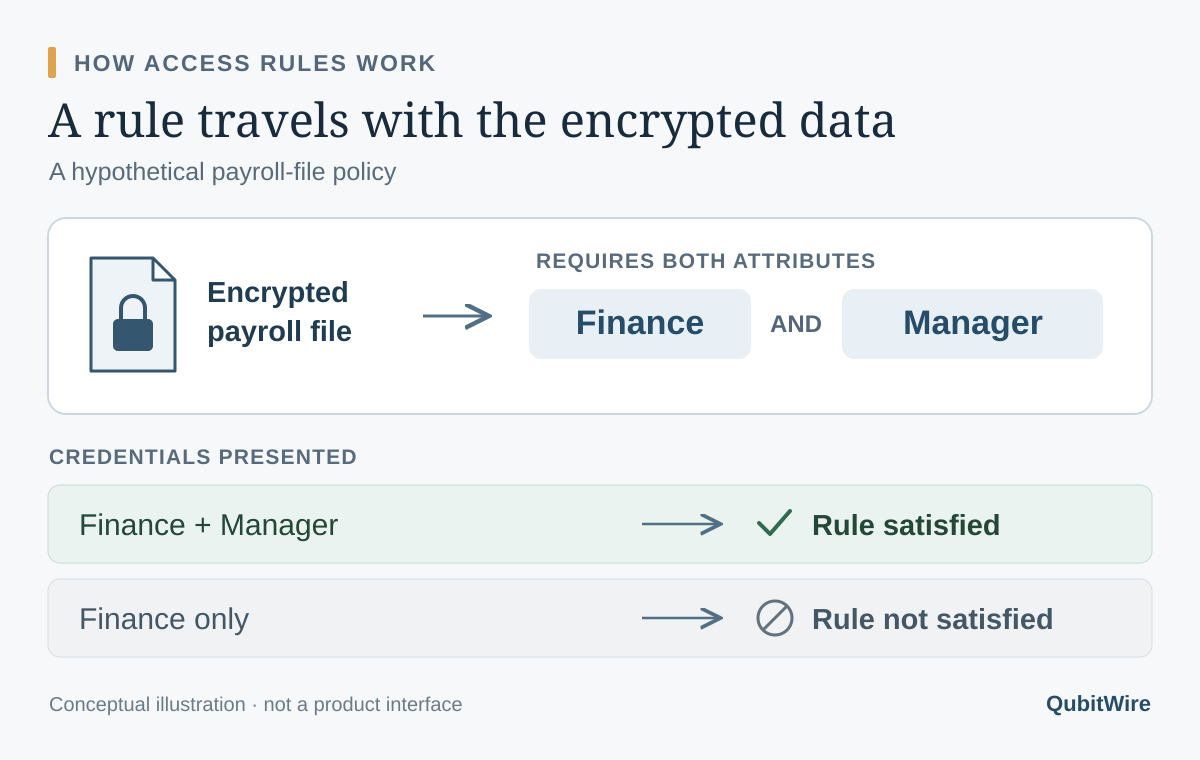
Conceptual diagram: an encrypted payroll file requires Finance AND Manager; both credentials satisfy the rule, while Finance alone does not.
Illustrative attribute-based access rule: this hypothetical encrypted payroll file requires both finance and manager credentials. This is a conceptual example, not Saltgrain’s interface or a deployed configuration.QubitWireQubitWire conceptual illustration

A multi-authority version allows separate organizations to issue credentials independently. The research uses Learning With Errors, a lattice-based mathematical problem believed difficult for quantum computers. Its security proofs have stated assumptions and a specific mathematical model; this is not a guarantee against every attack on a deployed system.[3]

The practical tradeoff is visible in the company’s benchmark. Decrypting a protected 256-bit AES key took roughly 6–34 milliseconds on an Apple M4 Pro laptop for AND rules containing one to four attributes. But the cryptographic keys and ciphertexts occupy megabytes. Those are research measurements, not Saltgrain product-performance promises or the time to process an arbitrary-size file.[1]

The underlying paper was first posted in September and accepted at ACM CCS 2026. November brings the integration announcement, not the first appearance of the mathematics. NTT says further optimization and expert code review are planned before adding the technology to Saltgrain.[2][3]

For organizations, the interesting prospect is combining flexible access rules with post-quantum protection. The schemes themselves are not NIST-standardized. Adoption still needs evidence about deployment cost, credential management and audited implementation, not just a fast decryption number.[1][2]

Keep your reading trail

Evidence & context

3 linked sources

Company integration announcement and research archive abstract; research timings not product benchmarks.

How to read the evidence and dates

An announcement records what an organization stated. An experiment reports an observation. A simulation or resource estimate depends on its assumptions. QubitWire’s analysis connects these sources; the labels are not quality scores.

Published is the article’s first QubitWire publication. Updated marks a substantive content change. Sources checked records a review of the underlying evidence. An older paper can support a new explanation, and another press release about the same work is not independent replication.

Sources

  1. NTT Research/Saltgrain announcement, distributed by Business Wire

    Full company release syndicated by TMC, November 16. Reports integration status and research benchmark conditions, not product performance.

  2. NTT Research: post-quantum attribute-based encryption

    November 16 company technical account; mechanism, planned optimization and code review.

  3. Large-Universe (Multi-Authority) ABE from LWE: paper record

    Paper abstract and archive history: first received September4, revised September11,2026; accepted at ACMCCS2026. Research predates the integration announcement.

READ NEXT

Continue exploring

All Security stories
  1. Explore cryptography migration

    Post-quantum certificate tests do not all check the same thing

    A new checker highlights the difference between using a public key and verifying a certificate’s signature. Proposed warnings would separately flag formatting problems.

    Published · Source report · Sources checked · About 2 min read
  2. Explore cryptography migration

    Quantum XChange’s PhioTX-V gains EU cybersecurity certification

    The evaluation includes post-quantum key exchange, but covers one software version and configuration. Certificate validity and security support have different end dates.

    Published · Source report · Sources checked · About 2 min read