
Matching quantum emitters takes voltage and time to settle
A silicon-carbide experiment separates tuning an emitter’s optical frequency from keeping it steady, an important distinction for future quantum links.
Reading tools for text size, copying, printing and your reading list
Electrical tuning can bring two silicon-carbide quantum emitters into spectral agreement, but the adjustment does not necessarily settle immediately. A preprint posted November 10 describes how their optical frequencies respond to voltage and illumination, revealing a practical obstacle between moving a signal and keeping it steady.[1]
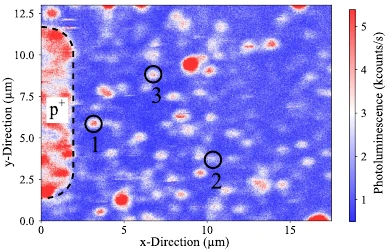
Researchers at institutions in Erlangen and Leipzig studied silicon vacancies: missing silicon atoms that create useful optical transitions inside the crystal. Their diode experiment operated at 4 kelvin, close to absolute zero. The report is a preprint, not a demonstration of a working quantum network.[1]
Changing the voltage changes the local electric field, which shifts an emitter’s optical resonance. The team recorded matching resonances from two defects at different voltage settings. Those separately recorded spectra do not demonstrate simultaneous photon interference or between the emitters.[1]
The complication appeared after an adjustment. Exposure to the initialization laser temporarily shifted an emitter’s resonance. Changing the voltage and returning to an earlier setting could also leave the frequency displaced before it relaxed over several minutes.[1]
The authors propose that trapped electrical charges reshape the local field around the defect. This is their interpretation of the transient behavior, rather than a separately established identification of every microscopic cause.[1]
After the system settled, a continuous spectral measurement at a fixed voltage showed stability over four hours. That describes the optical frequency during the measurement, not a four-hour quantum-memory lifetime.[1]
For anyone trying to connect separate quantum devices, the distinction is useful: moving an optical line, keeping it in place and demonstrating interference between photons are three different engineering tests. Passing one does not automatically pass the others.
The diode itself has a longer history. A September 2025 presentation from the group described fabrication, electrical measurements down to 4 kelvin and improved optical signal. The November preprint supplies the detailed tuning and transient-behavior account discussed here; its posting date should not be read as the date the experiments occurred.[1][2]
Readers following our thin-crystal single-photon story will recognize the broader challenge of matching optical signals, although that experiment used a different material. Here, the next consequential test is whether settled, controlled emitters can supply the matching photons needed for interference, beyond the separately recorded spectra.[1]