
SkyWater and Qolab Put a Foundry Model Behind Superconducting Hardware
Qolab will be a lead customer for SkyWater's SC250 wafer platform, but the partners disclosed no new quantum-processor benchmark or shipment.
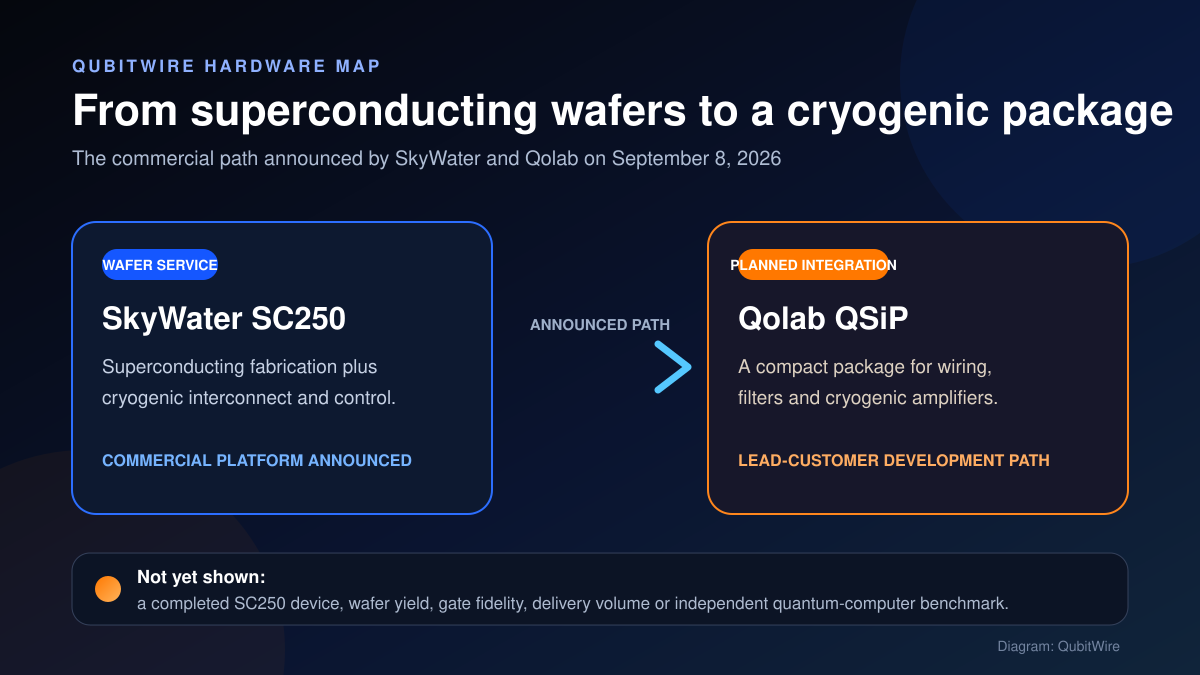
SkyWater Technology and Qolab have announced a multi-year manufacturing agreement intended to turn superconducting quantum-chip work into a repeatable commercial wafer service. Qolab will be a lead customer for SkyWater's SC250 platform, linking foundry fabrication in Minnesota with Qolab packaging, integration and testing in Wisconsin.
The attraction is consistency. A quantum processing unit can only scale if many delicate superconducting components can be fabricated repeatedly and connected to control hardware without a thicket of one-off parts. Qolab calls its approach a Quantum System-in-Package (QSiP), combining wiring, filters and cryogenic amplifiers around the processor.
The companies describe SC250 as the wafer-service side of that path and Qolab as a lead customer rather than merely a research collaborator. SkyWater's broader quantum-manufacturing launch also separates SC250 for superconducting interconnect and control from a different photonics platform, helping define what this agreement actually covers.
What the announcement does not contain is just as important. The partners report no completed SC250 quantum processor, count, wafer yield, , price, delivery volume or independent customer benchmark. Their claims describe a commercial framework and engineering plan, not proof that the resulting hardware already outperforms existing systems.
The meaningful milestones will be fabricated customer devices, repeatable yield across wafers and measured error rates after packaging. Until those arrive, the agreement matters because it creates a more industrial route from a superconducting design to a packaged device—not because it has already delivered a better quantum computer.