
A Qubit Classifier Can Start Deciding Before the Measurement Ends
A spiking neural network nearly matched a full-trace classifier on stored five-qubit readout data while producing updated answers as each 100-nanosecond chunk arrived.
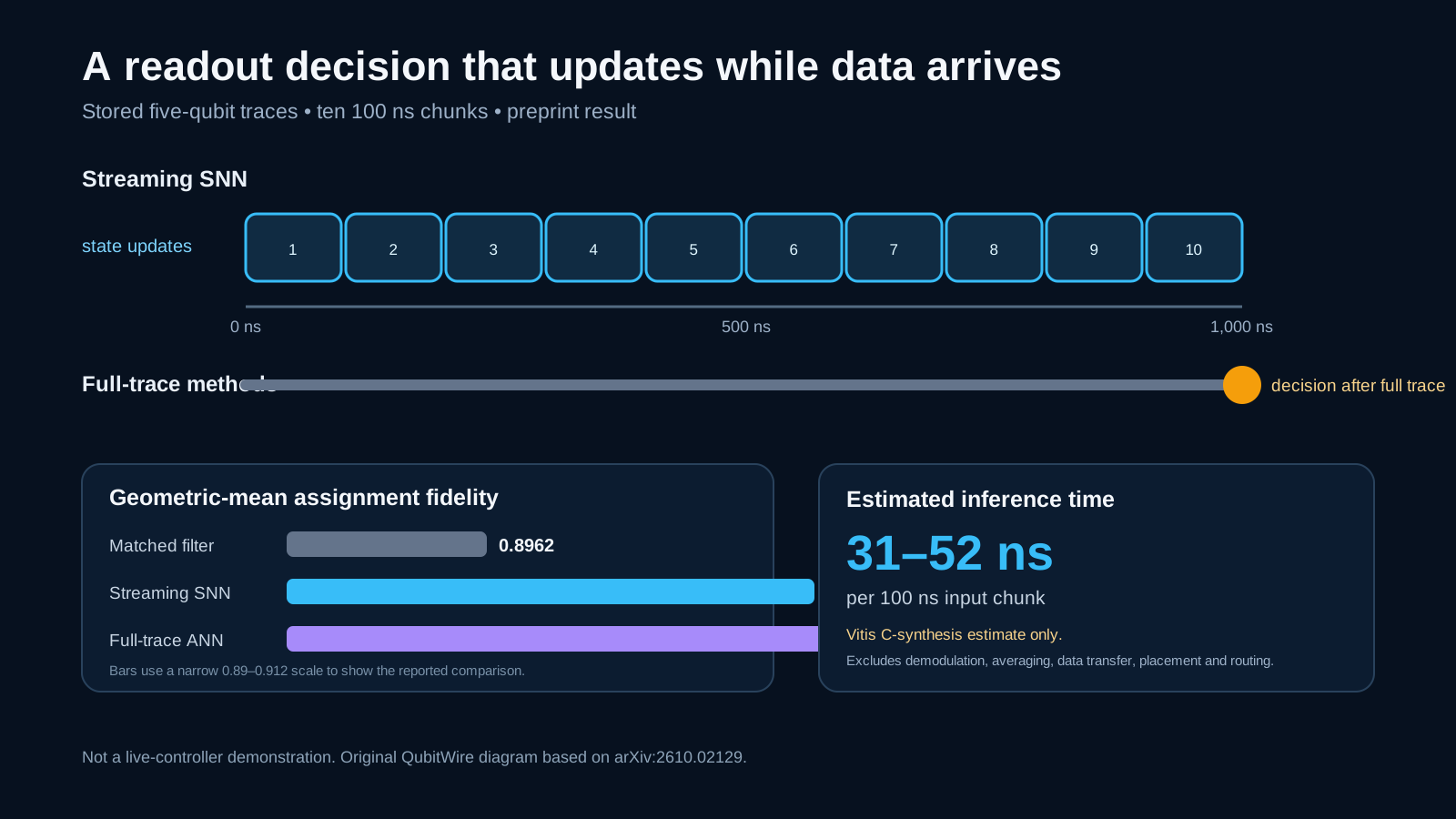
A qubit-readout classifier does not necessarily have to wait for the measurement to finish. Researchers trained a spiking neural network to process stored signals from five in ten successive 100-nanosecond chunks, updating its five-bit answer after every chunk of the one-microsecond record.[1][2]
On the paper's test set, the best spiking model reached 0.9084 geometric-mean assignment fidelity. A conventional matched filter reached 0.8962, while a larger artificial neural network that saw the complete trace at once reached 0.9100. The streaming model therefore gained most of the learned classifier's accuracy without needing the entire trace for every update.[1][2]
The intermediate answer can also be trained for a chosen decision time. Adding a loss term at 600 nanoseconds raised the ten-step model's fidelity there from 0.8885 to 0.8939, while its final fidelity changed from 0.9083 to 0.9076. Different qubits reached their plateaus at different times.[2]
The authors then translated quantized versions of the network into high-level FPGA designs. Vitis synthesis estimated 31 to 52 nanoseconds for each inference update, below the 100-nanosecond chunk interval. That estimate covers only the inference kernel, excluding demodulation, averaging, data transfer and final FPGA placement and routing.[2]
This is an arXiv preprint evaluated on an existing five-qubit dataset, not a live feedback demonstration. Its reported models used one fixed-seed training run, and the weakest qubit remained difficult. The decisive next test is an end-to-end controller that includes signal processing and shows whether earlier assignments improve calibration or cycles on operating hardware.[1][2]
The timing result matters because measurement is part of a larger control loop. If a reliable assignment becomes available before a fixed readout window closes, a controller could in principle begin the next conditional step sooner. The paper does not demonstrate that system-level gain, however, so the synthesis latency should be read as an enabling component rather than proof of a faster quantum-computing cycle.[1][2]
The accuracy comparison also needs a like-for-like reading. The headline values are geometric means across the five qubits on the authors' stored test data, not universal hardware error rates. The full-trace neural network retains a small final advantage, while the streaming model's distinctive benefit is that it exposes meaningful intermediate predictions and lets training emphasize a selected early decision point.[2]
For hardware teams, the most useful follow-up would combine the classifier with the complete acquisition path and report wall-clock latency, resource use, calibration drift and per-qubit failure modes. Repeating the comparison across processors and random seeds would show whether the result generalizes. Only then could researchers judge whether early decisions translate into measurable gains for feedback, reset or error-correction workloads.[1][2]
Keep your reading trail
Keep up with these topics
Choose the subjects you want to find again in Your Updates.