
A superconducting diode can change its preferred direction
The crystal underneath a strip of niobium helps decide which way current can flow without resistance. Researchers flipped that preference and used it to read a bit.
Reading tools for text size, copying, printing and your reading list
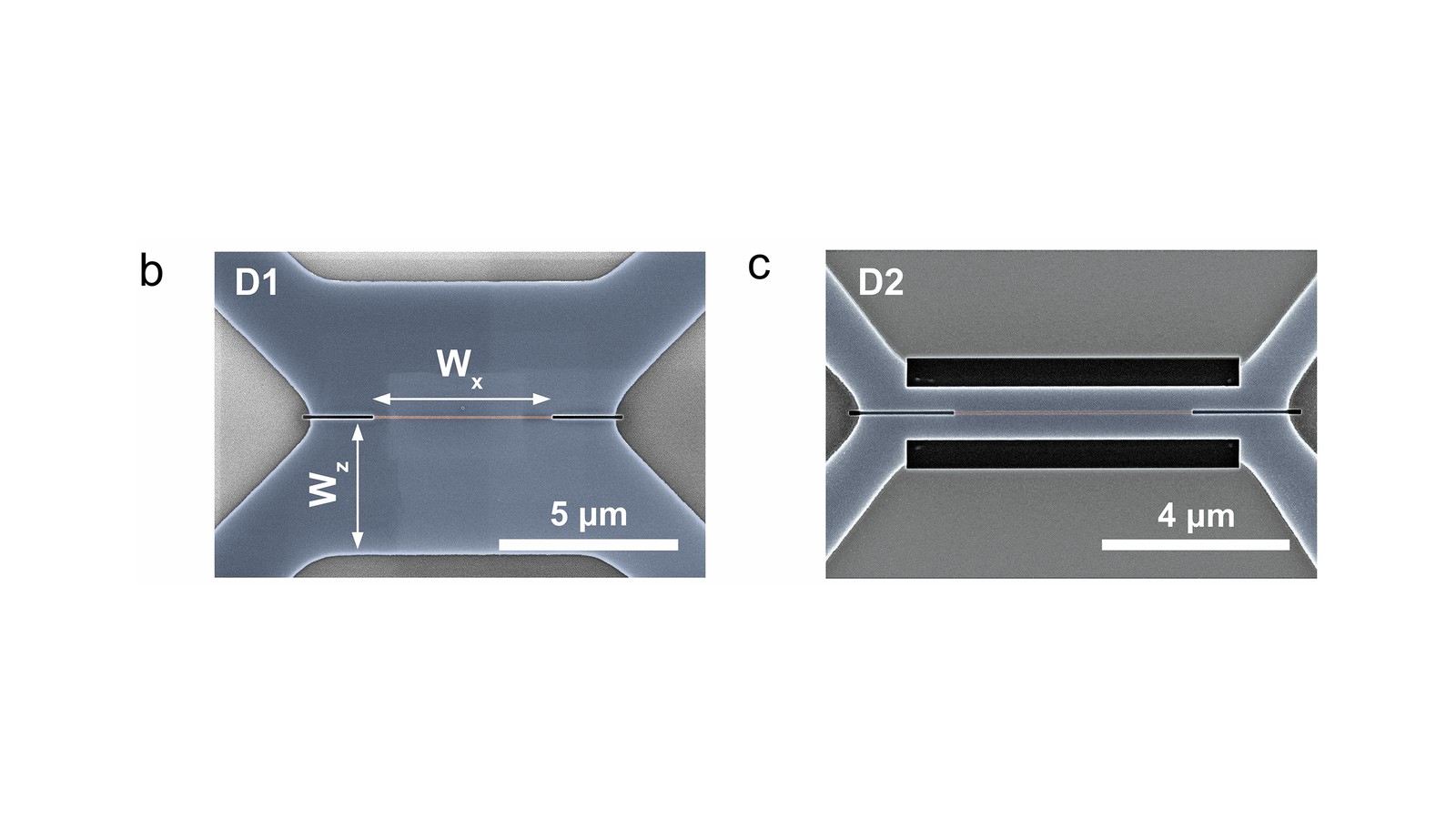
A diode normally has a preferred direction built into it. In a new experiment, researchers made a superconducting device whose preference could be reversed after it was made. They did it by flipping the magnetization of a layer beneath the superconductor. With one magnetic setting, a test current flowed with no measurable resistance. With the other, the same current produced a voltage. That gave the team a way to read which of two magnetic states it had written.[1]
The device, described in a preprint by He Yu and colleagues, combines niobium with a cobalt-platinum film. It is not a perfect one-way valve. Below a certain current, the strip can carry current without resistance in either direction. Above a second threshold, it becomes resistive in both. The useful range is in between: one direction still carries current without resistance while the other does not. The experiment shows two ways to choose which direction has the higher threshold.[1]
The crystal picked a direction
The researchers patterned strips along seven directions relative to the underlying crystal. A strip oriented at 0° favored the opposite direction from one oriented at 60°. The preference at 120° matched 0°, and the one at 180° matched 60°. Halfway between those orientations, at 30°, 90° and 150°, the effect nearly disappeared. Those angles compare separately oriented strips; the researchers did not mechanically turn one device during use.[1]
On a given strip, they could instead reverse the preference by flipping the cobalt-platinum layer’s magnetization. No external magnetic field had to be held on during the readout. That does not mean magnetism was absent: the layer next to the niobium remained magnetized. The team’s electrical measurements are consistent with an explanation involving vortices, tiny regions around which superconducting current circulates. The evidence suggests the strip’s edges let vortices enter more readily for one current direction than the other; the team did not directly image that process.[1]
A bit written warm and read cold
To show what a reversible preference buys you, the team wrote opposite magnetic states with electrical pulses at room temperature. After cooling the device to 5.4 kelvin, it applied the same read current each time. In one magnetic state the strip was superconducting; in the other it was resistive. The difference persisted across repeated warm-write, cold-read cycles. It’s a proof of concept for reading stored magnetic information, not a memory chip that can be written and read at one operating temperature.[1]
Earlier experiments had already demonstrated switchable superconducting diodes, including niobium devices controlled through their junction geometry and applied currents. In a related cobalt, platinum and niobium experiment last year, researchers used a deliberately asymmetric shape to produce the effect. The new result shows how the orientation of the crystal itself selects a direction, even without that engineered asymmetry. That could be useful in circuits that already run cold, but there is no demonstration here of a working memory array, a speed or power advantage at system scale, or an improvement to a . The next practical question is whether many such elements could be written and read reliably at the same temperature.[1][2][3]