
Skip to content
RESEARCH · COMPUTING / LOGICAL QUANTUM INFORMATION

Moving a logical quantum state puts error tolerance to the test

A surface-code experiment studies when encoded information survives imperfect teleportation. Both code patches sit on the same superconducting processor.
Published Source report Sources checked
My reading list
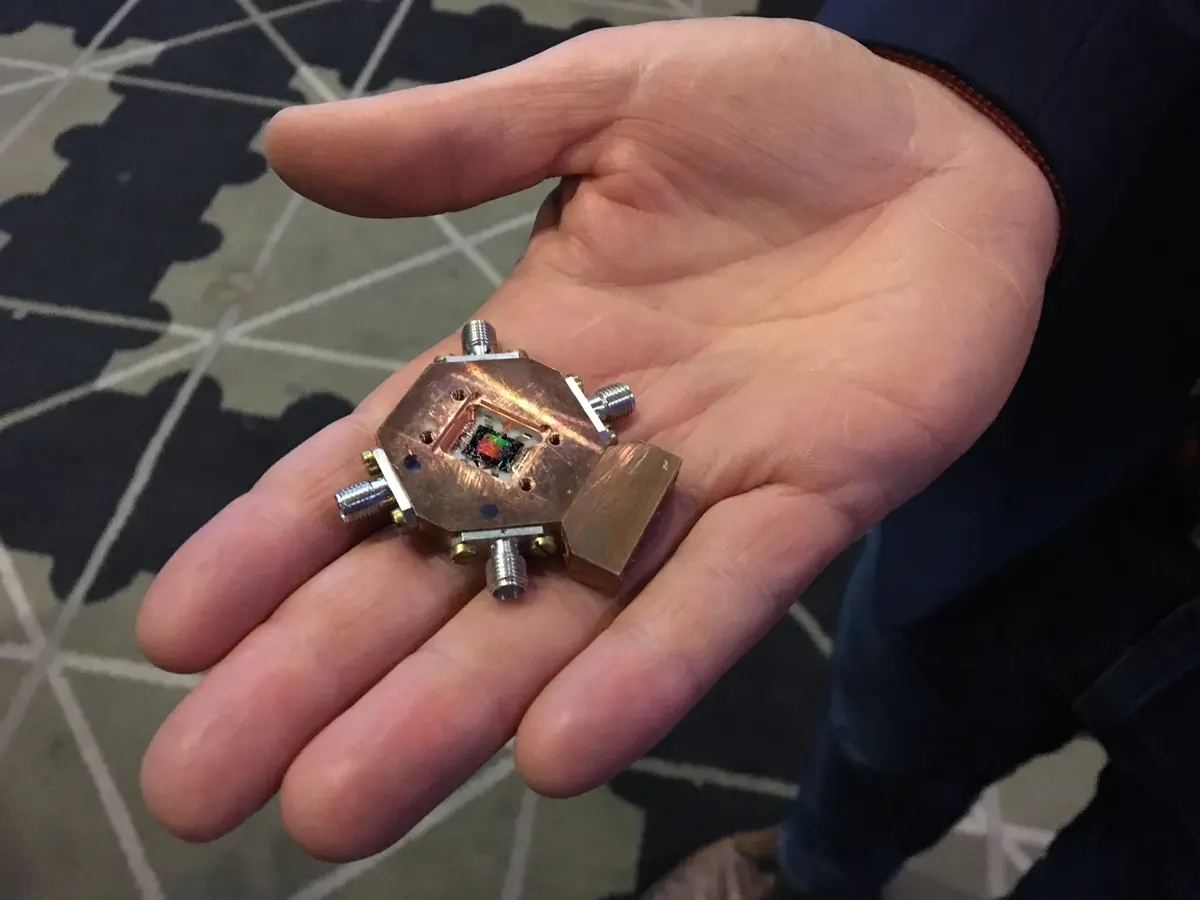
A processor with three qubits and three readout cavities, fabricated at Chalmers’ Nanofabrication Laboratory in 2017.
A three-qubit superconducting processor from Chalmers, photographed on October 23, 2017. Historical hardware context; this is not the surface-code device used in Zou and colleagues’ teleportation experiment.Photo: Anita Fors (Chalmers) · CC BY-SA 4.0 · CC BY-SA 4.0Full image credit

Yiren Zou and colleagues’ Nature Physics study, published October 22, tests when logical information remains recoverable under imperfect teleportation. Its preprint has been public since February 24, 2026. The new milestone is publication, with a protocol and its limits now available to inspect.[1][2]

The preprint describes two interlaced surface-code patches on one 125-qubit superconducting processor, with code distances up to seven. Entangling operations, measurements and classical decoding support the transfer. Both patches share the processor; this is not a demonstrated link between remote computers.[2]

That distinction changes the reader’s next question. Moving information within an experimental system and connecting separate systems present different integration problems. A successful demonstration of one should not silently become a claim about the other. The archival image shows Chalmers’ three-qubit processor from 2017, which is different hardware from the device in this experiment.

The final supplement treats integration with repeated as further work. An encoded-state transfer and a continuously protected computation are therefore separate milestones. The latter cannot be inferred merely because an experiment uses a code: protection has to remain effective through the operations required by the larger task.[3]

Encoding changes the question from moving one ’s state to preserving information represented across a collection of qubits. The supporting classical information remains part of the protocol. Quantum teleportation transfers a state using shared quantum resources and ordinary communication; it does not transport matter or provide faster-than-light signalling.

The next informative test would combine transfer with the repeated correction needed during a longer computation, while accounting for the extra measurements, resets and errors. That would connect this study’s recoverability question to an operating system’s reliability. Code size, transfer quality and sustained protection should remain separate quantities until a common experiment measures them together.

Keep your reading trail

Your Updates →

Evidence & context

3 linked sources

Peer-reviewed publication; author preprint and final supplement

How to read the evidence and dates

An announcement records what an organization stated. An experiment reports an observation. A simulation or resource estimate depends on its assumptions. QubitWire’s analysis connects these sources; the labels are not quality scores.

Published is the article’s first QubitWire publication. Updated marks a substantive content change. Sources checked records a review of the underlying evidence. An older paper can support a new explanation, and another press release about the same work is not independent replication.

QubitWire take

Encoded-state transfer is one step toward protected computation, with integration still to demonstrate.

Sources

  1. Teleportation transition of surface codes on a superconducting quantum processor

    Nature Physics publication dated October 22, 2026. Publisher metadata matched to the author preprint.

  2. Author preprint: teleportation transition of surface codes

    First posted February 24, 2026. Protocol, same-processor geometry, code sizes and decoder methods reviewed.

  3. Final publisher supplementary information

    14-page final supplement reviewed, including noise characterization and S6: integration with repeated error correction is proposed future work.

READ NEXT

Continue exploring

All Research stories
  1. Related reading

    Why One Logical Qubit Can Need 101 Physical Qubits

    Physical qubits are the hardware. Logical qubits are error-protected systems built from them—and the conversion is never a universal ratio.

    Published · Source report · Sources checked
  2. Related reading

    Stitched surface codes give a quantum memory another layer of checks

    A distinct Willow memory experiment connects layered checks, corridor geometry and classical decoding.

    Published · Source report · Sources checked
THE QUANTUM BRIEFING

A clearer signal.
Read the latest edition.

A little perspective on a fast-moving field.

Read the on-site briefing →

Read selected quantum coverage in the on-site briefing, or register your interest below.