
A Quantum “String” Broke in the Lab. The Surprise Was Where It Started.
A simulator using 13 active trapped-ion qubits explored how an electric-field string breaks in a simplified particle-physics model. The behavior began near the edges.
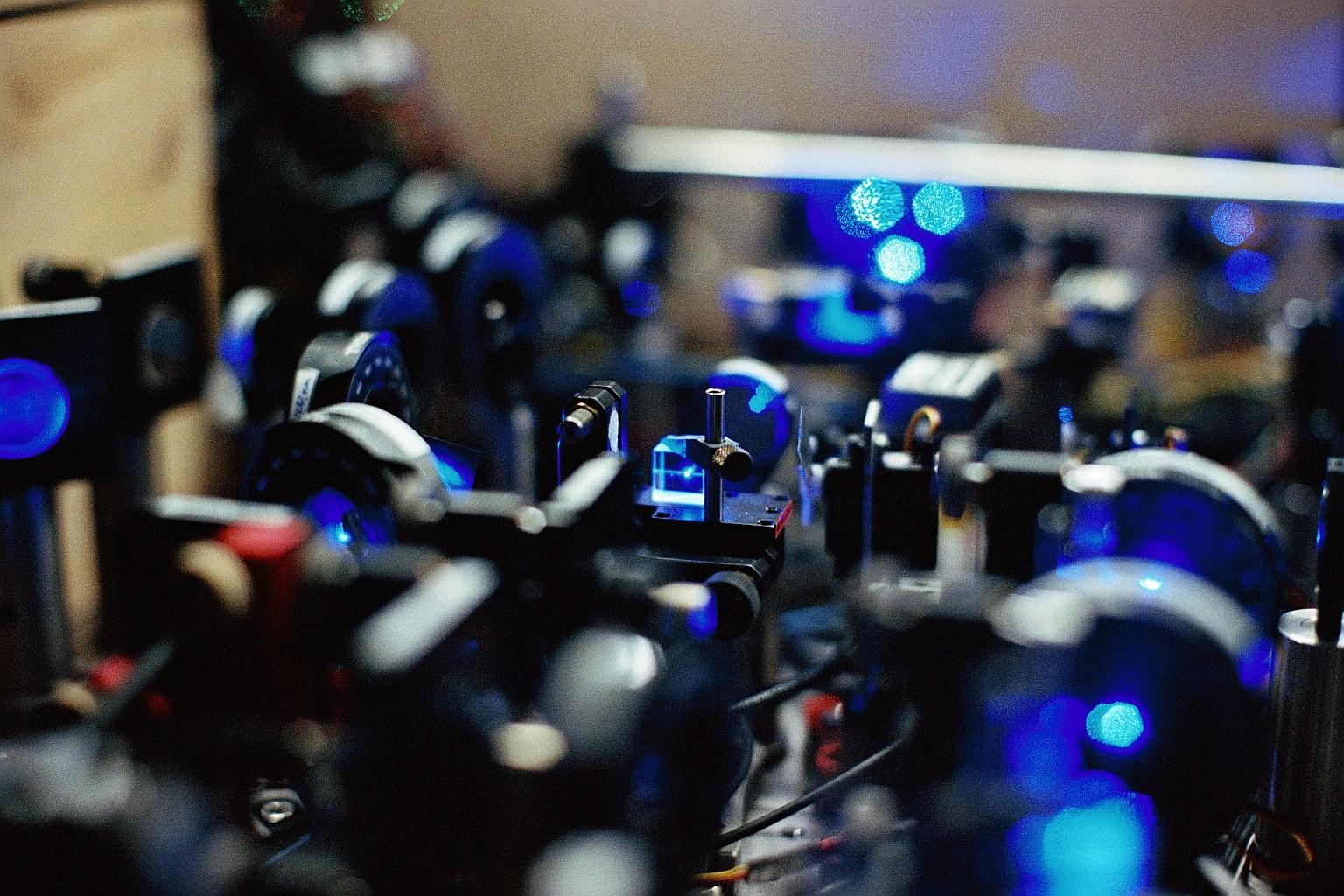

Pulling on a string normally makes you expect a snap. In a quantum model, the more interesting question is what appears where the string used to be.
A Nature Physics paper published on September 23 reports a string-breaking experiment using 13 active ytterbium-ion . Those qubits occupied the middle of a 15-ion chain; the two outer ions helped support the apparatus but did not encode the simulated spin dynamics. The work previously appeared as a preprint in October 2024.[1][2]
Nothing in the laboratory was a miniature cosmic string. The string was a pattern in a simplified one-dimensional model, represented by the quantum states of the ions. Carefully controlled laser interactions made those states behave according to the chosen rules. That is the promise of quantum simulation: use one controllable quantum system to investigate another.[1]
The surprising result concerned where charge pairs formed in the model. In the conditions studied, pairs appeared near the string's edges and spread inward. The authors distinguish this edge-facilitated behavior from the conventional Schwinger mechanism.[1]
That makes the boundaries part of the physics, not merely an annoying laboratory limitation. By programming how the finite simulated region interacted with a virtual static environment, the team could investigate behavior that a less carefully controlled experiment might obscure.[1]
The scale and model should remain visible in any retelling. This was a simplified lattice-gauge setting, not a full simulation of the strong force inside a proton. It did not create real particle-antiparticle pairs out of empty laboratory space, and the paper includes comparisons with classical numerical calculations. It does not establish universal computational advantage.[1]
The achievement is more specific: a quantum simulator was made flexible enough to prepare, evolve and inspect a physical model under controlled conditions. It connects the engineering of lasers and trapped atoms to questions otherwise discussed in the language of high-energy physics.
The reason to share the story is not that the universe has been recreated on a chip. It is that a small, carefully controlled quantum experiment can make an abstract idea observable and reveal why the way a system is bounded can change the way it breaks.