
Universal Quantum unveils a chip built to pass an atom to its neighbor
The iQPU puts a trap, voltage controls and a link to the next chip in one module. A German customer has set out two separate tests of the idea.
Reading tools for text size, copying, printing and your reading list
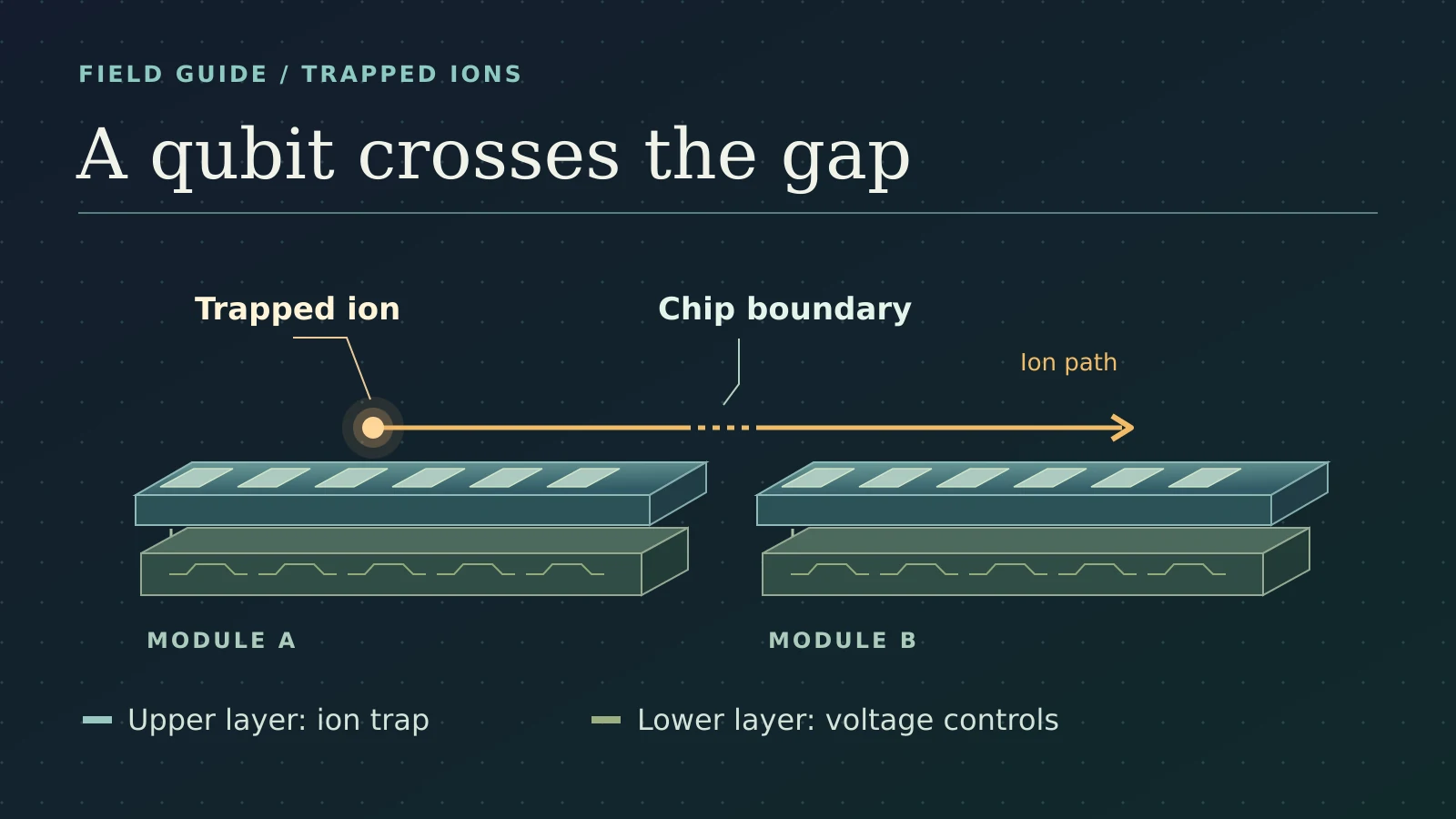
What crosses between chips?
Picture two chips side by side, with a single charged atom hovering above the first one. To use that atom in a calculation on the second chip, the machine must carry it across the seam without losing the information it holds. Universal Quantum has announced a processor built around that handoff.[2][4][5]
The company unveiled its integrated quantum processing unit, or iQPU, on November 3. It brings an ion trap, the electronics that help steer the ions, and an interface to a neighboring module into one design. Universal Quantum says this chip will go into systems it is building for the German Aerospace Center.[1][2][6]
Why bring the controls inside?
An ion is an atom with an electric charge. Its internal states can encode a . Electrodes create electric fields that hold the ion above the chip. Changing the voltages moves it between places where the machine can store it or perform an operation. Putting voltage controls underneath the trap shortens the route from the electronics to the electrodes.[3][5]
Follow the ion from trap to link
That layout gives the chip two jobs. Its surface offers room to move and work on ions. Its edges provide a way to reach another module. The company reports more than 400 square millimeters of active area and says it uses a commercial 200 millimeter wafer line. The first number measures space on a chip. The second describes the wafer used in manufacturing.[1][2]
What has already crossed the gap
There is already evidence for the crossing itself. In a separate experiment published in 2023, researchers moved an ion back and forth between two adjacent trap modules at 2,424 transfers per second. In their test they could detect no loss of phase coherence, a property that matters to the stored quantum information.[5]
That experiment measured transport. A working customer machine must also prepare qubits, perform operations and read the answers while its controls are running. The November launch release gives neither an error rate for such a calculation nor the fraction of manufactured chips that meet specifications.[1][5]
Two different customer tests
The German Aerospace Center provides a concrete place to watch. Its Toccata project describes a design for at least 50 qubits. A separate project, Legato, aims to connect four modules, beginning with two. Those are targets for two different prototypes. The project descriptions do not report that the completed four-module machine has passed customer testing.[3][4]