
A vibrating carbon nanotube is getting closer to feeling one quantum of motion
A suspended tube just 385 nanometers long changed its pitch as it vibrated harder. At one setting, its own mechanics dominated the shift. Detecting that shift from one quantum of vibration is still a goal, not a result.
Reading tools for text size, copying, printing and your reading list
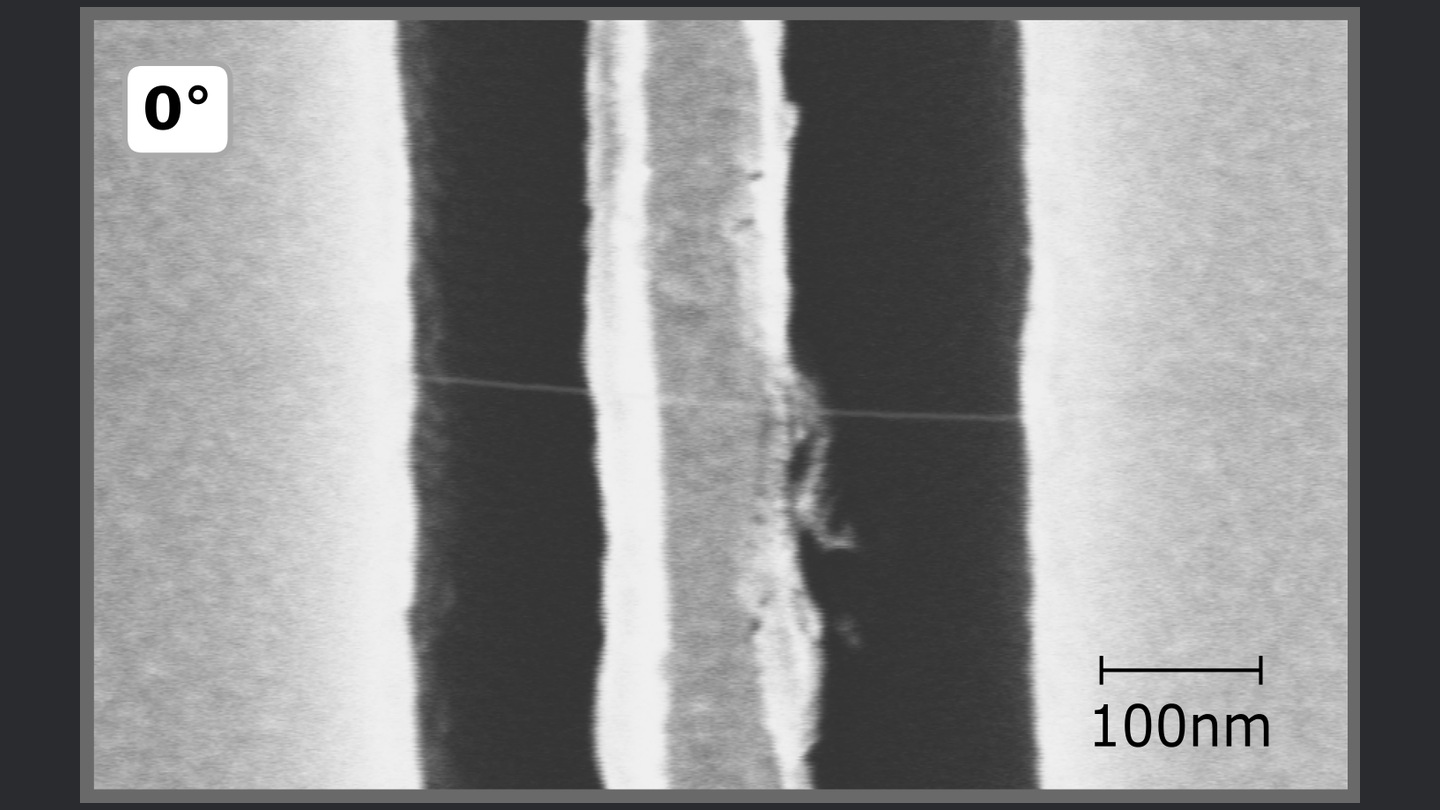
A guitar string tells you its pitch changes if you tighten it. A carbon nanotube suspended above a chip can do something stranger: the harder it vibrates, the more its own motion changes the pitch. Researchers at the Karlsruhe Institute of Technology measured that effect in a tube 385 nanometers long. Their preprint shows a way to make the effect stronger without borrowing it from a separate , although the experiment did not resolve individual quanta of motion.[1]
A tube that can bend two ways
The nanotube was already slightly bowed upward between its electrical contacts. A radio-frequency signal drove it to move, and the team used its electrical conductance as a readout. They saw two principal ways the tube could bend, with resonances in the neighborhood of 400 to 600 megahertz. One mode moved roughly along the direction of the bow, and the other roughly across it. The researchers varied a voltage on a nearby gate to rotate the directions of the vibrations.[1]
That rotation gave the team a way to tell apart two effects that can both change a measured resonance. A moving tube can experience a different electrical force as it approaches the gate. Its own mechanics can also change the effective stiffness as the vibration grows. Driving one bending mode while tracking the pitch of the other let the team estimate the mechanical contribution. Near one gate setting, the most useful motion was parallel to the chip, reducing the confounding effect of the electric field.[1]
The number to watch is not one yet
At the best setting, the researchers inferred an upper bound corresponding to about 34 quanta of vibration, with an uncertainty of about 10, for the onset of mechanical bistability. That is when a driven resonator can settle into either of two amplitudes at the same drive setting. This number came from the measured mechanical response and a model, not from counting 34 individual quanta or directly observing a single-quantum step.[1]
Why aim for one? In a perfectly linear resonator the jump from zero quanta to one costs the same energy as the jump from one to two, so a drive tuned to one transition can also excite the next. If one added quantum shifts the pitch by more than the natural width of the resonance, those transitions could in principle be addressed separately. That is the test for the so-called single-phonon Kerr regime. A phonon here is one quantum of a mechanical vibration.[1]
The researchers estimate that a shorter, 100-nanometer tube might produce a large enough shift if it can also match the low mechanical losses achieved in other experiments. That is a design estimate, not a measurement on a shorter device. The next experiment has to show both properties on the same tube: a sizeable frequency step per quantum and a resonance sharp enough to distinguish it.[1]