
The laboratory around a quantum-logic clock
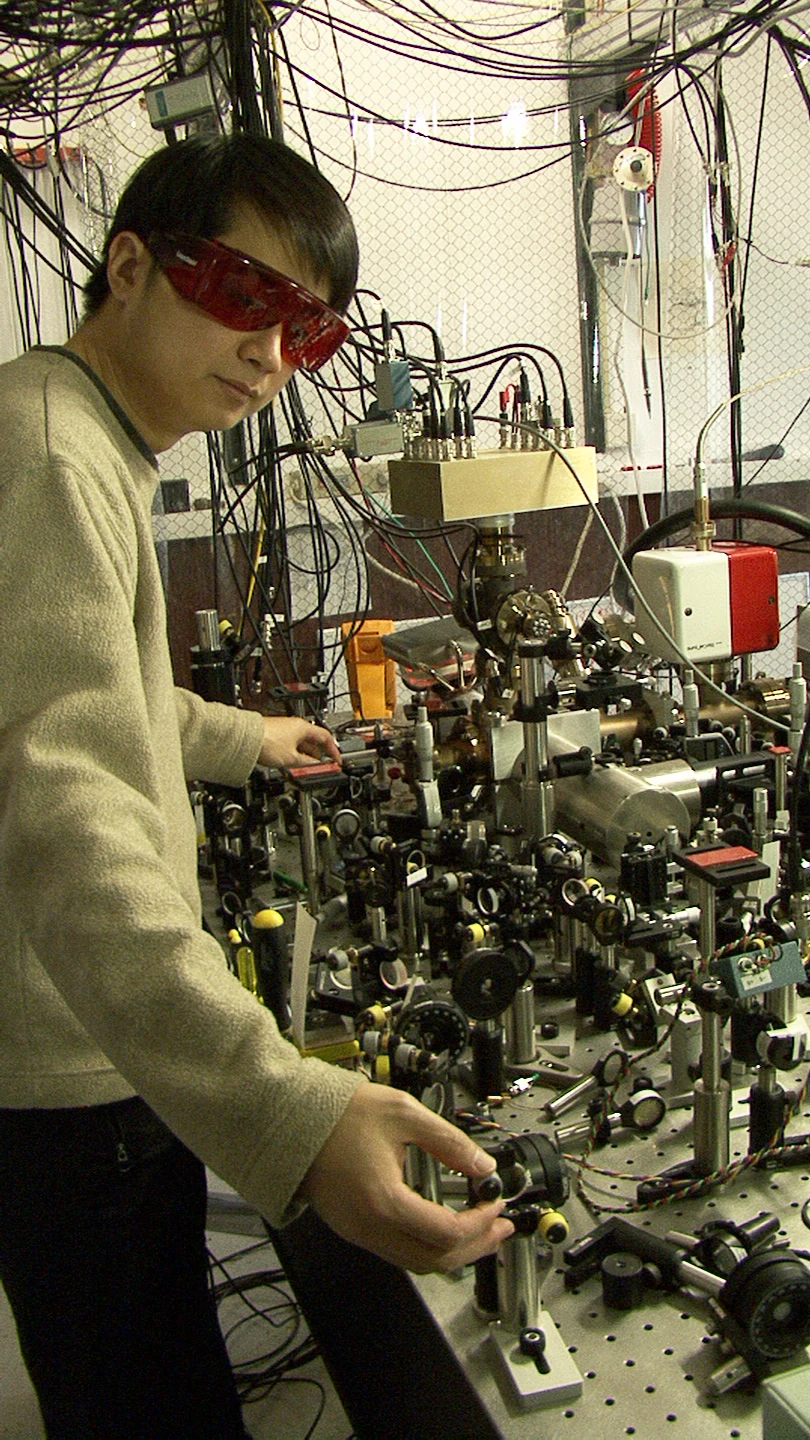
A single-ion experiment can occupy far more space than the trapped object suggests. This photograph supplies that missing scale by showing a researcher alongside the optical equipment of a quantum-logic clock. The original NIST caption used a superlative appropriate to its publication period; do not carry that old ranking into a current headline. Instead, explain the relationship between a microscopic reference and the macroscopic apparatus needed to control and compare it. The scene is a good companion to the penny-sized trap photograph, provided the article clearly states that the two images show different clock-related apparatus rather than one complete matching installation.
- Organization
- NIST
- Image type
- Photograph
- Capture date
- 2010-01-27
- Photographer / creator
- J. Burrus / NIST
- Reuse terms
- Public domain
J. Burrus / NIST — NISTs Second Quantum Logic Clock Based on Aluminum Ion is Now Worlds Most Precise Clock (5941058358).jpg — Public domain — https://commons.wikimedia.org/wiki/File:NISTs_Second_Quantum_Logic_Clock_Based_on_Aluminum_Ion_is_Now_Worlds_Most_Precise_Clock_(5941058358).jpg — https://commons.wikimedia.org/wiki/File:NISTs_Second_Quantum_Logic_Clock_Based_on_Aluminum_Ion_is_Now_Worlds_Most_Precise_Clock_(5941058358).jpg#Licensing.
Full original frame retained; EXIF orientation normalized where present, resized without enlargement and converted to WebP. No crop or content alteration.
Read the image
The clock’s reference sits inside an optical experiment
James Chin-wen Chou leans toward a dense optical table in this 2010 NIST photograph. The clock’s atomic reference is not presented as a visible dial. Instead, readers see the equipment and human work needed to interrogate that reference and interpret its response.
In the aluminum-ion quantum-logic clock described by NIST, a partner magnesium ion assists with cooling and readout. This division of roles explains why the surrounding apparatus matters. A useful reference must be prepared, probed and connected to an observable result before it can support timekeeping.
The photograph can introduce that measurement chain, while the source paper supplies its precision and uncertainty analysis. Historical superlatives in the original asset title belong to the 2010 report. A new gallery should retain the achievement’s date and explain the method rather than presenting an old ranking as current.
Where is the clock in a photograph without a face or hands?
The clock is an experimental system built around an atomic transition, probing light, control and measurement. The visible table shows parts of that supporting system.
Why use a partner ion?
In the cited aluminum-clock method, the partner makes cooling and readout more practical. The reference and the helper have distinct roles.
Can the image establish uncertainty?
No. Uncertainty comes from measurement and analysis of relevant effects. The photograph makes the experimental setting visible.
An independent QubitWire lesson based on this image and the cited source reading. The image does not establish a performance result.
Keep exploring
More from the same organization or hardware architecture.
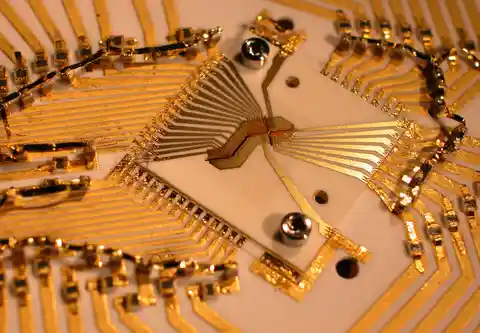 Gold electrodes for trapped ionsBlakestad/NIST · NQI gallery reuse permission
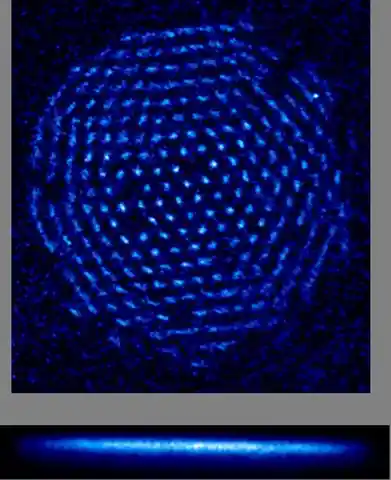 A crystal of trapped ionsNational Institute of Standards and Technology · Public domain (U.S. Government)
 NIST’s beryllium-ion apparatusY. Colombe / NIST · Public domain (U.S. Government)
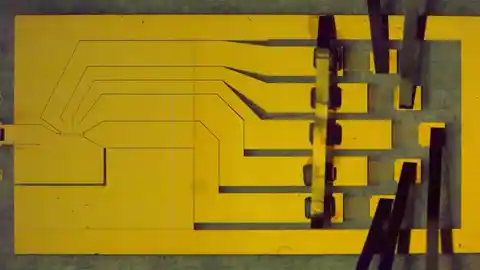 Gold electrodes for trapping ionsSigne Seidelin and John Chiaverini / NIST · Public domain (U.S. Government)
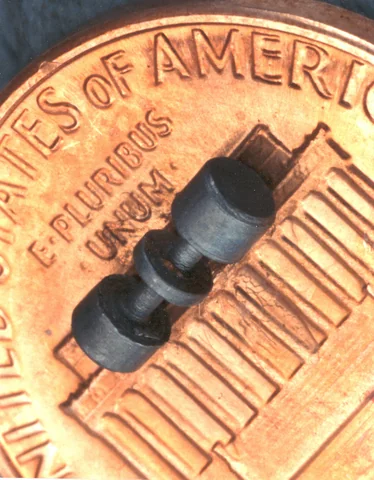 An ion trap resting on a pennyJ. Bergquist and D. Wineland / NIST · Public domain
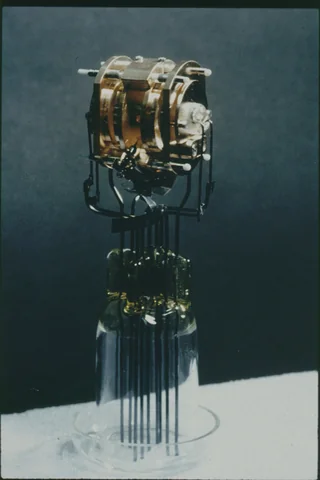 An early laser-cooling ion trapNIST · Public domain
Back to all images · Explore the interactive Model · Image rights and corrections