
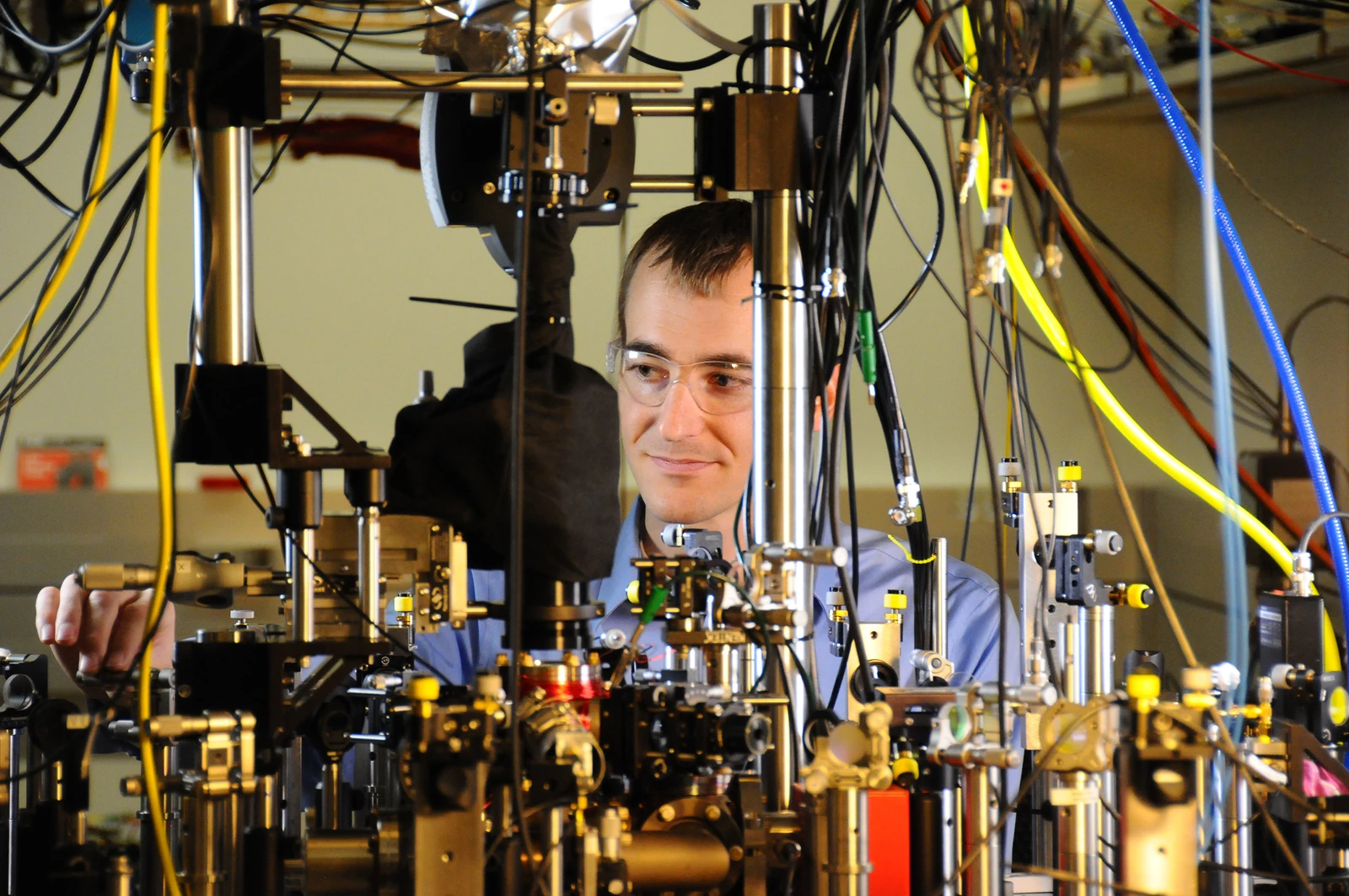
A quantum-logic clock behind an optical table
The crowded foreground makes control equipment the main visual subject. NIST identifies David Leibrandt and a quantum-logic clock, giving the picture a specific research context. Readers can use it to ask why observing one carefully chosen quantum transition involves so many macroscopic parts. Keep the explanation focused on functions such as delivering light, collecting a signal and stabilizing conditions; do not assign an exact role to each visible component without a layout reference. As an archival photograph, it can illuminate how a measurement is organized while remaining separate from present-day claims about clock precision or records.
- Organization
- NIST
- Image type
- Photograph
- Capture date
- 2013-10-24
- Photographer / creator
- Burrus / NIST
- Reuse terms
- Public domain
Burrus / NIST — David Leibrand and Quantum Logic Clock (13586705734).jpg — Public domain — https://commons.wikimedia.org/wiki/File:David_Leibrand_and_Quantum_Logic_Clock_(13586705734).jpg — https://commons.wikimedia.org/wiki/File:David_Leibrand_and_Quantum_Logic_Clock_(13586705734).jpg#Licensing.
Full original frame retained; EXIF orientation normalized where present, resized without enlargement and converted to WebP. No crop or content alteration.
Read the image
Precision timekeeping is a sequence of controlled comparisons
David Leibrandt’s face appears behind a crowded optical table in this archival NIST image. Posts, components and hanging cables fill the foreground. The composition gives the viewer a sense of the apparatus between a researcher and the atomic reference being studied.
A precision clock experiment depends on comparisons. A probing signal must be related to an atomic transition, and the inferred frequency must be evaluated against relevant environmental and instrumental effects. Repeated measurements help distinguish statistical variation from systematic shifts that require separate analysis.
The photograph offers a human-scale introduction to that work, but it cannot encode the uncertainty budget. It is best paired with a simple measurement-loop diagram and a dated source explaining the particular clock result. The scientist’s surname should be written Leibrandt even though the historical Commons filename omits the final letter.
Why does repeatability matter?
Repeated measurements reveal variation under the stated conditions. Agreement is useful, but it does not by itself rule out a shared systematic shift.
What is an uncertainty budget?
It is an account of the contributions limiting confidence in a reported measurement. Its contents come from analysis and tests, not the apparent complexity of the apparatus.
Why correct the filename’s spelling in the caption?
A file identifier can preserve an old typo. Reader-facing identification should use the verified person’s name while retaining the exact source URL.
An independent QubitWire lesson based on this image and the cited source reading. The image does not establish a performance result.
Keep exploring
More from the same organization or hardware architecture.
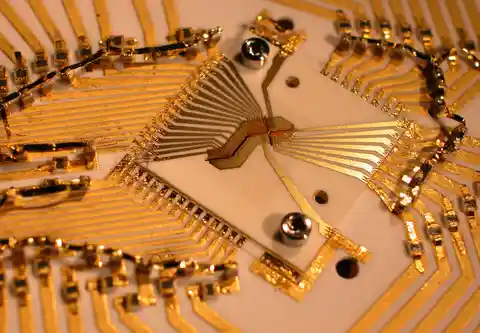 Gold electrodes for trapped ionsBlakestad/NIST · NQI gallery reuse permission
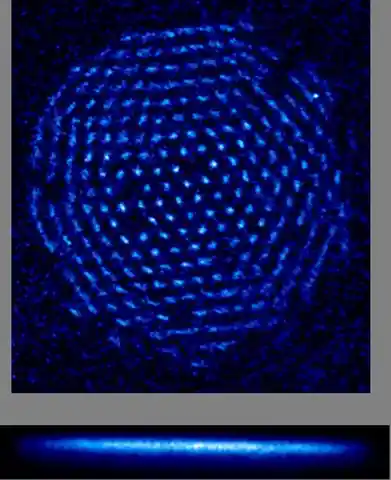 A crystal of trapped ionsNational Institute of Standards and Technology · Public domain (U.S. Government)
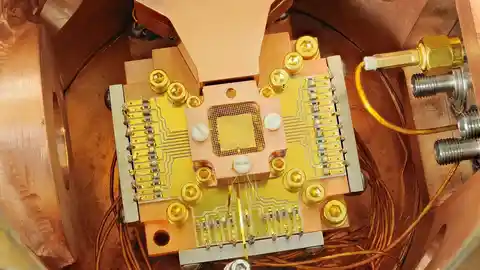 NIST’s beryllium-ion apparatusY. Colombe / NIST · Public domain (U.S. Government)
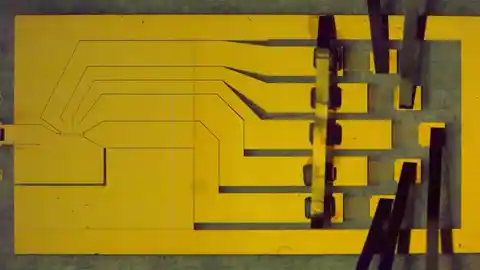 Gold electrodes for trapping ionsSigne Seidelin and John Chiaverini / NIST · Public domain (U.S. Government)
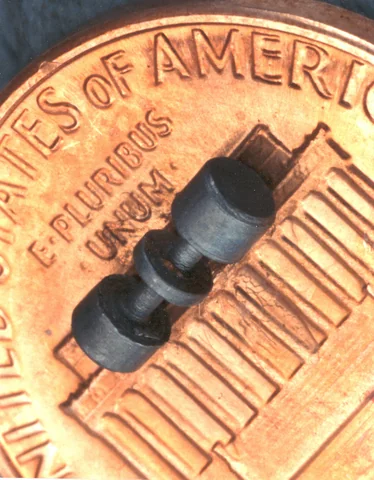 An ion trap resting on a pennyJ. Bergquist and D. Wineland / NIST · Public domain
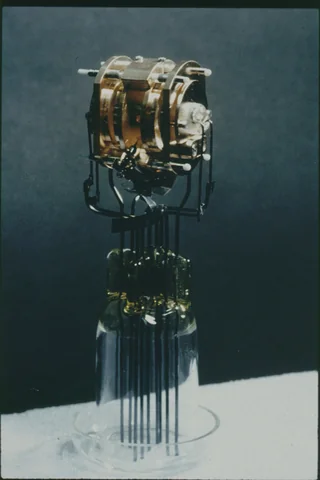 An early laser-cooling ion trapNIST · Public domain
Back to all images · Explore the interactive Model · Image rights and corrections