
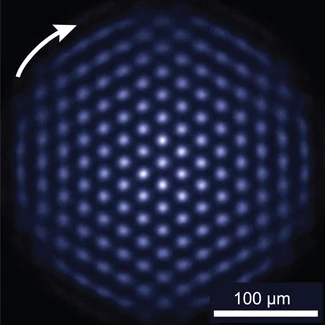
A photographed crystal of fluorescing ions
Here the pattern of bright spots is experimental imagery rather than an artist’s array of decorative spheres. NIST identifies it as fluorescence from an ion crystal whose arrangement forms a triangular lattice. The existing scale bar and arrow are part of the published image and should remain visible. Use the file to teach readers to look for a measurement method, scale and preparation conditions before interpreting a striking scientific picture. Do not infer that every bright point is executing a useful logical operation. The image documents a prepared physical arrangement; computational capability requires evidence about the operations and measurements performed on it.
- Organization
- NIST
- Image type
- Photograph
- Capture date
- Not supplied by source
NIST identifies image creation as April 25, 2012. The conflicting 2013 Commons metadata is not used as a capture date.
- Photographer / creator
- Joe Britton / NIST
- Reuse terms
- Public domain
Joe Britton / NIST — Quantum Simulator Crystal.jpg — Public domain — https://commons.wikimedia.org/wiki/File:Quantum_Simulator_Crystal.jpg — https://commons.wikimedia.org/wiki/File:Quantum_Simulator_Crystal.jpg#Licensing.
Full original frame retained; EXIF orientation normalized where present, resized without enlargement and converted to WebP. No crop or content alteration.
Read the image
A lattice photograph contains structure and measurement context
Blue-white points form a roughly circular triangular lattice against a dark field. A white arrow and a 100-micrometer scale bar are already included in NIST’s original photograph. The original NIST record dates the image to April 25, 2012, earlier than some later file metadata.
Fluorescence makes the ion arrangement visible. The regular pattern gives a reader a way to discuss sites, neighbors and spatial order. It does not by itself display every property of the many-body quantum state. The experimental preparation and measurement protocol determine how the observed light relates to the underlying information.
The source connects the image to a trapped-ion simulator studying engineered interactions. This makes the picture useful for introducing the difference between a physical lattice, a mathematical interaction model and a measured observable. The three are related, but none can be replaced simply by counting bright dots.
What is the scale bar for?
It supplies a physical length reference within the source image. Preserve it and avoid rescaling it independently of the photograph.
Are the dots decorative atom icons?
No. This is a fluorescence photograph, with explanatory annotations added in the source. It should remain distinct from a separate conceptual lattice drawing.
Why correct the historical date?
The original NIST record identifies 2012. Later upload metadata should not change the year of the research image.
An independent QubitWire lesson based on this image and the cited source reading. The image does not establish a performance result.
Keep exploring
More from the same organization or hardware architecture.
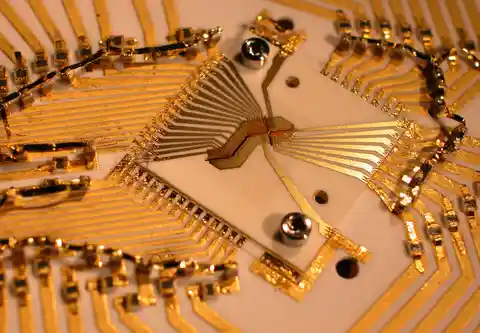 Gold electrodes for trapped ionsBlakestad/NIST · NQI gallery reuse permission
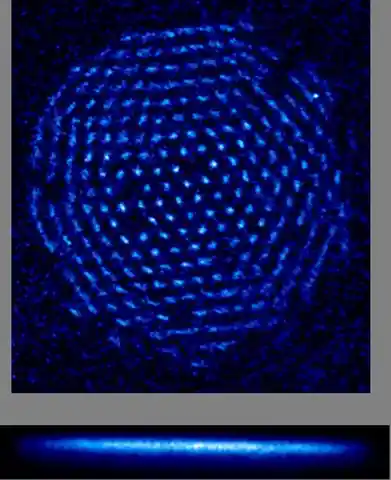 A crystal of trapped ionsNational Institute of Standards and Technology · Public domain (U.S. Government)
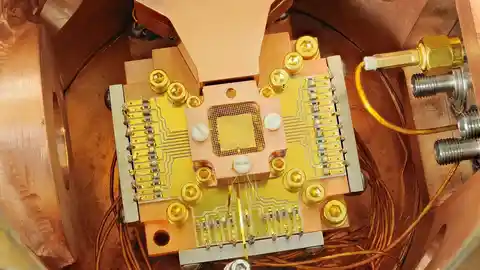 NIST’s beryllium-ion apparatusY. Colombe / NIST · Public domain (U.S. Government)
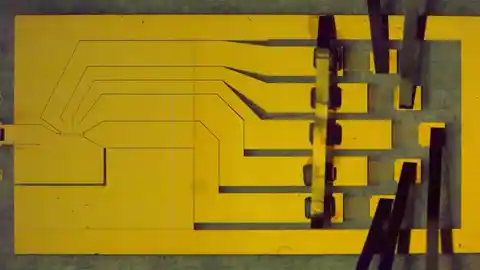 Gold electrodes for trapping ionsSigne Seidelin and John Chiaverini / NIST · Public domain (U.S. Government)
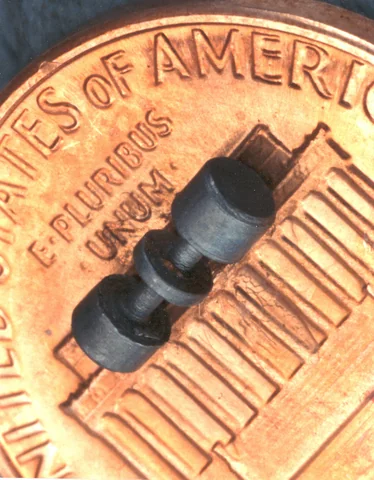 An ion trap resting on a pennyJ. Bergquist and D. Wineland / NIST · Public domain
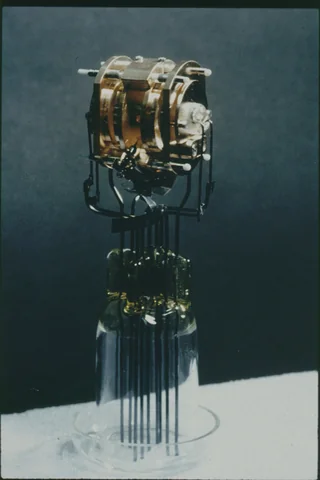 An early laser-cooling ion trapNIST · Public domain
Back to all images · Explore the interactive Model · Image rights and corrections