
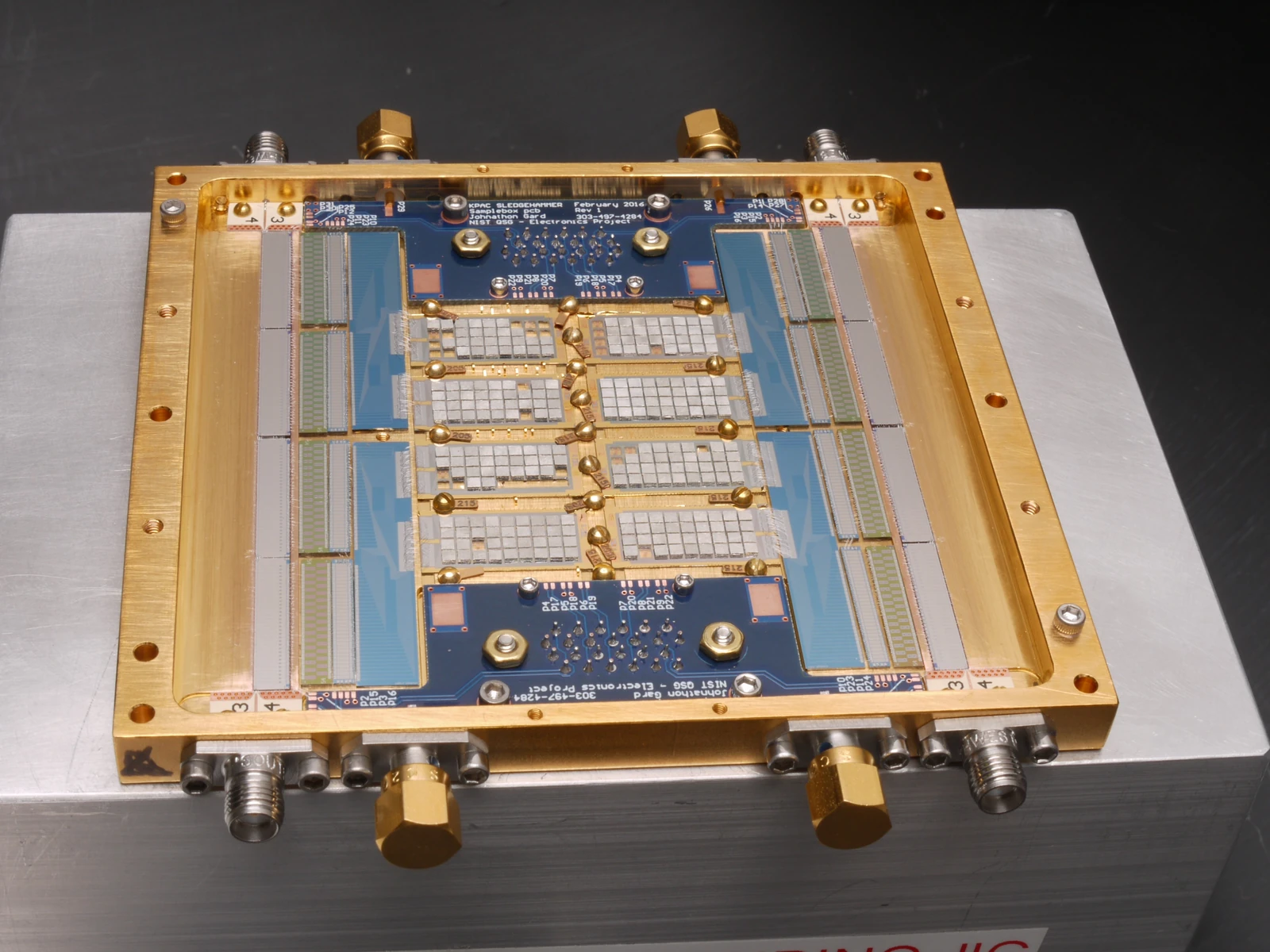
Transition-edge sensor array used in nuclear-monitoring research
A sensor array makes a measurement system visible without making its performance visible. The repeated light rectangles sit inside a larger assembly of connectors, a circuit board and a mechanical frame. Those surrounding parts matter because the sensing elements must be addressed and their signals carried away. NIST associates this photograph with its nuclear-monitoring work. The picture can introduce the apparatus, but accuracy still requires calibration data, uncertainty estimates and a description of the material being measured. Notice the older date printed on the board: a photograph accompanying a new result does not imply that every component was newly manufactured.
- Organization
- NIST
- Image type
- Photograph
- Capture date
- Not supplied by source
Source publication and upload dates are separate from capture dates. The capture date is not verified.
- Photographer / creator
- NIST
- Reuse terms
- Public domain in the United States; NIST worldwide reuse terms
NIST — Transition-edge sensor array used in nuclear-monitoring research — Public domain in the United States; NIST worldwide reuse terms — https://www.nist.gov/image/transition-edge-sensors — https://www.nist.gov/open/copyright-fair-use-and-licensing-statements-srd-data-software-and-technical-series-publications.
Full original frame retained; EXIF orientation normalized where present, resized without enlargement and converted to WebP. No crop or content alteration.
Read the image
Read an array as a measurement system
An array combines repeated sensing elements with structures that connect, support and read them. The photograph makes that hierarchy visible: the central sections sit within a circuit board, a frame and a larger mounting plate. A useful visual lesson begins by describing those parts without turning their count into a performance rating.
Imagine two channels observing the same reference event. Their raw responses differ, so a calibration maps each response onto a comparable scale. Repeating that process across an array introduces questions about stability, rejected channels and how uncertainty is combined. The exercise needs no invented claim about the photographed instrument.
The NIST source connects this specific array with a nuclear-monitoring study. Keep that documentary relationship in the caption. The photograph cannot establish the study’s uncertainty reduction, and it does not show a spectrum. A useful reader follows the image to a description of calibration and then to the measurement result.
Are these computing qubits?
The source identifies transition-edge sensors. Counting sensing elements is not a count of logical or physical qubits in a computer.
What does the older board marking establish?
Only that the printed marking is visible. It should prevent casually assigning a new fabrication date to every component in a later photograph.
An independent QubitWire lesson based on this image and the cited source reading. The image does not establish a performance result.
Keep exploring
More from the same organization or hardware architecture.
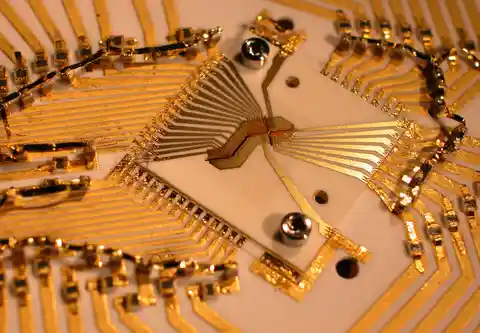 Gold electrodes for trapped ionsBlakestad/NIST · NQI gallery reuse permission
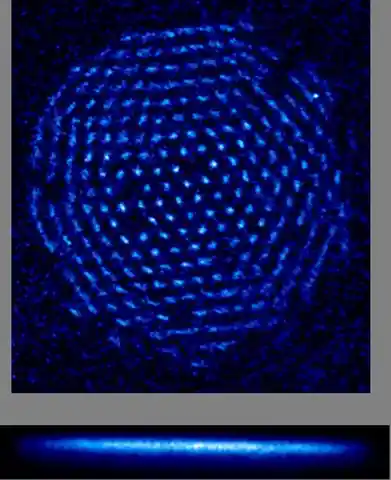 A crystal of trapped ionsNational Institute of Standards and Technology · Public domain (U.S. Government)
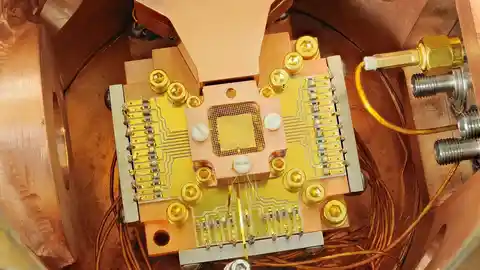 NIST’s beryllium-ion apparatusY. Colombe / NIST · Public domain (U.S. Government)
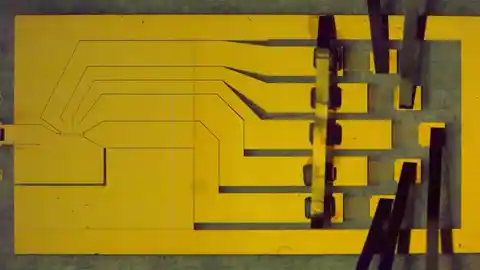 Gold electrodes for trapping ionsSigne Seidelin and John Chiaverini / NIST · Public domain (U.S. Government)
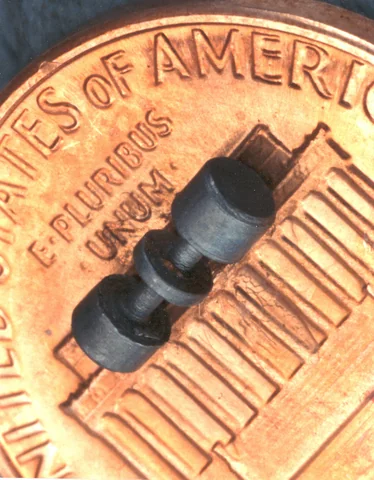 An ion trap resting on a pennyJ. Bergquist and D. Wineland / NIST · Public domain
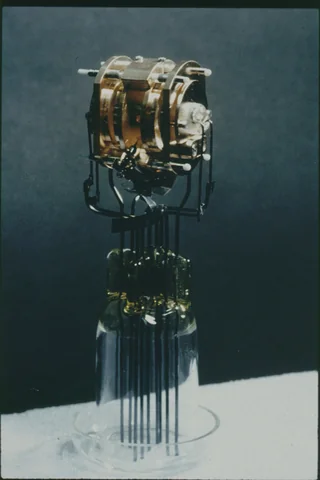 An early laser-cooling ion trapNIST · Public domain
Back to all images · Explore the interactive Model · Image rights and corrections