
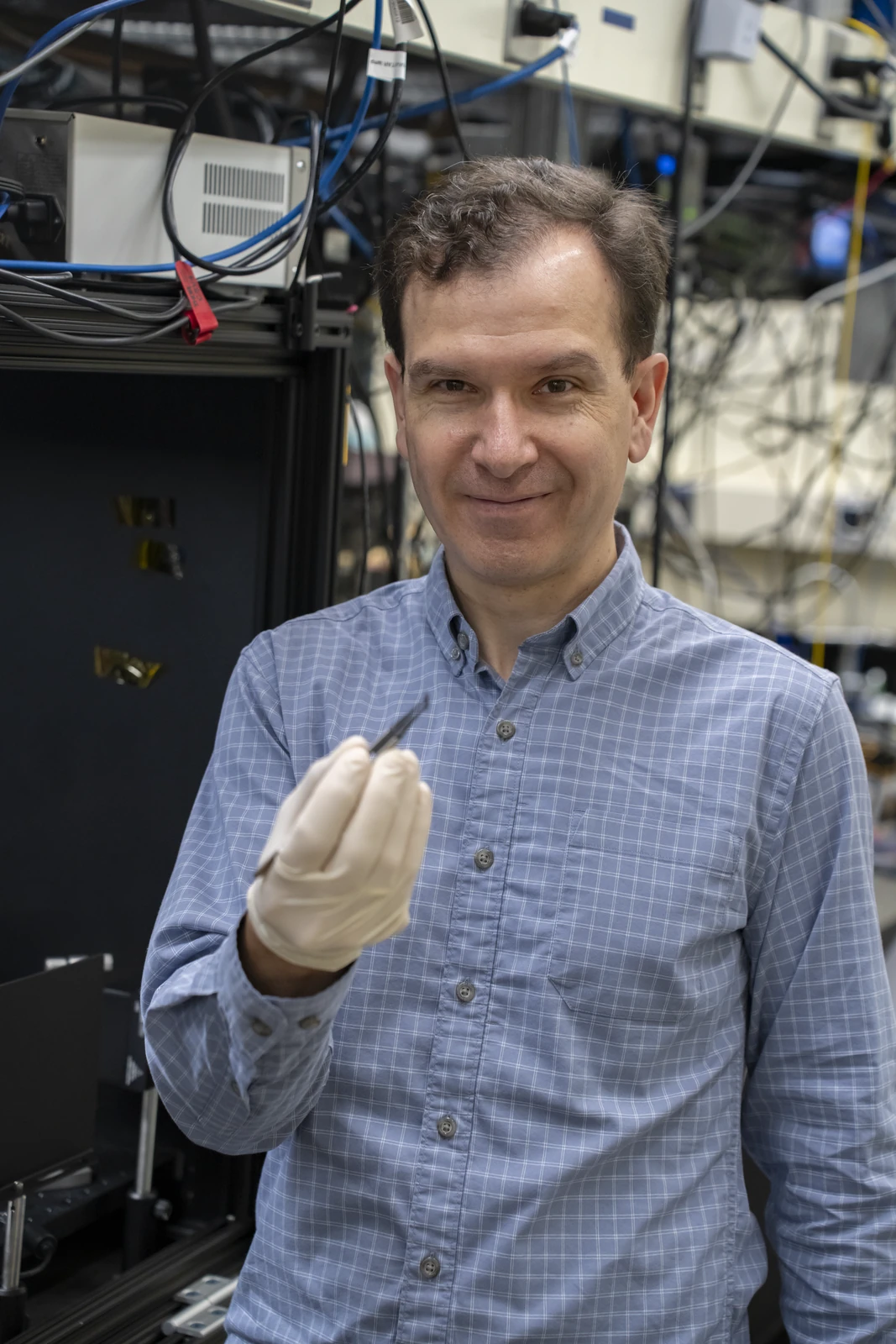
Nikolai Klimov holds a photonic integrated chip
The white glove and tweezers give the chip a useful human scale. They also move attention toward a practical problem: a small optical component has to connect reliably to the rest of an instrument. NIST identifies the researcher as Nikolai Klimov and associates the photograph with work on packaging for harsh environments. The image does not reveal how the connection was made or how it survived testing. Pair this portrait with the closer chip photograph, then explain which claims come from laboratory tests. Keeping those roles separate allows a compelling human image to support a precise engineering story.
- Organization
- NIST
- Image type
- Photograph
- Capture date
- Not supplied by source
Source publication and upload dates are separate from capture dates. The capture date is not verified.
- Photographer / creator
- M. King/NIST
- Reuse terms
- Public domain in the United States; NIST worldwide reuse terms
M. King/NIST — Nikolai Klimov holds a photonic integrated chip — Public domain in the United States; NIST worldwide reuse terms — https://www.nist.gov/image/nikolai-klimov-photonic-integrated-chip — https://www.nist.gov/open/copyright-fair-use-and-licensing-statements-srd-data-software-and-technical-series-publications.
Full original frame retained; EXIF orientation normalized where present, resized without enlargement and converted to WebP. No crop or content alteration.
Read the image
Use a portrait to establish scale and context
A research portrait can serve a technical story when it makes relationships easier to understand. Here the hand, tweezers and chip form one scale relationship, while the instruments behind the researcher form another. The first concerns handling a small object; the second places that object inside a working laboratory.
Avoid asking the portrait to establish the microscopic mechanism. A person holding a chip does not show the internal optical path or the bond that attaches a fiber. Those belong in separately sourced technical explanation. The portrait’s contribution is concrete: a real person, a real object and a setting in which the work occurs.
Pair the image with the closer chip photograph only when the sequence adds information. Lead with the close-up to introduce the object; use the portrait when naming the researcher or discussing practical work. Repeating both images at the same scale with nearly identical captions would spend space without improving understanding.
What should alt text emphasize?
The researcher, gloved hand, tweezers, chip and laboratory background. Identity may be included because the official source names the person, rather than inferred from appearance.
What does the glove prove?
It shows how the object is handled in this photograph. It does not establish a cleanliness specification or prove that the image records a particular experiment.
An independent QubitWire lesson based on this image and the cited source reading. The image does not establish a performance result.
Keep exploring
More from the same organization or hardware architecture.
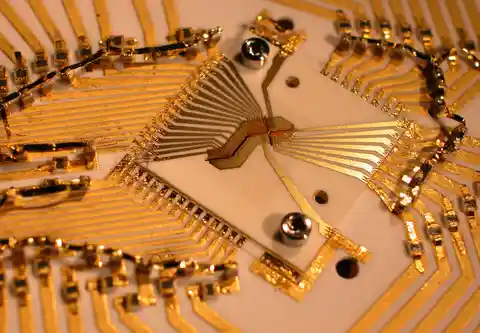 Gold electrodes for trapped ionsBlakestad/NIST · NQI gallery reuse permission
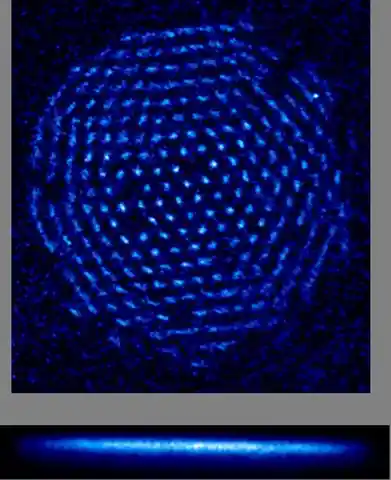 A crystal of trapped ionsNational Institute of Standards and Technology · Public domain (U.S. Government)
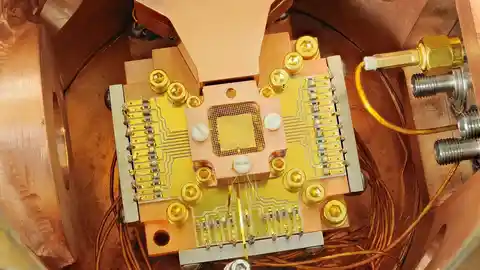 NIST’s beryllium-ion apparatusY. Colombe / NIST · Public domain (U.S. Government)
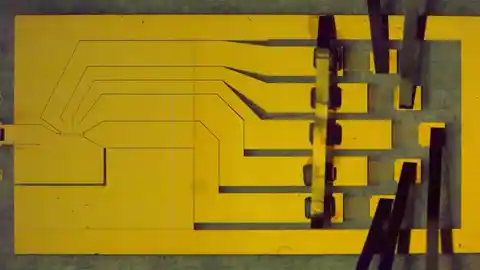 Gold electrodes for trapping ionsSigne Seidelin and John Chiaverini / NIST · Public domain (U.S. Government)
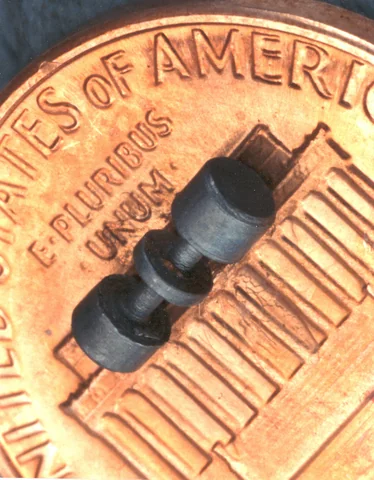 An ion trap resting on a pennyJ. Bergquist and D. Wineland / NIST · Public domain
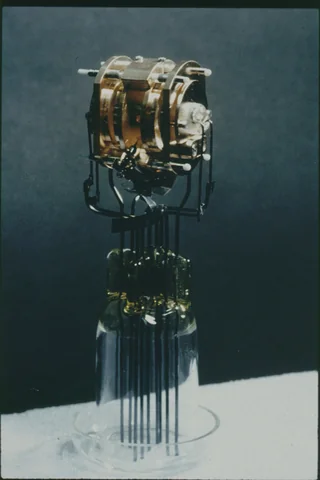 An early laser-cooling ion trapNIST · Public domain
Back to all images · Explore the interactive Model · Image rights and corrections