
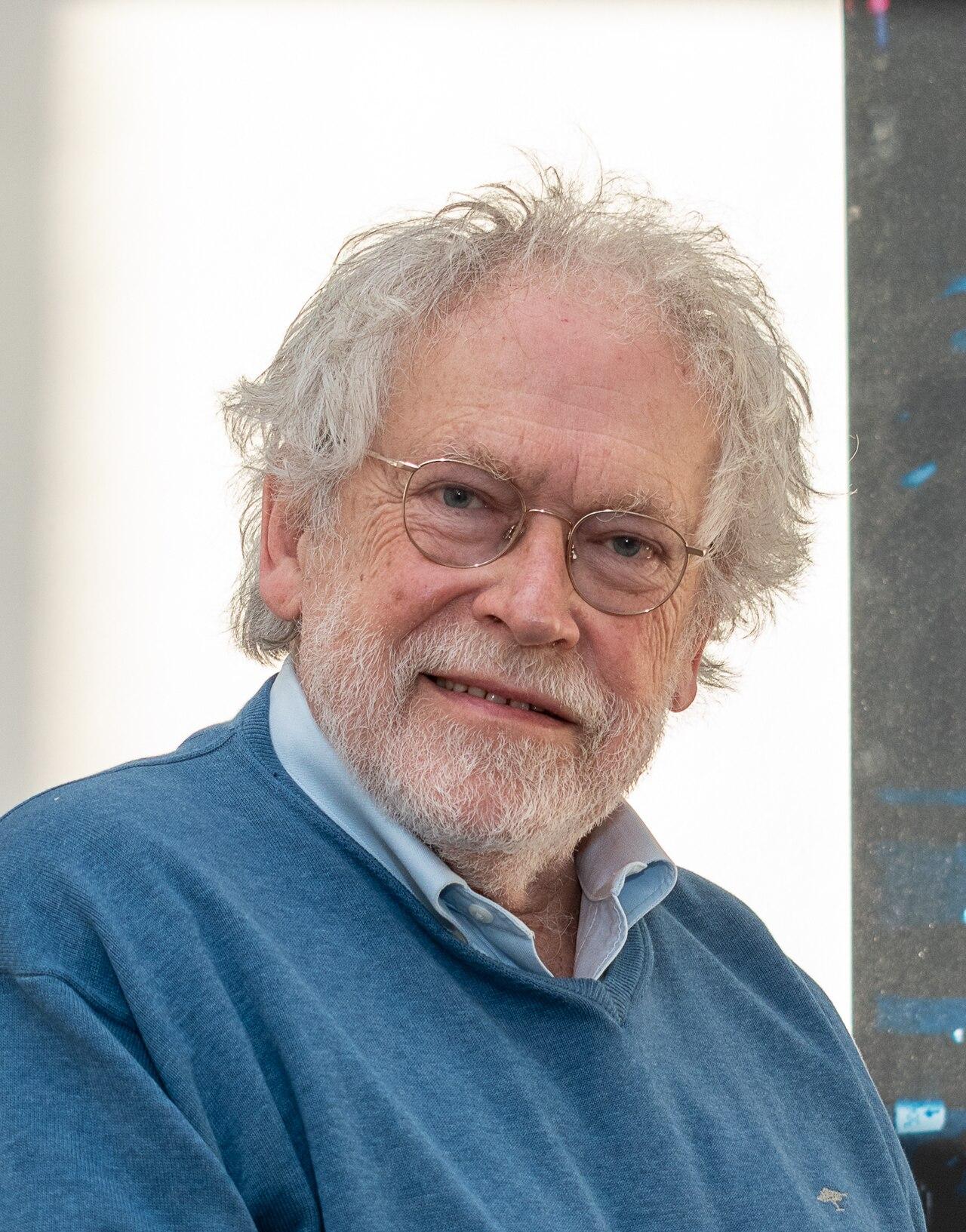


Advanced the foundations and experimental control of photon entanglement, including multipartite quantum states and entanglement swapping between photons that had never interacted directly.
Austrian Academy of SciencesPhysical Review LettersZeilinger helped make entanglement an experimentally usable resource as well as a test of quantum foundations. His work ranges from the theoretical structure of multipartite correlations to laboratory protocols that connect initially separate entangled pairs. These contributions matter for quantum information because a network must create and distribute correlations, not merely send ordinary signals. His inclusion reflects that foundational and experimental record, with the GHZ framework and entanglement-swapping experiment attributed to their collaborators.
IQOQI ViennaAustrian Academy of SciencesPhysical Review LettersTeleportation still needs an ordinary message
Quantum teleportation transfers a quantum state through a protocol that combines shared entanglement, a measurement and an ordinary message. The receiver uses that message to reconstruct the state. A person or object does not make a science-fiction journey, and the communication step prevents the protocol from delivering a usable message faster than light. [1]
Anton Zeilinger and his collaborators helped make these ideas experimental. The 2022 Nobel Prize in Physics recognised Zeilinger, Alain Aspect and John Clauser for work on entangled photons, Bell inequality violations and quantum information science. The recognition joins several contributions and experimental traditions; it does not make one person the sole inventor of quantum teleportation. [2][3]
For the next teleportation headline, follow the resources: where was entanglement prepared, what was measured and what ordinary information reached the receiver? Those questions help explain how the result works and what it can accomplish. They also keep a memorable name connected to the wider collaboration behind the experiment. [1][3]
Keep asking: What does the receiver need before a transferred quantum state becomes usable?
Sources for this question
- Teleporting an unknown quantum state via dual classical and Einstein-Podolsky-Rosen channels — IBM Research / Physical Review Letters.
The original six-author protocol requires shared entanglement and transmission of the sender’s classical measurement result.
Protocol paper published 29 March 1993. Checked 2026-10-09. - The Nobel Prize in Physics 2022 — press release — NobelPrize.org.
The three laureates and the award’s entangled-photon, Bell-inequality and quantum-information scope.
Historical award announcement, 2022. Checked 2026-10-09. - Experimental Nonlocality Proof of Quantum Teleportation and Entanglement Swapping — arXiv / Physical Review Letters.
Experimental teleportation and entanglement swapping by Thomas Jennewein, Gregor Weihs, Jian-Wei Pan and Anton Zeilinger.
Preprint submitted 29 January 2002; journal publication in 2002. Checked 2026-10-09.
The work behind the recognition
Work, in context- Year not documented
The Greenberger–Horne–Zeilinger framework
With Daniel Greenberger and Michael Horne, Zeilinger developed the framework for GHZ states. These multipartite entangled states provided a way to explore correlations involving more than two quantum systems and their implications for quantum foundations.
Co-developer of the GHZ framework with Daniel Greenberger and Michael Horne.
Source-supported recordAustrian Academy of Sciences - 1998
Entangling photons that never interacted
Zeilinger, Jian-Wei Pan, Dik Bouwmeester and Harald Weinfurter demonstrated entanglement swapping. A joint measurement on one photon from each of two pairs projected the remaining photons into an entangled state, although those photons had not interacted.
Co-author with Jian-Wei Pan, Dik Bouwmeester and Harald Weinfurter.
Source-supported recordPhysical Review Letters
Keep in perspective
The institutional GHZ account does not specify a publication year, so that contribution remains undated.
The evidence map
Both views link each contribution to its sources. Choose a contribution on the map or read them all in the list.
The Greenberger–Horne–Zeilinger framework
Biosketch Anton Zeilinger
Supports: GHZ collaboration, photon-entanglement research and current senior group-leader/emeritus status.
Checked 19 Sept 2026Credit & limits: Co-developer of the GHZ framework with Daniel Greenberger and Michael Horne.
Read the full contribution| Contribution | Evidence & what it supports | Credit & limits |
|---|---|---|
| The Greenberger–Horne–Zeilinger frameworkDate not documented | Institutional recordBiosketch Anton Zeilinger GHZ collaboration, photon-entanglement research and current senior group-leader/emeritus status. Checked 19 Sept 2026 | Co-developer of the GHZ framework with Daniel Greenberger and Michael Horne. |
| Entangling photons that never interacted1998 | Primary paperExperimental Entanglement Swapping: Entangling Photons That Never Interacted Four co-authors, two-pair Bell measurement and entanglement of the remaining noninteracting photons. Published 4 May 1998 · Checked 19 Sept 2026 | Co-author with Jian-Wei Pan, Dik Bouwmeester and Harald Weinfurter. |
Follow the evidence
3 sourcesPrimary papers, institutional records and attributed announcements. Each source supports the claims linked above.
- IQOQI ViennaInstitutional record
Anton Zeilinger
Current group-leader identification and Vienna institutional base.
Checked 19 Sept 2026 - Austrian Academy of SciencesInstitutional record
Biosketch Anton Zeilinger
GHZ collaboration, photon-entanglement research and current senior group-leader/emeritus status.
Checked 19 Sept 2026 - Physical Review LettersPrimary paper
Experimental Entanglement Swapping: Entangling Photons That Never Interacted
Four co-authors, two-pair Bell measurement and entanglement of the remaining noninteracting photons.
Published 4 May 1998 · Checked 19 Sept 2026