
Skip to content
RESEARCH · FOUR-PHOTON MEASUREMENT

A four-photon measurement could link distant qubits in one step

A proposed optical circuit recognizes a useful family of outcomes with probability 9 in 32, up from 4 in 32 for earlier designs. Both figures assume an ideal experiment.

Published Updated Source report Sources checked
Reading tools for text size, copying, printing and your reading list
My reading list
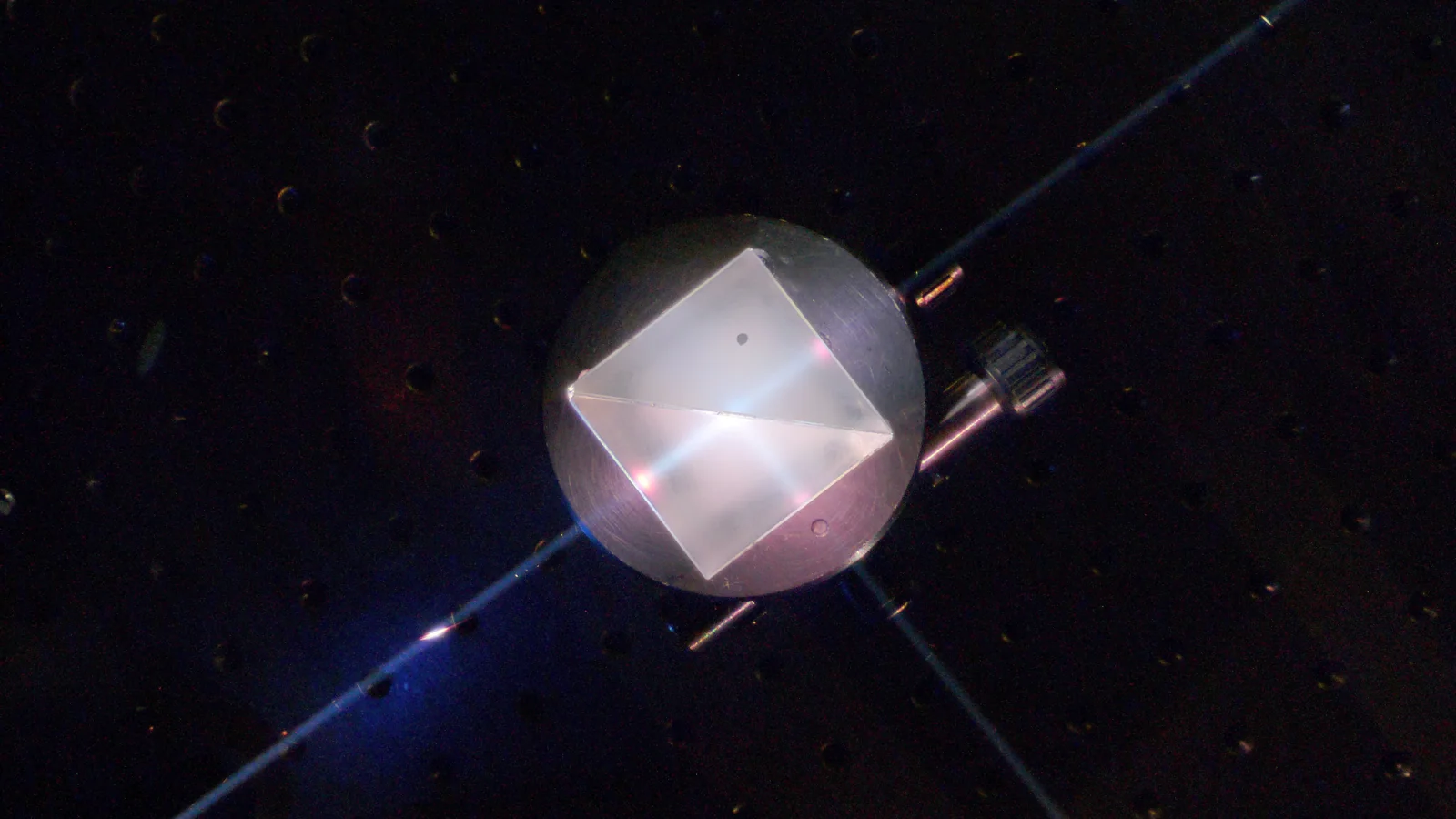
A glass cube on a dark optical table redirects a pale laser beam along two paths.
A cube beam splitter redirects a laser beam in Peeter Piksarv’s 2012 photograph. The image illustrates how an optical element routes light. The four-photon measurement described in the preprint is a theoretical proposal.Image: Light at a cube beam splitter · Peeter Piksarv · CC BY-SA 3.0Full image credit

How light can connect four stationary qubits

Imagine four distant stations, each holding a spin that can store quantum information. Each station emits a photon with its own spin and sends the photon to a shared detector setup. A suitable measurement can leave the four distant spins entangled with one another, even though the photons that connected them have been absorbed.[2]

Stefan van den Hoven and colleagues propose routing those four photons through an optical circuit that lets their paths interfere. Several patterns of detector clicks correspond to successful joint measurements. Each tells the experimenter which member of a family of entangled states was selected. The family is called GHZ after Greenberger, Horne and Zeilinger.[1][2]

Where 9 in 32 comes from

Among 16 equally likely four- GHZ basis states, six send two photons to each half of the apparatus. For those six, three quarters of the outcomes reveal enough information to identify the state. Multiplying 6/16 by 3/4 gives 9/32. Earlier designs for the same ideal task achieve 1/8, or 4/32.[2]

QubitWire Visual explainer

How often the four-photon measurement succeeds

Earlier scheme4 / 32

12.5% ideal success probability

Proposed basic scheme9 / 32

28.125% ideal success probability

Each square represents 1/32 of the ideal probability. Several detector patterns count as success. The squares show a calculation.

The remaining outcomes are not all equivalent. Some project onto a different kind of entangled state, which can be useful in another protocol. For the distant-spin example, a lab would also have to deliver all four photons, overlap them closely enough for their paths to interfere and detect them reliably. Loss during transmission cuts the number of usable links per hour.[2]

What a higher success rate buys

The team also calculated the cost of assembling a particular six-node ring used in photonic quantum computing. Their design needed an estimated 1,140 three-qubit GHZ states on average, down from 1,520. That is about one quarter fewer starting states for the same encoded ring.[2]

These calculations give an experiment two different benchmarks. Counting successful patterns among trials where all four photons arrive would test the proposed optical measurement. Counting every attempt from emission onward would show how quickly the whole apparatus can produce useful connections. The latter includes photons that never reach a detector.

Keep your reading trail

Your Updates →

Evidence & context

2 linked sources

Theory preprint

How to read the evidence and dates

An announcement records what an organization stated. An experiment reports an observation. A simulation or resource estimate depends on its assumptions. QubitWire’s analysis connects these sources; the labels are not quality scores.

Published is the article’s first QubitWire publication. Updated marks a substantive content change. Sources checked records a review of the underlying evidence. An older paper can support a new explanation, and another press release about the same work is not independent replication.

For material corrections, check the article’s context note and source trail. A routine formatting or link change does not create a new scientific result.

Sources

  1. Van den Hoven et al. · Theory preprint, October 30

    Primary submission record for a theoretical proposal.

  2. Version 1 · Target probability in Section II and resource costs in Table 1

    Same study, full manuscript. Section II compares the same four-photon target. Table 1 models resource costs rather than measured operating time.

READ NEXT

Continue exploring

All Research stories
  1. Error correction

    OptQC separates resource preparation from the online photonic processor

    A proposed interface makes the division of work in photonic error correction explicit.

    Published · Source report · Sources checked · About 3 min read
  2. Photonic hardware

    Detector timing separates seven photons from eight in a laboratory study

    A narrow detector result explains the importance of defining an accuracy metric.

    Published · Source report · Sources checked · About 1 min read
THE QUANTUM BRIEFING

A clearer signal.
Read the latest edition.

A little perspective on a fast-moving field.

Read the on-site briefing →

Read selected quantum coverage in the on-site briefing, or register your interest below.