
Light-based chips tackled a 40-point puzzle, with 80 connections built in
Researchers joined 12 photonic chiplets to tackle a larger graph. The wiring made the test possible, but also limited which problems it could run.
Reading tools for text size, copying, printing and your reading list
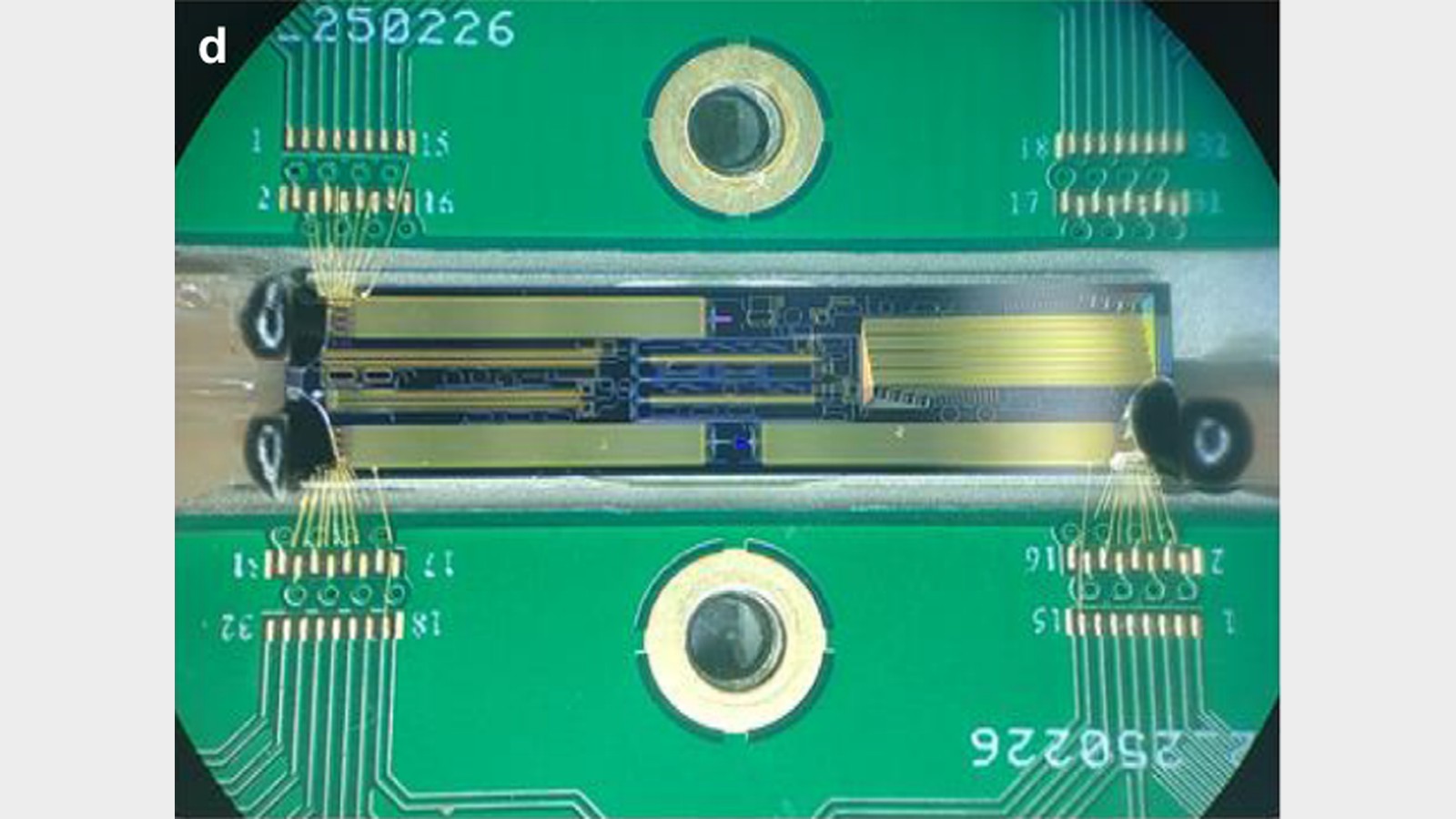
A computer that uses light can race through a specific part of a puzzle and still take longer to solve it from start to finish. A chiplet experiment in Nature Communications shows why. Hang Song and colleagues at Shanghai Jiao Tong University and partner institutions built a prototype that handled a graph with 40 points by joining a dozen pieces of optical hardware. Their reported gains were in evaluating candidate answers. Depending on the problem and search method, some electronic approaches still delivered a finished answer sooner.[1][2]
The November 25 publication is the peer-reviewed accepted paper, ahead of the final journal version. Its prototype separates the parts that put information onto light from the structures that route the light. The researchers say that could make it easier to build bigger photonic packages. They demonstrated classical optical processing. Using the design for quantum information remains a possibility, not an outcome of the experiment.[1][2]
What changed between six points and 40
A graph is a collection of points joined by lines, like stations and tracks on a rail map. One puzzle the researchers tested asks for the smallest set of points that touches every line. A computer can evaluate many proposed sets, but the number of possibilities grows quickly with the graph.[1][2]
The team started with a six-point system that could be reconfigured for multiple tasks. To reach 40 points, it used eight thin-film lithium niobate chips to modulate light and four chips with paths written into them by ultrafast laser pulses to route it. Those paths can run at different depths, giving light routes that are harder to fit into a single flat layer. Keeping the two jobs separate also lets the team add more routing without putting the entire network on the same modulator chip.[1][2]
The larger device was built for a sparse graph with 80 possible links. The operators could turn selected links off, but they could not add arbitrary connections between the 40 points. The experiment showed that the architecture could grow by adding modules. It did not show a general-purpose 40-point graph solver.[1][2]
Two numbers that should not be confused with a finished answer
The authors reported a rate of 10 billion candidates per second for the larger configuration. The figure refers to evaluating candidates, not solving 10 billion instances of the puzzle or eliminating the work of finding which candidates to test. In the authors’ benchmarks, ordinary CPUs, GPUs and a constraint solver could produce complete solutions sooner in some cases.[1][2]
Power has a similar boundary. The reported 0.072 watts for the 40-point configuration was the load on the modulators, not the power used by the lasers, electronics and detectors together. The paper reports system-level efficiency separately. Reading both sets of measurements shows what the prototype adds: a way to scale a specific part of optical processing, with performance still depending on what the rest of the system has to do.[1][2]