
An atom experiment turns a measurement into its next instruction
Detection, decisions and complete circuits have different timings.
Reading tools for text size, copying, printing and your reading list
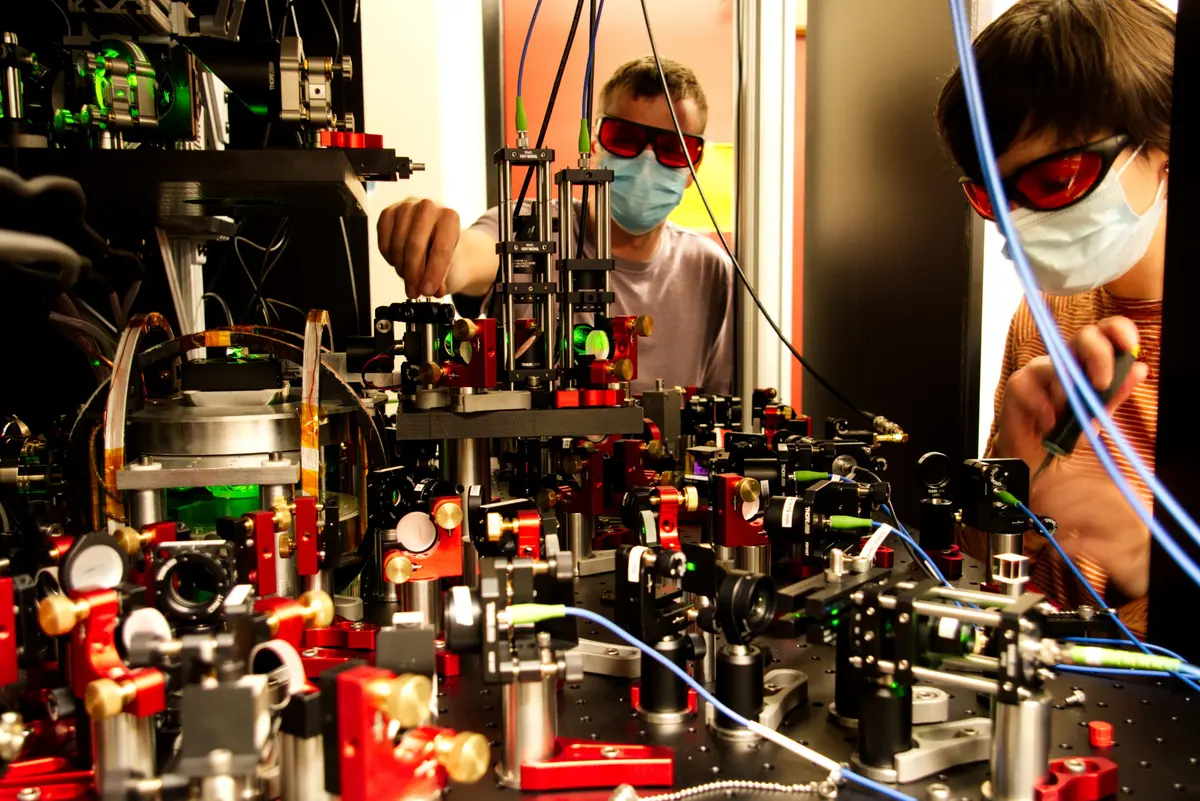
A quantum computer sometimes needs to measure one atom without disturbing another, then change its next move using the answer. Fast light collection alone does not complete that job.
Published November 10 in Physical Review Letters, the Berkeley-led work was already public in a June 23 preprint, revised July 28.[1][2]
In the five-atom rubidium setup, a cavity traps light between mirrors for readout. A controller adjusts later microwave pulses while lasers shield unmeasured atoms. When distinguishing prepared states, the first result changes how the next atom is measured.[2]
Three different timings
Detection took an average of 9.5 microseconds for a light-scattering atom in a separate readout test.[2]
Each measurement-and-decision step in the adaptive test used 45 microseconds: a 40-microsecond detection window and five microseconds to process the answer and program the next pulse.[2]
The full three-atom sequence took about 300 microseconds, including the time to execute the microwave pulses.[2]
Earlier cavity experiments already offered fast readout. Berkeley’s 2022 study read one atom while a second sat outside the cavity region. MIT’s 2025 work demonstrated site-selective readout and classical error correction. The present study integrates rapid measurement with conditional quantum control.[3][4]
The readout tests lost an average 8% of measured light-scattering atoms. No cycle was demonstrated.[2]
Keep your reading trail
Keep up with these topics
Explore the subjects covered in this story.