
Quantum-key packets pass through two routers in a new lab test
A Korean-led experiment sends light toward three receivers while preserving each packet’s address header from one router to the next. It tests a useful building block for more flexible quantum networks, not a finished quantum internet.
Reading tools for text size, copying, printing and your reading list
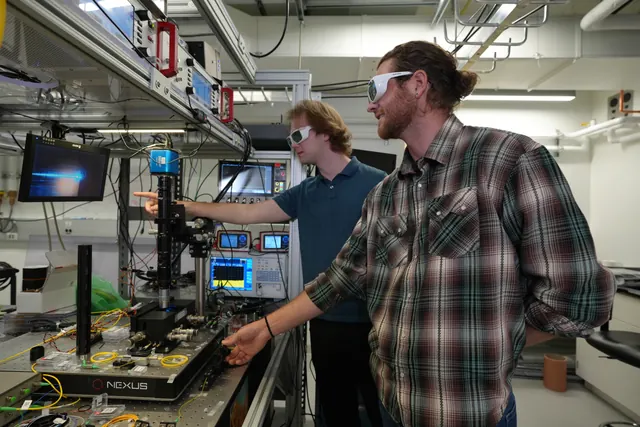
A quantum network needs more than a connection between two places. It also needs to send each piece of quantum information toward the right destination. A new laboratory experiment tackles that problem by directing quantum-key packets through two connected routers without rebuilding their address labels at each stop.
The study, led by researchers at the Korea Research Institute of Standards and Science, appears in the November 11 arXiv listings after submission on November 10. It is reported as an arXiv preprint, with no journal publication listed. One sender reached three receivers, using one router for the first destination and two for the others. The equipment stayed inside a laboratory, with coils of optical fiber standing in for longer communication links.[1]
Read the label, preserve the contents
An ordinary network router reads a packet's destination and chooses an outgoing path. Quantum networking adds a complication: the information carried by quantum states cannot simply be copied and regenerated like ordinary digital data. Optical components must guide the signal while protecting the properties that make it useful.[2]
The team's packets therefore have two parts: a conventional address header and a faint-light payload carrying quantum-key information. Think of the header as the address on an envelope. A routing device needs to read that address, not inspect the enclosed information.
In this experiment, the header and payload occupy different wavelengths and time slots. Each router taps approximately 10% of the header light for its electronics to read, while the remaining header continues toward the next stop. An optical switch directs the packet. Unlike earlier designs discussed in the paper, this arrangement does not generate a replacement header at every router. The 10% tap applies to the ordinary address signal, not to a measurement of the quantum payload.[1]
That matters because a destination can change from packet to packet. A network could become more flexible than a set of permanently assigned point-to-point links. It is a step toward directing quantum traffic, rather than a demonstration that many quantum computers can already work together.
Keys arrived, but routing still costs photons
The researchers tested quantum key distribution, or QKD. This produces shared secret bits that can be used to protect later communications; the quantum packets were not carrying emails or video. QKD's security also depends on the actual devices and protocol, not simply the word “quantum.”[2][3]
The three receiver branches included 20-, 10- and 5-kilometer fiber spools. After , privacy amplification and finite-size security calculations, the authors report secret-key rates of 35–270 bits per second across the tested links. Those are key-generation rates, not internet download speeds. One receiver performed worse than the model predicted, and the authors say the cause remains unclear, with experimental instability a possible explanation.[1]
Loss is another limit. The measured average loss was 2.8 decibels per router. Converting that figure gives about 52% transmission through one router and 28% through two identical routers in succession, before adding the separate fiber-span and receiver losses. This is QubitWire's calculation, not a new measurement. Keeping an address label intact does not prevent the quantum signal from becoming weaker.[1]
Each router also used a kilometer of fiber to delay the packet by roughly five microseconds while its control electronics selected the route. That is a controlled laboratory solution, with room to improve speed, loss and stability.[1]
The next convincing step would be operation over deployed fiber with more routing stages and stable performance across changing conditions. -photon traffic would require additional work. For now, the useful result is narrower and concrete: one address header survived successive routing decisions while the receivers still generated secret keys.[1]