
Can one set of controls work across a batch of quantum chips?
A new simulation found that tuning a photonic circuit for just one chip made its settings harder to reuse. Training across virtual chips helped, but some tasks held up better than others.
Reading tools for text size, copying, printing and your reading list
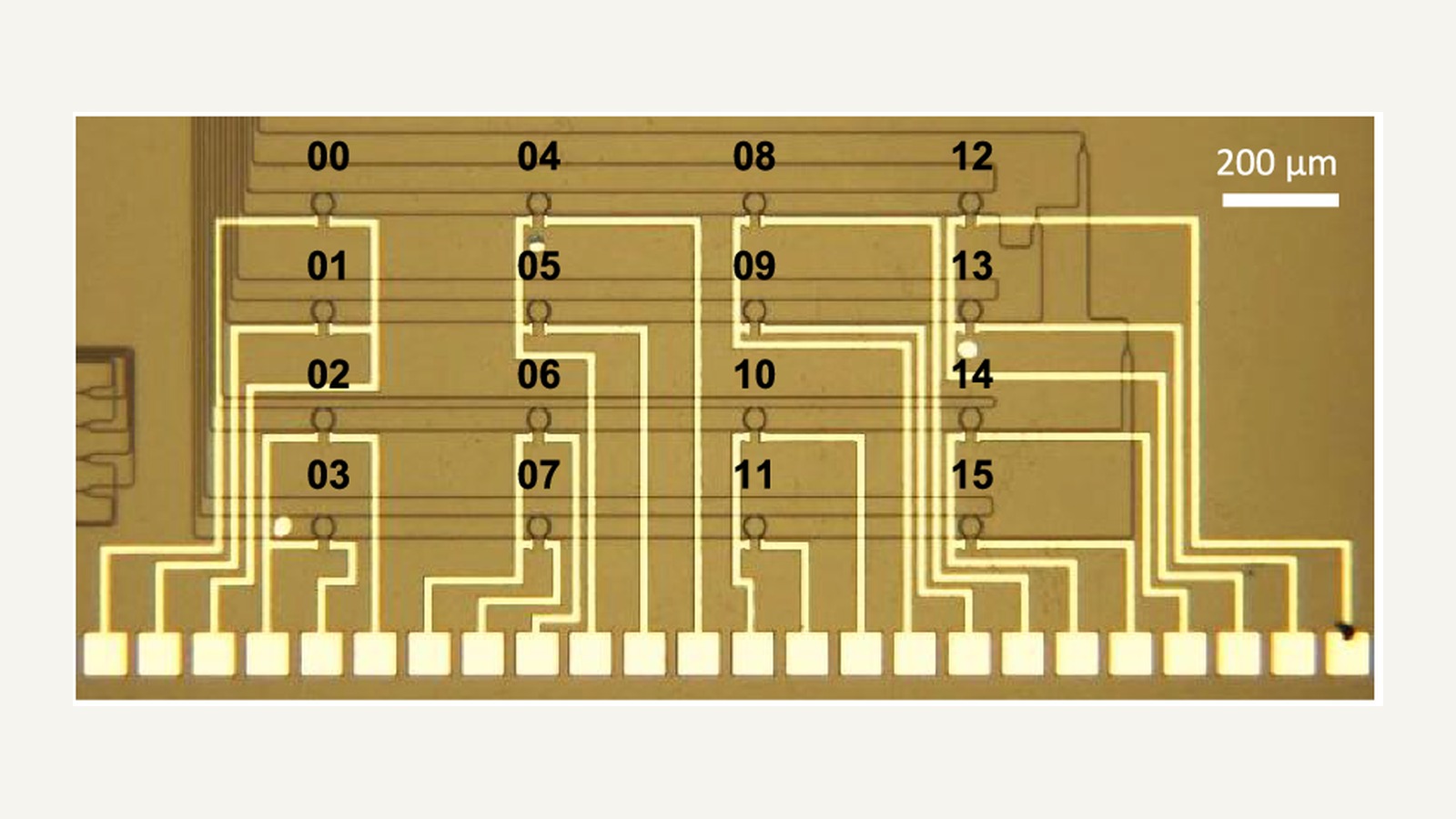
Two chips made from the same design rarely come out identical. In an optical circuit, a small fabrication difference can alter how much light goes down each path. Tuning the controls to compensate can make one chip work well and leave the next chip worse off. In a November 25 preprint, Iqra Bashir and colleagues modeled that trade-off and tested a way around it: train on a changing mix of virtual chips rather than on a single device. The team did not fabricate or test a physical chip batch.[1][2]
Train for a batch, not just the best fit
The circuit in the study uses adjustable optical components to control how light paths combine. Instead of picking settings that best correct the quirks of one simulated device, the researchers picked settings that kept the average error low across multiple simulated devices. The 16-chip version drew 16 fresh virtual chips at each training step, guided by an assumed distribution of fabrication errors. Once trained, the same settings went to 1,000 independent simulated chips at each level of fabrication variability, without fine-tuning each chip. They trained separate settings for each task or target.[1]
That mattered for a two- operation called a controlled NOT. At one modeled level of manufacturing variability, the mean mismatch with the intended operation, measured as process infidelity on accepted outcomes, was 19.1% on new virtual chips when the authors reused settings tuned for one device. It was 2.7% with settings trained on a mix. The comparison is conditional on getting a usable outcome, not a claim that a real gate succeeds 97.3% of the time. At the largest variability tested, all four methods had average process infidelity above 50% on accepted outcomes for that task.[1]
A correct answer doesn't mean the circuit stayed the same
A classification test gave a different picture. For an existing banknote dataset, the task was to pick between two labels, not to reproduce a quantum operation exactly. At a higher simulated variability level, training across virtual chips gave an average classification accuracy of 98.1%, even though the underlying circuit scored 58.7% on a measure of how closely it reproduced the intended transformation. The same label can still win if its score starts far enough ahead, even when the optical outputs change. Those percentages measure two different things and aren't evidence of a commercial banknote detector.[1]
The next test is a real wafer
Earlier laboratory work has shown why optical training needs to account for differences between the ideal design and the hardware. The new study gives a way to test what happens when engineers refuse to tune every device separately. Its strongest assumption is that the new chips vary in ways the training model already represents. A real test would measure multiple fabricated chips, train without some of them, then see how well the shared settings work on those held-out devices. Until then, the study tells researchers where shared controls could help and which tasks need the strictest checks.[1][2][3]