
Toshiba puts three quantum-safe tools into one network platform
The QSN announcement combines post-quantum cryptography, quantum key distribution and quantum randomness. Each addresses a different part of the security problem.

Toshiba announced its Quantum Safe Network platform on October 21, bringing several security technologies into a modular networking product family. The company describes configurations for metropolitan networks, hub-and-spoke connections and longer links, with a management layer intended to deliver keys across existing infrastructure.[1]
The three ingredients do different jobs. Post-quantum cryptography uses mathematical algorithms designed to resist quantum attacks on ordinary computers. Quantum key distribution, or QKD, uses quantum signals to establish key material between locations. Quantum random-number generation supplies randomness. Toshiba says its platform combines these approaches; the names should not be treated as interchangeable security guarantees.[1][2]
NIST finalized its first three post-quantum standards in August 2024. That is separate from buying a QKD link: organizations can migrate cryptographic algorithms without installing an optical quantum network. The practical choice depends on which information is being protected, where it travels and how the receiving application handles its keys.[2]
Toshiba’s range includes transceivers, hub and spoke units, point-to-point links, a multiplexer for quantum and conventional optical traffic, and a key-delivery system. Those are proposed building blocks for an operator’s network. The announcement alone does not establish the delivered performance, cost or interoperability of a particular customer installation.[1]
A useful acceptance test would follow a key all the way to the application: creation, authentication, delivery, storage, replacement and failure recovery. It should also test what happens when a link goes down. Strong key exchange cannot repair a compromised endpoint that already exposes the protected information. This is QubitWire’s assessment of the system boundary an evaluation should cover.
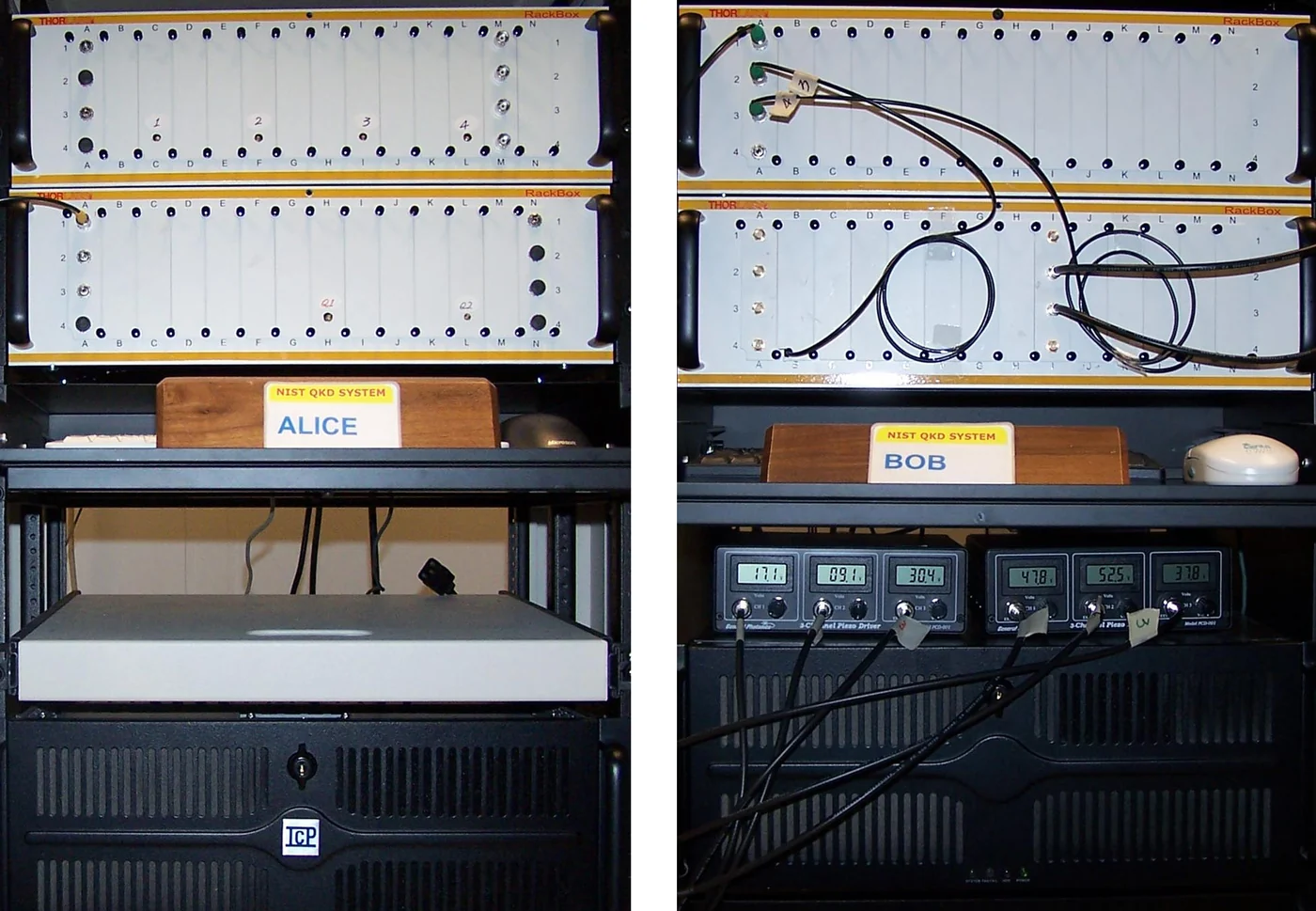
The next evidence to watch is a named deployment with its topology, operating conditions and measured service behavior. That would make the modularity claim concrete. The archival photograph shows NIST fiber-QKD equipment from 2007; it illustrates the technology’s history and does not depict Toshiba’s new platform.