
Skip to content
RESEARCH

Willow test targets quantum errors that linger across time

On Google’s Willow chip, a qubit that slips into a higher energy state can disrupt several rounds of error correction. Giving each qubit a turn to reset helped.

Published Source report Sources checked
Reading tools for text size, copying, printing and your reading list
My reading list
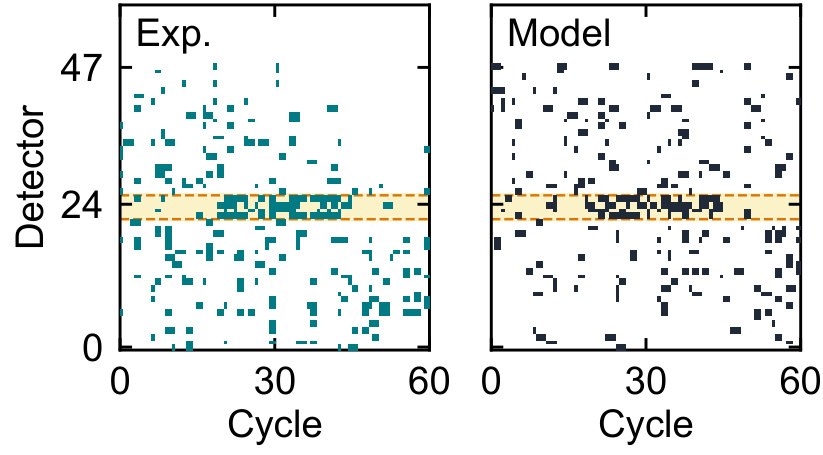
Colored detector hits cluster across successive error-correction cycles in the experiment and model panels.
A single recorded Willow run (left) and a simulation (right). The highlighted band marks neighboring detectors that fired repeatedly across several cycles.Alec Eickbusch et al. / Google Quantum AI and collaborators

Google Quantum AI researchers report a way to suppress errors that persist across repeated correction cycles on the 105- Willow processor. Their November 16 preprint investigates a failure mode that ordinary quantum-memory tests can miss.[1]

The team traced the recurring errors to qubits gaining enough energy to leave the two states used for computation. Its “walking” circuit shifts the jobs of neighboring qubits, so each one periodically gets a chance to reset.[1]

In a 3×3 stability test, the modified circuit used more qubits but reached an error-probability upper bound of 3.20 × 10⁻⁸ after 60 cycles, about two orders of magnitude below the standard construction. Radiation-induced bursts still limited performance. This is not a general error rate for quantum computations.[1]

In a separate analysis of recorded data, researchers stopped adding rounds when the decoding software was confident enough. Compared with the best fixed number of rounds, this reduced the study’s combined space-time error metric by 38% and time overhead by 34%. The researchers tested this strategy offline.[1]

Keep your reading trail

Evidence & context

1 linked source

Experimental stability test; adaptive stopping assessed offline.

How to read the evidence and dates

An announcement records what an organization stated. An experiment reports an observation. A simulation or resource estimate depends on its assumptions. QubitWire’s analysis connects these sources; the labels are not quality scores.

Published is the article’s first QubitWire publication. Updated marks a substantive content change. Sources checked records a review of the underlying evidence. An older paper can support a new explanation, and another press release about the same work is not independent replication.

Sources

  1. Google Quantum AI, arXiv:2611.21578v1

    Preprint submitted November 16, 2026.

Keep up with these topics

Explore the subjects covered in this story.

READ NEXT

Continue exploring

All Research stories
  1. More on error correction

    A cloud-accessible quantum memory improves with code size, with a long-run caveat

    A rectangular surface-code memory improves as one dimension grows. Longer sequences reveal why the duration of the test matters too.

    Published · Source report · Sources checked · About 3 min read
  2. More on error correction

    Google Uses Error Signals to Retune Willow's Quantum Controls

    A reinforcement-learning experiment improves stability under injected drift and fine-tunes an already calibrated processor.

    Published · Source report · About 1 min read