
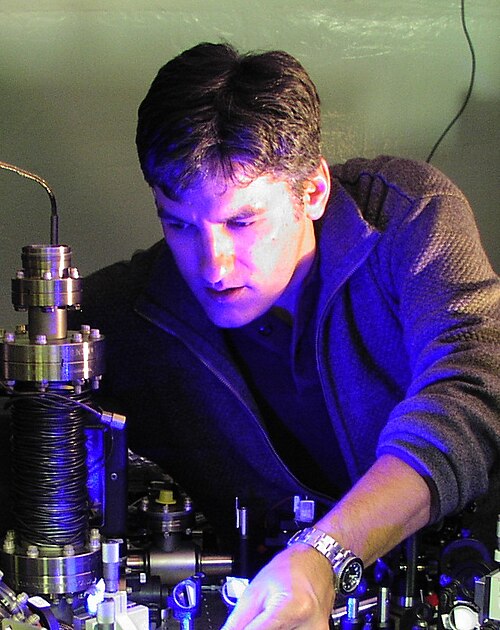


Develops trapped-ion quantum computers and photonic interconnects, linking precise control of individual atomic qubits with architectures that connect separate quantum processors into larger systems.
arXivarXivMonroe’s work addresses both computation inside an ion processor and communication between processors. The reviewed experiments show why those tasks belong together: mid-circuit measurement must avoid damaging stored data, while modular machines need entanglement across physically separated memories. His Duke group’s recent papers offer concrete examples of each. These are specific experimental building blocks for scalable systems, rather than evidence that a useful, fully fault-tolerant machine has already been delivered.
Duke UniversityarXivarXivHow does a quantum processor connect to another device?
A processor becomes more useful when it can share quantum information with a different kind of device. Christopher Monroe is among the authors of a 7 October 2026 preprint linking a trapped barium ion with a silicon-vacancy centre in diamond. The collaboration brings an ion system and a solid-state memory into one experiment. [1]
The researchers convert the photon’s wavelength and encoding, then use a detection event to herald an entangled pair. They report an average rate of about 1,030 pairs per second and a Bell-state fidelity of 87.9%. Rate describes how often the resource arrives; fidelity describes how closely it matches the intended state. Both matter. [1]
The next questions concern how long the shared state can wait and how several links can support a larger operation. This preprint demonstrates a particular connection, rather than a complete fault-tolerant network. Its full author list keeps the wider team’s contribution in view. [1]
Keep asking: Can the shared state arrive reliably, wait long enough and contribute to the next operation?
Sources for this question
- Quantum Networking at the Speed of Quantum Computation: Kilohertz Entanglement in a Heterogeneous Quantum System — arXiv.
Exact authorship, heterogeneous ion–diamond interface, heralding, reported rate and fidelity. This is a preprint, not a peer-review claim.
Preprint v1 submitted 7 October 2026. Checked 2026-10-11.
The work behind the recognition
Work, in context- 2025
Measurement during a trapped-ion computation
Coauthored a study demonstrating measurement and reset in a single-species ion chain without ion shuttling, using metastable states to isolate measured qubits from data.
Coauthor of the trapped-ion measurement and reset study; the experimental result belongs to the full author team.
Source-supported recordarXiv - 2026
Three-node atomic entanglement
Coauthored a preprint reporting a distributed GHZ state across three individual atomic memories linked by photons, extending the components available for modular quantum networks.
Coauthor of the three-node entanglement preprint; an experimental claim reported by the full research team.
Source-supported recordarXiv
Keep in perspective
The two recent research records are identified as preprints; no current IonQ executive title is asserted.
The evidence map
Both views link each contribution to its sources. Choose a contribution on the map or read them all in the list.
Measurement during a trapped-ion computation
In-situ mid-circuit qubit measurement and reset in a single-species trapped-ion quantum computing system
Supports: Authorship and experimental measurement/reset method
Published 17 Apr 2025 · Checked 19 Sept 2026Credit & limits: Coauthor of the trapped-ion measurement and reset study; the experimental result belongs to the full author team.
Read the full contribution| Contribution | Evidence & what it supports | Credit & limits |
|---|---|---|
| Measurement during a trapped-ion computation2025 | Research preprintIn-situ mid-circuit qubit measurement and reset in a single-species trapped-ion quantum computing system Authorship and experimental measurement/reset method Published 17 Apr 2025 · Checked 19 Sept 2026 | Coauthor of the trapped-ion measurement and reset study; the experimental result belongs to the full author team. |
| Three-node atomic entanglement2026 | Research preprintTripartite entanglement of remote atomic qubits Authorship and three-node experimental entanglement Published 15 Jun 2026 · Checked 19 Sept 2026 | Coauthor of the three-node entanglement preprint; an experimental claim reported by the full research team. |
Follow the evidence
3 sourcesPrimary papers, institutional records and attributed announcements. Each source supports the claims linked above.
- Duke UniversityInstitutional record
Christopher R Monroe
Identity, professional identification and contribution context
Checked 19 Sept 2026 - arXivResearch preprint
In-situ mid-circuit qubit measurement and reset in a single-species trapped-ion quantum computing system
Authorship and experimental measurement/reset method
Published 17 Apr 2025 · Checked 19 Sept 2026 - arXivResearch preprint
Tripartite entanglement of remote atomic qubits
Authorship and three-node experimental entanglement
Published 15 Jun 2026 · Checked 19 Sept 2026